


Witches Hat Filters
In industrial fluid handling and piping systems, protecting sensitive downstream equipment is a critical engineering priority. Among the various mechanical separation tools available, witches hat filters—technically known as conical strainers—serve as a fundamental line of defense. These components are specifically designed to remove oversized particulates, construction debris, and suspended solids that could otherwise damage pumps, valves, meters, and heat exchangers.
As a specialized manufacturer of stainless steel filtration solutions, Kaifil understands that the efficacy of these filters depends on precise engineering, material integrity, and application-specific design. This guide provides a technical overview of witches hat filters, exploring their design principles, material considerations, and the factors engineers must evaluate to ensure optimal system performance.
Understanding the Role of Witches Hat Filters in Industrial Piping
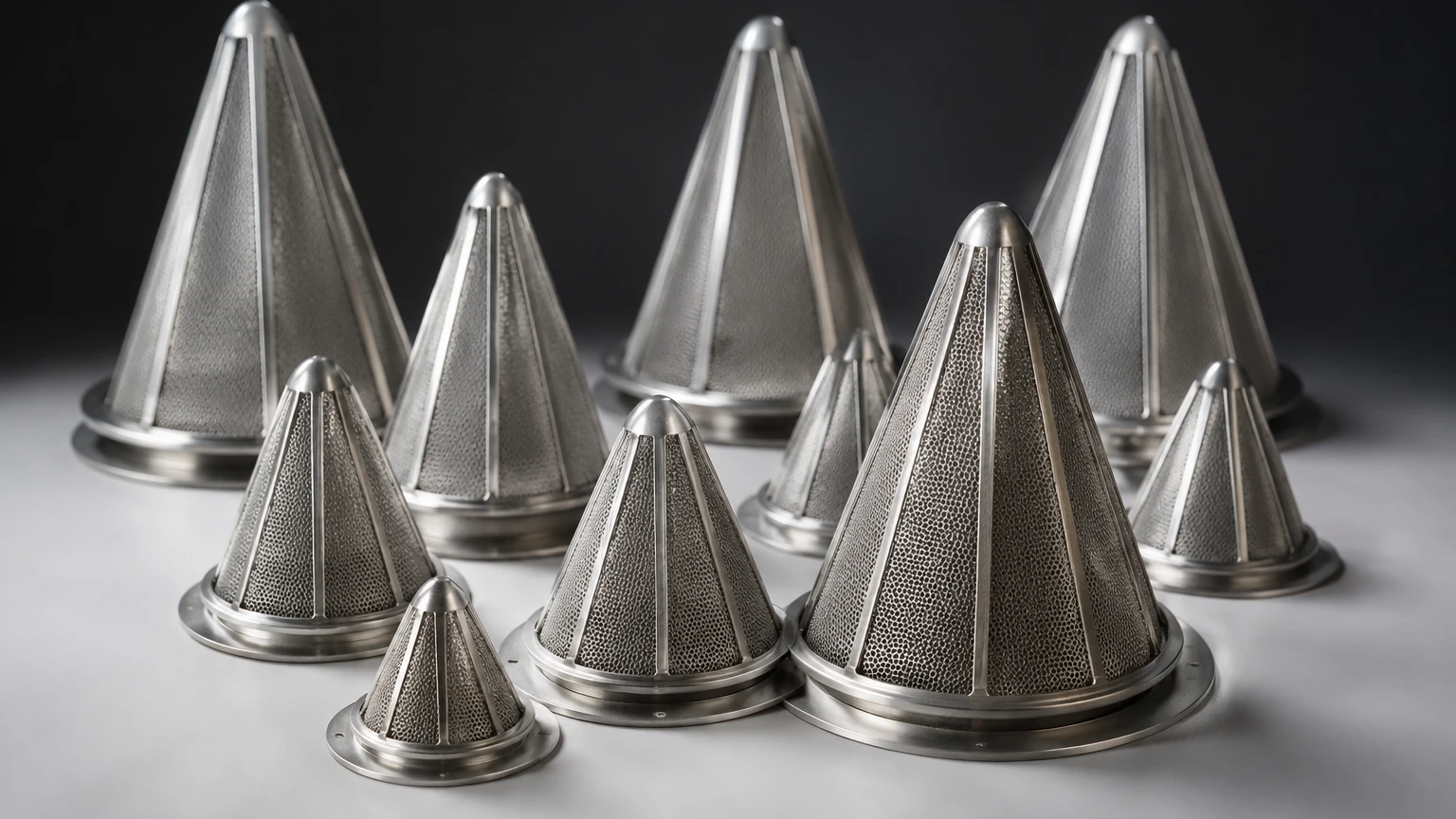
Witches hat filters get their name from their distinct conical shape, which features a wide base flange and a tapered body. This geometry is not merely aesthetic; it is a functional design choice that maximizes the filtration surface area within a restricted pipe diameter. By providing a larger surface area compared to a flat disc filter, the conical design allows for a higher dirt-holding capacity and a lower initial pressure drop.
These filters are primarily categorized into two use cases: temporary (start-up) and permanent filtration. During the commissioning of a new piping system, construction debris such as welding slag, scale, and gasket fragments are often present. Witches hat filters are installed between flanges to capture these contaminants during the initial flushing phase. In some applications, however, they are utilized as permanent fixtures where the flow rates are steady and the particulate load is predictable.
For engineers managing complex systems in chemical processing or water treatment, selecting the right strainer involves balancing the need for fine filtration with the hydraulic requirements of the system. A well-designed conical strainer ensures that the fluid path remains unobstructed while capturing particles that exceed the specified micron rating.
Key Engineering Specifications and Material Selection
The performance of witches hat filters is heavily dictated by the materials used in their construction. Because these filters often operate in demanding environments involving high pressures, extreme temperatures, or corrosive fluids, stainless steel is the industry standard.
Material Grades
At Kaifil, we focus on high-grade stainless steel alloys to ensure longevity and chemical compatibility:
* SS304: Suitable for general industrial applications, food and beverage processing, and environments where moderate corrosion resistance is required.
* SS316/316L: Preferred for pharmaceutical, chemical, and marine applications. The addition of molybdenum provides superior resistance to chlorides and pitting, making it essential for aggressive media.
* Specialty Alloys: For highly specialized environments, materials like Monel or Hastelloy may be utilized to withstand specific chemical reactions or thermal stresses.
Construction Layers
A standard witches hat filter often utilizes a multi-layer construction to achieve both structural strength and filtration precision. The "skeleton" of the filter is typically a perforated metal sheet, which provides the mechanical rigidity necessary to withstand the force of the fluid flow. Over this perforated core, a fine stainless steel wire mesh is layered. This mesh determines the actual filtration rating, ranging from coarse particles (several millimeters) down to fine particulates (measured in microns).
Performance Evaluation: Flow Rate and Pressure Drop
One of the most critical aspects of filter selection is the calculation of the pressure drop (ΔP). Every filter introduces some level of resistance to the flow. If the pressure drop is too high, it can lead to cavitation in pumps, reduced flow efficiency, and potential structural failure of the filter element itself.
The Open Area Ratio
Engineers must consider the "Open Area Ratio," which is the ratio of the total open area of the filter mesh to the cross-sectional area of the pipe. A common industry benchmark for temporary strainers is a 300% open area ratio. This means the total area of the holes in the cone is three times the area of the pipe opening. This redundancy ensures that even as the filter begins to collect debris, there is sufficient open space to maintain flow without a catastrophic spike in pressure.
Flow Direction
Witches hat filters can be designed for flow to enter from the inside of the cone out, or from the outside in.
* Inside-Out Flow: Debris is collected inside the cone, making it easier to remove the contaminants when the strainer is pulled from the line.
* Outside-In Flow: Often used when the structural integrity of the cone needs to be supported by an internal perforated core against high external pressures.
Application-Specific Considerations for Conical Strainers
The versatility of witches hat filters allows them to be integrated into various industrial sectors. However, each industry brings unique challenges that influence the design of the filtration component.
Chemical and Petrochemical Processing
In these sectors, chemical compatibility is the primary concern. The filter must resist degradation from solvents, acids, or bases. Furthermore, these systems often operate at high temperatures, requiring the stainless steel to maintain its tensile strength and preventing the mesh from warping.
Food and Beverage Industry
Filtration in food processing requires adherence to sanitary standards. Witches hat filters used here must feature smooth welds and high-quality surface finishes to prevent bacterial growth and ensure ease of cleaning (CIP/SIP compatibility). Stainless steel 316L is typically mandated for its non-reactive properties.
Hydraulic and Oil Systems
Precision is paramount in hydraulic systems where even microscopic particles can cause valve stiction or pump wear. Here, the focus is on high-strength mesh that can handle high-viscosity fluids without deforming.
For a broader look at how these components integrate into comprehensive industrial setups, you can review product options and application support on our Main Page.
Installation, Maintenance, and Replacement Cycles
Proper installation is as important as the design of the filter itself. Witches hat filters are typically installed between two pipe flanges. This requires the use of appropriate gaskets to ensure a leak-proof seal. Engineers must ensure that the "hat" is oriented correctly according to the intended flow direction and that there is sufficient downstream clearance for the length of the cone.
Monitoring Performance
In a professional B2B environment, maintenance should be data-driven. Installing differential pressure gauges upstream and downstream of the filter allows operators to monitor the loading of the strainer in real-time. A significant increase in differential pressure indicates that the filter is reaching its dirt-holding capacity and requires cleaning or replacement.
Cleaning and Reuse
Because Kaifil manufactures these filters from durable stainless steel, they are often cleanable and reusable. Cleaning methods include backflushing, ultrasonic cleaning, or chemical baths, depending on the nature of the contaminants. However, if the wire mesh shows signs of fraying, bypass, or mechanical deformation, the unit must be replaced to prevent downstream contamination.
Customization and OEM Solutions for Precision Filtration
No two industrial processes are identical, and off-the-shelf filtration components often fall short of specific engineering requirements. Customization is a core strength of Kaifil’s manufacturing process. When specifying witches hat filters, engineers should confirm several variables with their supplier:
1. Dimensional Constraints: Custom lengths and diameters to fit non-standard piping or limited space envelopes.
2. Flange Types: Compatibility with RF (Raised Face), FF (Flat Face), or RTJ (Ring Type Joint) flanges.
3. Reinforcement: Adding support rings or heavier perforated plate backing for high-pressure applications.
4. Micron Ratings: Tailoring the mesh weave to capture specific particle sizes while optimizing flow.
By working closely with an OEM partner, purchasing teams can ensure that the filters they procure are optimized for the total cost of ownership. While a custom-engineered stainless steel filter may have a higher initial cost than a generic alternative, its durability, lower pressure drop, and cleanability often result in significant long-term savings by reducing downtime and protecting expensive machinery.
Conclusion: Making Informed Purchasing Decisions
Selecting witches hat filters requires a deep understanding of the fluid dynamics and mechanical requirements of your specific application. By focusing on material quality, structural design, and accurate filtration ratings, engineers can significantly enhance the reliability of their piping systems.
Whether you are preparing for a system start-up or looking for a durable solution for ongoing process filtration, the choice of a stainless steel conical strainer is a critical investment in equipment protection. At Kaifil, we combine manufacturing expertise with engineering insight to deliver filtration components that meet the rigorous demands of global industry. For detailed technical specifications and to explore our full range of custom solutions, please visit our Main Page.
