


Ss Filter
In the landscape of industrial processing, the efficiency of a filtration system is often the determining factor between operational success and costly downtime. For engineers and procurement specialists, selecting an ss filter (stainless steel filter) involves more than just identifying a micron rating; it requires a deep understanding of material science, fluid dynamics, and the specific rigors of the application environment. Stainless steel remains the gold standard for filtration in sectors such as chemical processing, pharmaceuticals, and food production due to its inherent durability, thermal stability, and resistance to corrosion.
Industrial filtration components must perform under extreme conditions, including high-pressure differentials and exposure to aggressive solvents. As a specialized manufacturer, Kaifil provides precision-engineered stainless steel filtration solutions designed to meet these exacting standards. To assist technical teams in making informed decisions, this guide explores the technical nuances of stainless steel filters, from material selection to performance evaluation.
Material Science: Selecting the Right Grade for Industrial Filtration
The performance of an ss filter begins with the alloy. While many grades of stainless steel exist, industrial filtration primarily utilizes the 300-series austenitic steels, and occasionally specialized alloys for high-corrosion environments.
304 Stainless Steel
Grade 304 is the most common stainless steel used in general industrial applications. It offers excellent strength and good corrosion resistance for water treatment and basic hydraulic systems. However, in environments containing chlorides or high acidity, 304 may be susceptible to pitting and crevice corrosion.
316 and 316L Stainless Steel
For more demanding applications, 316 stainless steel is the preferred choice. The addition of molybdenum (2-3%) significantly enhances its resistance to chlorides and industrial solvents. 316L, the low-carbon version, is critical for welded filter components. The lower carbon content prevents carbide precipitation during the welding process, ensuring that the filter maintains its corrosion resistance at the joints—a common failure point in lower-quality filtration units.
Specialized Alloys (904L and Inconel)
In extreme chemical processing where standard 316L might fail, specialized alloys like 904L or Inconel are used. These materials provide superior resistance to sulfuric acid and high-temperature oxidation, making them suitable for specialized petrochemical and aerospace filtration tasks.
Structural Design and Manufacturing Techniques
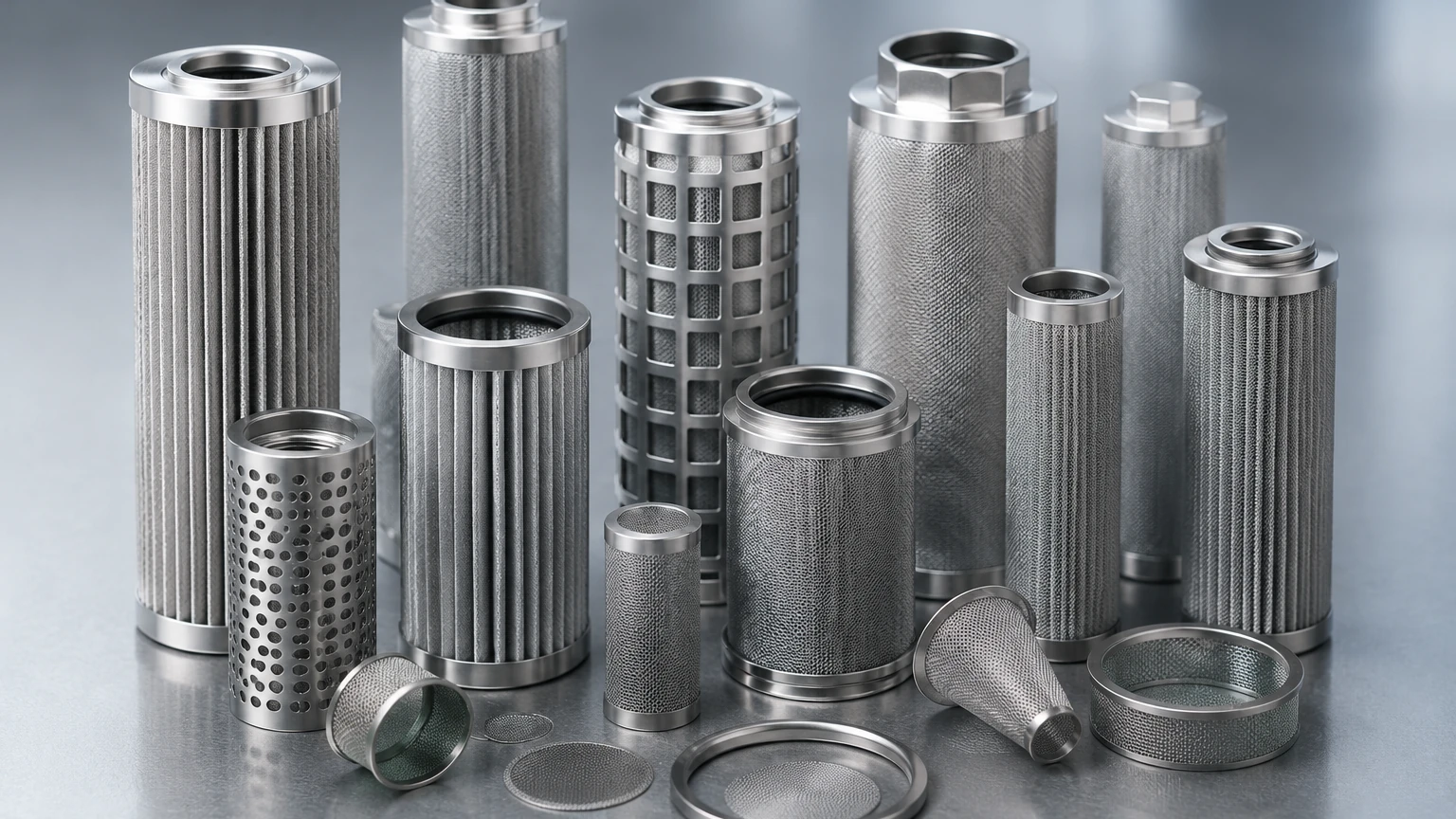
An ss filter can be manufactured using several different methods, each offering distinct advantages in terms of mechanical strength, flow rate, and cleaning capability. Understanding these structures is essential for matching the filter to the process requirements.
Woven Wire Mesh Filters
Wire mesh filters are created by weaving stainless steel wires into specific patterns, such as plain weave, twill weave, or Dutch weave.
- Plain Weave: Offers high open area and low pressure drop, ideal for coarse filtration.
- Dutch Weave: Provides a much denser structure with higher mechanical strength and finer filtration capabilities, often used in high-pressure hydraulic systems.
Sintered Metal Filters
Sintering is a process where multiple layers of wire mesh or metal powders are fused together under high heat and pressure without the use of binders. This creates a monolithic structure that is exceptionally robust. Sintered mesh filters offer precise pore size distribution and can withstand high back-pressure during cleaning cycles. They are often the first choice for steam filtration and polymer melt processing.
Wedge Wire Filters
Wedge wire, or V-wire, filters are constructed by wrapping a profile wire around longitudinal support rods. This design is non-clogging because the V-shaped opening widens inwardly. These are primarily used in water intake systems, pulp and paper processing, and large-scale food processing where high flow rates and easy surface cleaning are required.
Key Performance Metrics for Engineers
When evaluating an ss filter, engineers must look beyond the surface level to ensure the component will integrate seamlessly into their system. For more detailed technical specifications, professionals often visit the Main Page to review specific product data sheets.
Micron Rating: Absolute vs. Nominal
One of the most frequent points of confusion in filter selection is the distinction between nominal and absolute micron ratings.
- Nominal Rating: This is an indicative value, representing the ability of the filter to retain a certain percentage (usually 60% to 90%) of particles of a specified size. It is suitable for non-critical pre-filtration.
- Absolute Rating: This refers to the diameter of the largest hard spherical particle that will pass through the filter under specified test conditions. In pharmaceutical and high-purity chemical applications, an absolute rating is mandatory to ensure process integrity.
Pressure Drop ($ΔP$) and Flow Velocity
The pressure drop across a filter is a function of the fluid's viscosity, the flow velocity, and the filter's effective filtration area. A high initial $ΔP$ indicates that the filter may be undersized for the application, leading to shortened service life and increased energy consumption by pumps. Engineers should aim for a design that balances fine filtration with a low clean pressure drop to maximize the "dirt-holding capacity" before the terminal pressure drop is reached.
Porosity and Permeability
Porosity refers to the percentage of open space within the filter medium, while permeability measures how easily a fluid can pass through that space. High-quality stainless steel filters maximize porosity to ensure high flow rates while maintaining the structural integrity required to prevent media migration or pore deformation under pressure.
Applications Across Critical Industries
The versatility of the ss filter makes it indispensable across a wide range of industrial sectors. Each industry presents unique challenges that dictate the filter's design.
Chemical and Petrochemical Processing
In these environments, filters must resist aggressive chemical attack and high temperatures. Stainless steel filters are used to remove catalysts from process streams, protect downstream equipment from debris, and clarify final chemical products. The ability to operate at temperatures exceeding 300°C gives metal filters a distinct advantage over polymer-based alternatives.
Food and Beverage Industry
Hygiene is the primary concern in food and beverage production. Stainless steel filters are used for steam filtration (to ensure "culinary grade" steam), carbonation of beverages, and the removal of particulates from syrups and oils. Because stainless steel is inert, it does not impart flavors or odors to the product. Furthermore, these filters can withstand Clean-in-Place (CIP) procedures using caustic chemicals and high-temperature sterilization.
Pharmaceutical and Biotechnology
In pharmaceutical manufacturing, filtration is often a critical step in ensuring product safety. Sintered ss filter elements are used for gas sparging, solvent recovery, and as vent filters for storage tanks. The smooth surface finish of high-grade stainless steel prevents bacterial growth and allows for easy validation of cleaning protocols.
Hydraulic and Lubrication Systems
Precision hydraulic systems require extremely clean fluids to prevent wear on valves and pumps. Metal mesh filters provide the high collapse pressure ratings necessary to handle the surges and pulsations inherent in hydraulic circuits. They are also used in the lubrication systems of large turbines and compressors where reliability is paramount.
Maintenance, Cleaning, and Total Cost of Ownership
One of the primary advantages of a stainless steel filter over disposable plastic or paper cartridges is its cleanability. While the initial capital expenditure for an ss filter is higher, the total cost of ownership (TCO) is often significantly lower due to the extended service life and reduced waste disposal costs.
Cleaning Methodologies
Depending on the contaminant, several methods can be used to restore the filter's performance:
- Backwashing/Backpulsing: Using a reverse flow of fluid or gas to dislodge particles from the surface of the filter. This is common in automated systems.
- Ultrasonic Cleaning: Using high-frequency sound waves in a cleaning solution to remove fine particles trapped deep within the pores of sintered media.
- Chemical Cleaning: Soaking the filter in solvents, acids, or alkalis to dissolve organic or inorganic deposits. It is vital to ensure the cleaning agent is compatible with the specific grade of stainless steel.
- Burn-off/Pyrolysis: For filters used in polymer processing, high-temperature ovens can be used to burn off organic residues, followed by ultrasonic cleaning to remove the resulting ash.
Replacement Cycles
Despite being cleanable, stainless steel filters do have a finite lifespan. Repeated cleaning cycles and mechanical stress can eventually lead to fatigue or permanent pore blockage. Engineers should monitor the time it takes to reach terminal pressure drop after each cleaning. A consistent decrease in the interval between cleanings usually indicates that the filter is reaching the end of its functional life and should be replaced to prevent process inefficiency.
Selection Checklist: What to Confirm Before Purchase
Before finalizing a purchase order for an ss filter, procurement and engineering teams should confirm the following parameters with their manufacturer:
1. Fluid Compatibility: Confirm that the alloy (304, 316L, etc.) is resistant to the specific chemicals and concentrations in the process stream.
2. Operating Conditions: Define the maximum operating temperature and pressure, including potential pressure spikes.
3. Filtration Goal: Is the objective to protect downstream equipment (coarse filtration) or to ensure final product purity (fine/absolute filtration)?
4. Housing Interface: Ensure the filter end-caps (e.g., Code 7, DOE, NPT threads) are compatible with existing filter housings.
5. Customization Requirements: Does the application require a specific pleat density to increase surface area, or a reinforced core for high-viscosity fluids?
By addressing these factors, technical teams can ensure they select a filtration solution that provides the best balance of performance and longevity. For organizations seeking specialized engineering support or custom OEM designs, the Main Page offers a comprehensive overview of available manufacturing capabilities and technical resources.
Conclusion
The ss filter is a critical component in the modern industrial toolkit. Its ability to provide precise, repeatable filtration in the most hostile environments makes it an investment in process stability. Whether it is a simple wire mesh strainer or a complex sintered metal cartridge, the right stainless steel filter enhances product quality, protects expensive machinery, and contributes to a more sustainable, low-waste manufacturing process. Through careful material selection and a thorough understanding of application-specific demands, engineers can optimize their filtration systems for peak efficiency and long-term reliability.
