


Stainless Filter Basket
In industrial liquid processing, the stainless filter basket serves as a critical component for protecting downstream equipment and ensuring product purity. Unlike disposable filter media, these robust, reusable components are engineered to withstand high pressure, corrosive environments, and significant mechanical stress. As a specialized manufacturer, Kaifil provides precision-engineered filtration solutions that address the specific technical requirements of chemical, food and beverage, and water treatment sectors. Understanding the engineering variables—from material grade to mesh configuration—is essential for procurement teams and engineers looking to optimize filtration efficiency and reduce the total cost of ownership.
Engineering Principles of Industrial Filter Baskets
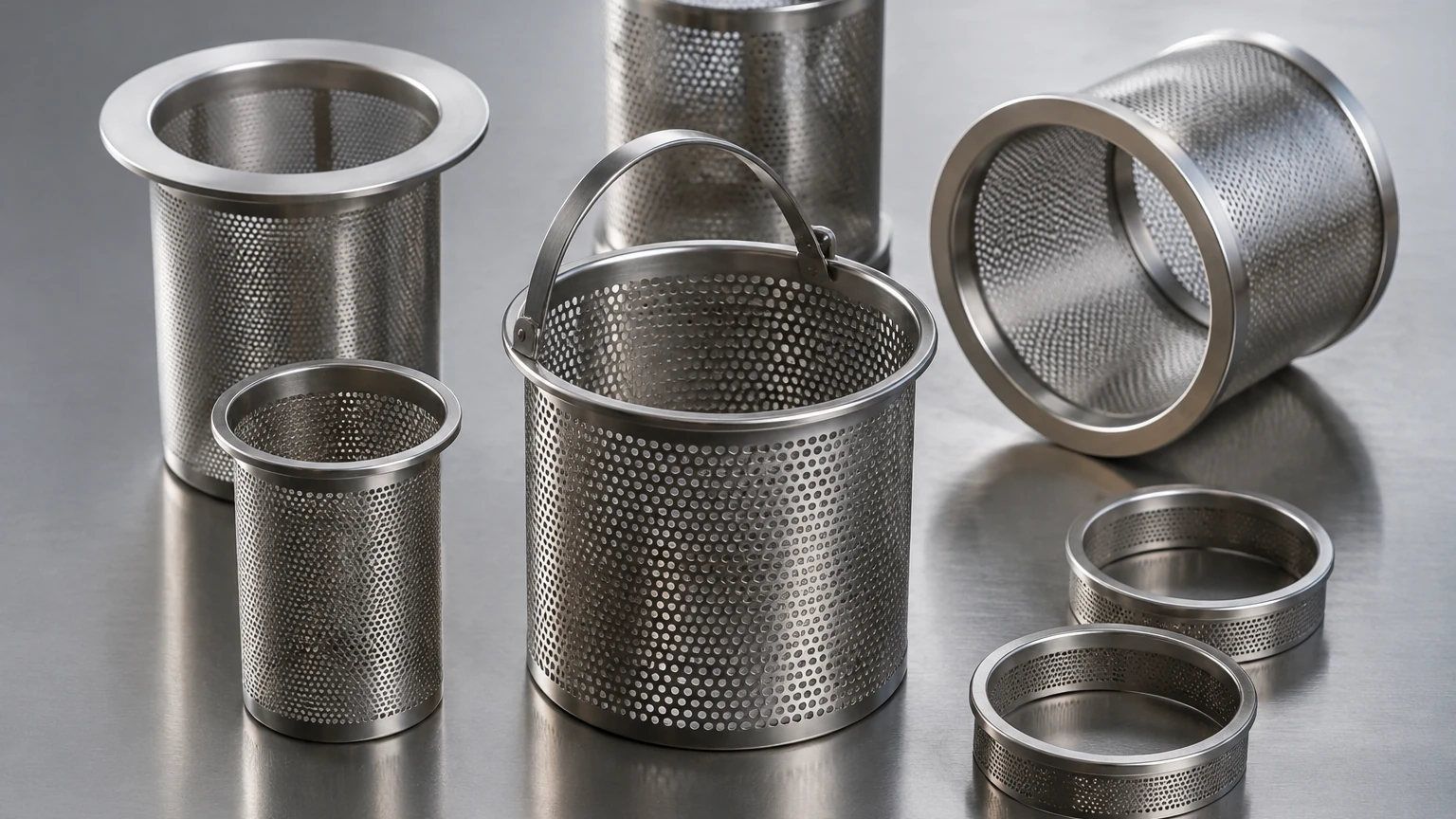
A stainless filter basket is essentially a high-strength strainer designed to fit into a filter housing or vessel. Its primary function is to capture solid particles from a fluid stream while maintaining a low pressure drop. The construction of these baskets typically involves a combination of structural support and fine filtration media.
Perforated vs. Mesh-Lined Construction
For coarse filtration (typically above 1,000 microns), a single-layer perforated metal basket is often sufficient. These are manufactured by punching holes into stainless steel sheets, which are then rolled and welded. However, for finer filtration requirements, a dual-layer design is employed. This consists of a heavy-duty perforated metal "backup" basket that provides mechanical strength, lined with a precision-woven stainless steel wire mesh that determines the actual filtration rating.
Structural Integrity and Welding
In high-viscosity or high-flow applications, the basket must resist deformation. Industrial-grade baskets utilize TIG (Tungsten Inert Gas) or spot welding to ensure seams remain intact under hydraulic surges. The top flange or ring is a critical structural point; it must provide a liquid-tight seal against the housing to prevent "bypass," where unfiltered liquid escapes around the edges of the basket.
Material Science: Selecting the Right Stainless Steel Grade
Material selection is the most significant factor in determining the longevity of a stainless filter basket. While several alloys are available, two primary grades dominate the industrial landscape due to their balance of cost and performance.
AISI 304 Stainless Steel
Grade 304 is the standard choice for general industrial applications. It offers excellent corrosion resistance to most oxidizing acids and is widely used in food processing and water filtration. It is durable and cost-effective but may be susceptible to pitting in high-chloride environments (such as seawater or concentrated brine).
AISI 316L Stainless Steel
The "L" in 316L stands for low carbon, which improves weldability and prevents intergranular corrosion. Grade 316 contains molybdenum, which significantly enhances resistance to chlorides and acetic acids. For pharmaceutical, chemical processing, and marine applications, 316L is the preferred material to ensure the filter does not leach metal ions or succumb to localized corrosion.
Advanced Alloys
In extreme cases involving highly acidic or alkaline fluids, specialized alloys like Duplex stainless steel or Monel may be used. These materials provide superior mechanical strength and chemical stability where standard 300-series steels might fail.
Customization and Structural Design Options
Every industrial process has unique parameters, making customization a necessity rather than a luxury. When sourcing a stainless filter basket, engineers must define several physical characteristics to ensure compatibility with existing systems.
* Flange and Seal Types: The top of the basket can be designed with a flat flange, an O-ring groove, or a specialized angled ring. A proper seal is vital to ensure that 100% of the fluid passes through the filtration media.
* Handle Configurations: For ease of maintenance, baskets are equipped with lifting handles. Options include fixed bar handles, swinging bails, or even heavy-duty threaded eyelets for crane-assisted removal in large-scale vessels.
* Bottom Designs: While a flat bottom is standard, some applications benefit from a slanted or conical bottom to facilitate easier sediment removal or to accommodate specific flow patterns within the housing.
* Reinforcement Ribs: For high-pressure differentials, external or internal reinforcement ribs can be added to the perforated support layer to prevent the basket from collapsing.
For those seeking specific configurations or OEM manufacturing, you can Review product options and application support on our Main Page to see how custom designs integrate into broader industrial systems.
Technical Performance Metrics: Flow Rate and Pressure Drop
The efficiency of a stainless filter basket is measured by its ability to balance filtration fineness with flow capacity. Engineers use the "Open Area Ratio" to evaluate this performance.
The Open Area Ratio
The open area is the total area of the holes or mesh openings expressed as a percentage of the total surface area. A higher open area results in a lower initial pressure drop ($ΔP$) and longer run times between cleanings. However, increasing the open area often requires thinner wire or more perforations, which can compromise the basket's structural rigidity. Finding the "sweet spot" requires precise engineering calculations based on fluid viscosity and particle load.
Micron Ratings and Mesh Counts
Filtration accuracy is defined by the micron rating. In stainless steel wire mesh, this is achieved through various weave patterns:
* Plain Weave: Simple over-under pattern, used for general straining.
* Dutch Weave: Uses heavier warp wires and finer shute wires to create a dense, strong mesh capable of very fine filtration (down to 5-10 microns).
* Twilled Weave: Allows for thicker wires in a given mesh count, increasing the durability of the filter cloth.
Operational Maintenance and Cleaning Protocols
One of the primary advantages of a stainless filter basket is its reusability. Unlike bags or cartridges that must be discarded, stainless baskets can be cleaned and returned to service, significantly reducing operational waste and long-term costs.
Cleaning Methods
1. Manual Cleaning: For coarse debris, high-pressure water hosing or soft-bristle brushing is often sufficient.
2. Ultrasonic Cleaning: For fine mesh baskets used in oil or chemical applications, ultrasonic baths use high-frequency sound waves to dislodge microscopic particles trapped deep within the weave.
3. Chemical Soaking: If the filter is fouled with organic matter or scale, soaking in a compatible detergent or mild acid solution can restore the open area without damaging the stainless steel.
4. Backwashing: In some automated systems, the flow is momentarily reversed to flush accumulated solids off the surface of the basket.
Determining Replacement Cycles
While stainless baskets are durable, they are not infinite. Fatigue from pressure cycling or erosion from abrasive particles will eventually necessitate replacement. Maintenance teams should monitor the "clean" pressure drop; if the $ΔP$ remains high even after cleaning, it indicates that the mesh is permanently blinded or deformed, and a new basket should be installed to prevent pump strain or fluid bypass.
Industry-Specific Applications and Compliance
Stainless filter baskets are ubiquitous across the industrial landscape, but their design must adapt to the regulatory and physical demands of each sector.
Food and Beverage
In this sector, hygienic design is paramount. Baskets must be manufactured with smooth, crevice-free welds to prevent bacterial growth. The stainless steel must be polished to a specific Ra (Roughness Average) value, and all materials must be FDA-compliant. These filters are commonly used to remove pulp from juices, seeds from preserves, or charred particles from frying oils.
Chemical and Petrochemical
Here, the focus shifts to chemical compatibility and high-temperature stability. Stainless filter baskets are used to protect expensive catalysts, remove scale from pipelines, and ensure the purity of refined products. The ability of 316L to withstand aggressive solvents makes it the industry standard.
Water Treatment and Desalination
In large-scale water intake systems, heavy-duty baskets act as the first line of defense, removing sand, shells, and debris that could damage pumps or clog membrane filtration systems. In desalination plants, the high salt content requires the use of high-molybdenum alloys to prevent rapid corrosion.
Conclusion: Making an Informed Procurement Decision
Selecting the right stainless filter basket requires more than just knowing the dimensions of your housing. It demands a thorough understanding of the fluid dynamics, chemical environment, and the specific solids being targeted for removal. By focusing on high-quality materials like 304 and 316L, and prioritizing structural integrity through advanced welding and reinforcement, industrial operators can ensure reliable performance and minimize downtime.
As a dedicated manufacturer, Kaifil specializes in bridging the gap between standard filtration needs and complex, custom-engineered requirements. Whether you are replacing an existing component or designing a new filtration system, confirming the micron rating, material grade, and seal compatibility is the first step toward an optimized process. For more detailed technical specifications and to explore our range of custom filtration components, visit our Main Page and consult with our engineering team to find the ideal solution for your application.
