


Stainless Steel Demister Pad
In industrial gas-liquid separation processes, the presence of entrained liquid droplets in a gas stream can lead to significant operational challenges, including equipment corrosion, catalyst poisoning, and product loss. A stainless steel demister pad, also known as a mist eliminator, is a specialized filtration component designed to remove these fine droplets through the principle of impingement and coalescence.
For engineers and procurement professionals, selecting the correct demister configuration is critical to balancing separation efficiency with system pressure drop. As a manufacturer specializing in custom stainless steel filtration solutions, Kaifil provides high-performance demister pads tailored to the rigorous demands of chemical processing, oil and gas, and pharmaceutical manufacturing. Understanding the technical nuances of these components ensures that industrial systems operate at peak efficiency with minimal maintenance downtime.
Technical Principles of Gas-Liquid Separation
The operation of a stainless steel demister pad relies on a mechanical process rather than chemical interaction. When a gas stream containing entrained liquid droplets passes through the knitted wire mesh of the demister, the gas follows a tortuous path around the wires. Due to their higher inertia, the liquid droplets cannot follow the rapid changes in gas direction and instead collide with the wire surfaces.
Once a droplet impacts the wire, it adheres to the surface and begins to coalesce with other captured droplets. As these droplets grow in size, their weight eventually overcomes the surface tension and the upward velocity of the gas stream, causing them to fall back into the vessel as larger liquid masses.
Successful separation depends on three primary factors:
1. Inertial Impingement: The primary mechanism for droplets larger than 5 to 10 microns.
2. Direct Interception: Occurs when a droplet's path brings it within one droplet radius of a wire.
3. Brownian Diffusion: Relevant only for extremely fine sub-micron mists, though knitted mesh is primarily optimized for the first two mechanisms.
Material Selection and Engineering Grades
Stainless steel is the preferred material for demister pads due to its mechanical strength, thermal stability, and resistance to a wide range of corrosive media. Choosing the correct grade is essential for the longevity of the filter component.
* Type 304 Stainless Steel: Suitable for general-purpose applications where moderate corrosion resistance is required. It is commonly used in food processing and standard industrial ventilation.
* Type 316L Stainless Steel: The standard for chemical and pharmaceutical environments. The addition of molybdenum provides superior resistance to chlorides and organic acids. The "L" (low carbon) designation prevents carbide precipitation during welding, ensuring the integrity of the support grids.
* Type 904L and Special Alloys: For highly aggressive environments involving sulfuric acid or high-salinity brines, specialized stainless alloys are utilized to prevent premature pitting and stress corrosion cracking.
When evaluating materials, engineers must consider the operating temperature and the pH levels of both the liquid and gas phases. A stainless steel demister pad manufactured by Kaifil ensures material traceability, which is a vital requirement for high-stakes industrial applications.
Key Design Parameters for Efficiency
A stainless steel demister pad is not a one-size-fits-all component. Its performance is defined by several geometric and physical properties that must be matched to the specific flow conditions of the application.
Mesh Density and Surface Area
Mesh density refers to the weight of the wire per unit volume (typically expressed in kg/m³ or lb/ft³). A higher density provides a greater specific surface area for droplet impingement, which increases separation efficiency. However, increased density also leads to a higher pressure drop. Standard industrial densities typically range from 120 kg/m³ to 240 kg/m³, depending on the required droplet cutoff size.
Wire Diameter
The diameter of the wire used in the knitted mesh significantly impacts the capture efficiency. Thinner wires create more surface area and are better at capturing smaller droplets but are more susceptible to corrosion and mechanical wear. Conversely, thicker wires offer greater structural rigidity and longer service life in erosive environments.
Pad Thickness
Most industrial demister pads are between 100mm and 150mm thick. Increasing the thickness increases the residence time of the gas within the mesh, providing more opportunities for impingement. In cases where extremely high efficiency is required, multiple layers or thicker pads may be specified.
Performance Evaluation: Pressure Drop and Flooding
In the design of a filtration system, the pressure drop across the stainless steel demister pad is a critical constraint. A high pressure drop increases the energy consumption of compressors or fans and can limit the overall throughput of the plant.
The Pressure Drop Curve
Under normal operating conditions, the pressure drop remains low (often less than 250 Pa). However, as the gas velocity increases, the pressure drop rises. Engineers must calculate the "Design Velocity" using the York-Demister equation, which factors in the densities of both the gas and the liquid phases to determine the optimal operating window.
The Risk of Flooding
Flooding occurs when the upward velocity of the gas is so high that it prevents the coalesced liquid from draining downward. When a demister reaches its flooding point, liquid begins to accumulate within the mesh, leading to a massive increase in pressure drop and eventually "re-entrainment," where liquid is blown out of the top of the pad. Proper sizing is the only way to prevent this failure mode.
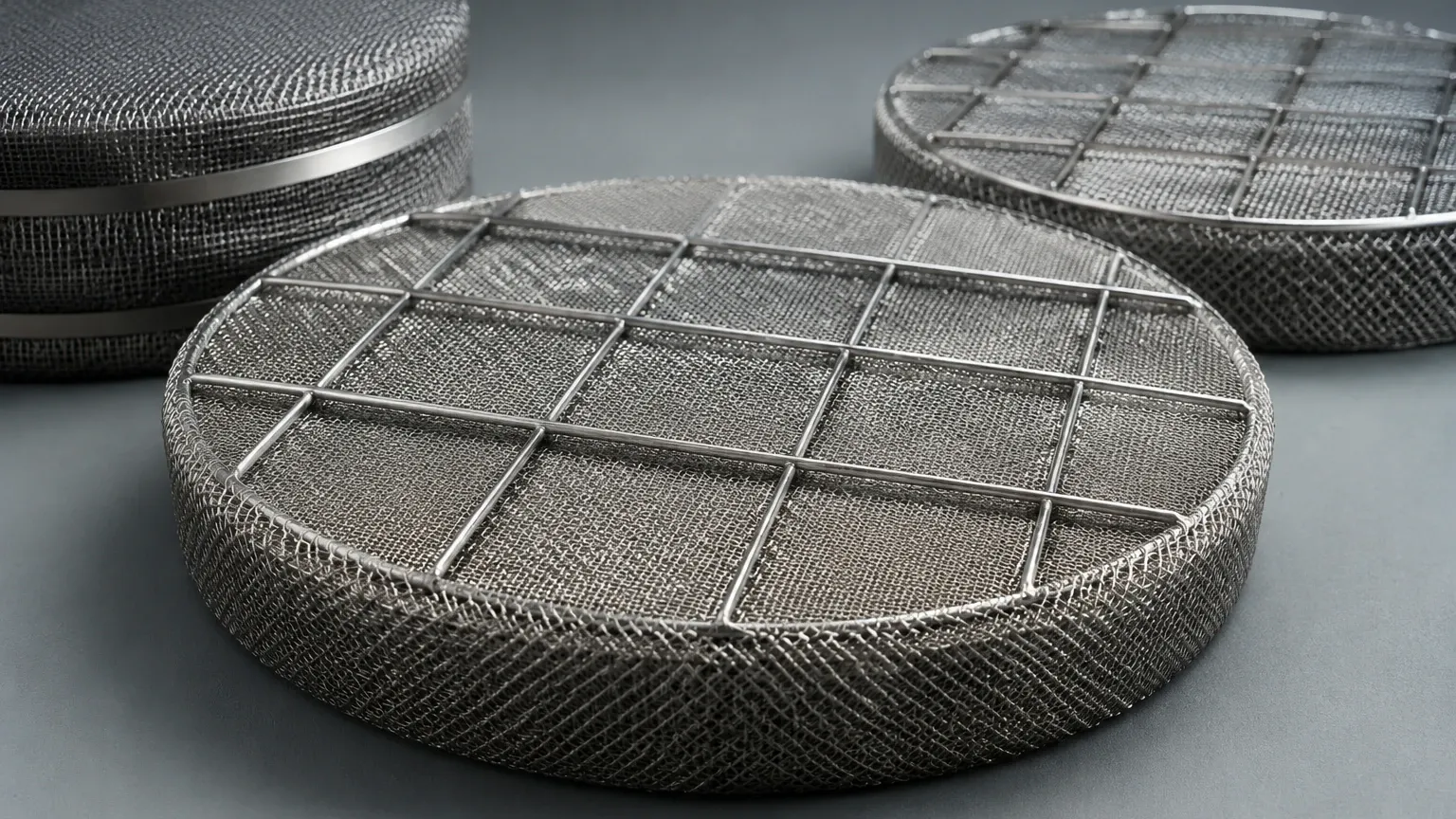
Customization and Structural Support
Industrial vessels come in various shapes and sizes, requiring customized demister configurations. Kaifil specializes in providing tailored solutions that fit seamlessly into existing infrastructure.
* Sectional Construction: For large diameter vessels, demister pads are often manufactured in sections that can pass through a standard manway. These sections are then assembled inside the vessel on support rings.
* Support Grids: To maintain the shape of the knitted mesh under the pressure of gas flow, stainless steel demister pads are typically sandwiched between top and bottom support grids. These grids are made from flat bars or round bars and are welded to provide maximum structural integrity.
* Integrated Solutions: Some applications require the demister to be integrated with other filtration stages, such as Main Page components that handle solid particulate removal before the gas reaches the mist eliminator.
Installation and Maintenance Considerations
To ensure the long-term reliability of a stainless steel demister pad, proper installation and a proactive maintenance schedule are necessary.
Installation Best Practices
The pad must be installed level to ensure uniform gas distribution. Any gaps between the demister sections or between the pad and the vessel wall will allow gas to bypass the filtration media, significantly reducing separation efficiency. Secure fastening to the support ring is required to prevent the pad from shifting or lifting during pressure surges.
Cleaning and Replacement
Over time, solid contaminants or scales may build up on the wire mesh, a phenomenon known as fouling. This reduces the open area of the mesh, leading to increased velocity and pressure drop.
* Cleaning: If the fouling is non-adherent, the pad may be cleaned using high-pressure water or compatible chemical solvents.
* Replacement: Stainless steel pads are durable, but they are not infinite. If the wire diameter has significantly thinned due to corrosion, or if the mesh has become permanently clogged, replacement is the only way to restore system performance. Regular inspections during plant shutdowns are recommended to assess the structural health of the mesh and the support grids.
Why Engineering Precision Matters
Choosing a stainless steel demister pad involves more than just selecting a part number. It requires a deep understanding of fluid dynamics and material science. A poorly specified demister can lead to downstream equipment damage, such as erosion of turbine blades or fouling of heat exchanger tubes.
By partnering with a specialized manufacturer like Kaifil, engineers gain access to technical expertise in wire mesh knitting and filter assembly. Whether the application involves removing oil mist from compressed air or capturing acid mist in a chemical tower, the focus remains on delivering a solution that balances filtration accuracy with mechanical durability.
Conclusion
The stainless steel demister pad is an essential component for maintaining the purity of gas streams and protecting downstream industrial assets. By focusing on the correct material grade, mesh density, and structural design, facilities can achieve efficient liquid separation with minimal operational costs. When evaluating your next filtration project, consider the total cost of ownership, including energy consumption and maintenance intervals, to ensure the selected demister provides the best long-term value. For those seeking technical guidance or customized filtration components, you can review product options and application support on the Kaifil Main Page to find a solution that meets your specific engineering requirements.
