


Stainless Steel Filter Manufacturers
In the landscape of industrial process engineering, the selection of filtration components is a critical decision that impacts system efficiency, product purity, and long-term operational costs. For engineers and procurement professionals, identifying competent stainless steel filter manufacturers is not merely about finding a vendor; it is about establishing a partnership with a manufacturer capable of meeting precise technical specifications and rigorous durability standards. Stainless steel filters, ranging from wire mesh elements to sintered metal cartridges, offer a level of chemical resistance and thermal stability that polymer-based alternatives cannot match. This guide explores the technical criteria, manufacturing standards, and evaluation metrics essential for selecting a high-performance filtration partner.
Technical Engineering Considerations for Stainless Steel Filtration
When engaging with stainless steel filter manufacturers, the conversation must begin with engineering requirements. Unlike disposable filters, stainless steel components are often designed for permanent or semi-permanent installation, requiring a deep understanding of the fluid dynamics and environmental conditions of the application.
Material Selection: 304 vs. 316L
The choice of alloy is the foundation of filter performance. While Type 304 stainless steel is suitable for many general-purpose industrial applications, Type 316L is the industry standard for environments involving corrosive chemicals, chlorides, or high-purity requirements (such as in the pharmaceutical or food and beverage sectors). The "L" in 316L denotes low carbon content, which is essential for preventing carbide precipitation during welding, thereby maintaining the corrosion resistance of the filter at the join points.
Filtration Accuracy: Absolute vs. Nominal Ratings
Engineers must confirm whether a manufacturer defines their filtration accuracy as nominal or absolute. Nominal ratings refer to a micron size where a major percentage of particles are retained, whereas absolute ratings indicate the diameter of the largest hard spherical particle that will pass through the filter under specified test conditions. High-precision stainless steel filter manufacturers provide detailed data on pore size distribution and beta ratios to ensure the filter meets the specific cleanliness levels required for hydraulic systems or sensitive chemical processes.
Manufacturing Capabilities and Quality Standards
The performance of a stainless steel filter is heavily dependent on the manufacturing techniques employed. A manufacturer’s ability to maintain consistency across large production runs is a key indicator of their technical maturity.
Advanced Welding and Assembly
For industrial filters, the integrity of the seams and end-cap attachments is paramount. Precision TIG (Tungsten Inert Gas) welding or plasma welding is typically preferred to ensure leak-proof seals without introducing contaminants. In high-pressure applications, the structural support—such as internal cores or external cages—must be engineered to withstand significant differential pressures without collapsing or bypassing.
Specialized Mesh Weaving and Sintering
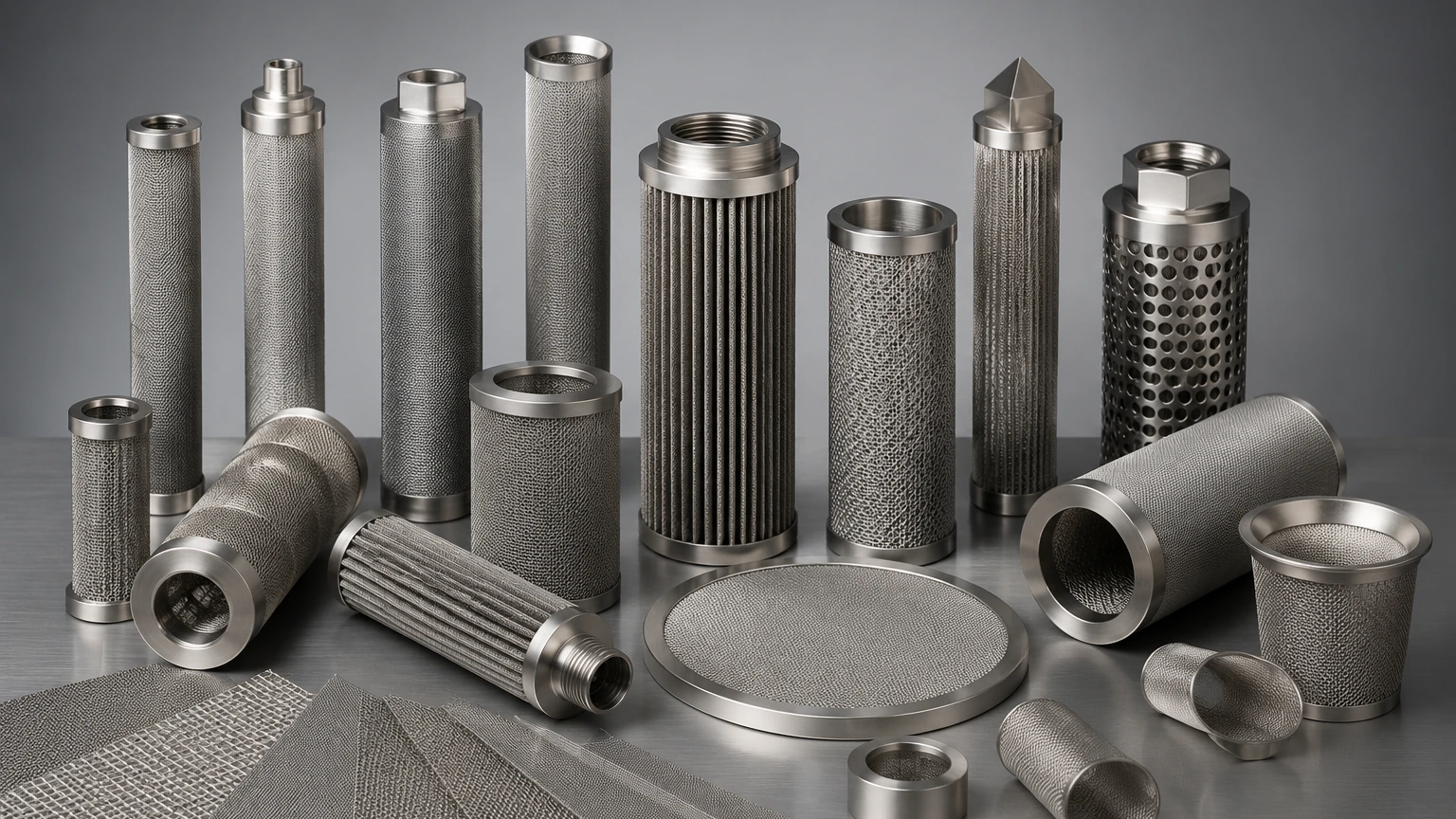
Top-tier stainless steel filter manufacturers often utilize various media types, including:
- Woven Wire Mesh: Available in plain, dutch, or twilled weaves, providing high flow rates and easy cleanability.
- Sintered Metal Fiber: Produced by bonding stainless steel fibers into a porous metallic cloth, offering high porosity and excellent dirt-holding capacity.
- Sintered Mesh: Multiple layers of wire mesh bonded through heat and pressure to create a robust, rigid filter element that maintains its pore structure even under extreme stress.
Evaluating Stainless Steel Filter Manufacturers
Selecting a supplier requires a vetting process that goes beyond price comparisons. For B2B buyers, the following criteria are essential for mitigating risk in the supply chain.
Technical Support and Engineering Collaboration
A reliable manufacturer does more than fulfill a purchase order; they provide application-specific guidance. This includes calculating pressure drops, recommending the appropriate surface area to extend service life, and advising on material compatibility. When reviewing options, engineers should look for manufacturers that offer comprehensive Main Page resources, including technical data sheets and customization guides.
Material Traceability and Certification
In regulated industries like pharmaceuticals or aerospace, material traceability is non-negotiable. Leading stainless steel filter manufacturers provide Mill Test Reports (MTRs) that confirm the chemical composition and physical properties of the raw materials used. Furthermore, compliance with international standards such as ISO 9001 for quality management and specific industry certifications (e.g., FDA compliance for food-contact materials) should be verified during the initial audit.
Testing and Validation Protocols
How does a manufacturer prove their filters work? Inquire about their in-house testing capabilities. Standard tests include:
- Bubble Point Test: To verify the integrity and pore size of the filter element.
- Differential Pressure Testing: To determine the clean pressure drop and the maximum allowable pressure before structural failure.
- Dirt Holding Capacity: To estimate the operational lifespan of the filter before cleaning or replacement is required.
Customization and OEM Solutions
One of the primary reasons to work directly with stainless steel filter manufacturers is the ability to develop customized solutions. Off-the-shelf filters rarely meet the exact dimensional or performance requirements of specialized industrial machinery.
Tailored Geometry and Fittings
Customization often involves unique lengths, diameters, and end-fitting configurations (such as NPT threads, flange mounts, or specialized O-ring seals). Whether the application involves a retrofitted hydraulic system or a new chemical reactor, the ability to manufacture filters to precise tolerances ensures a seamless fit and prevents bypass leakage.
OEM Partnerships
For original equipment manufacturers (OEMs), consistency is the highest priority. A manufacturing partner must be able to produce identical components over years of production, ensuring that the end-users of the machinery receive consistent filtration performance. This requires the manufacturer to have robust tooling capabilities and a stable supply chain for high-quality stainless steel wire and media.
Industry-Specific Application Challenges
Different sectors present unique challenges that stainless steel filter manufacturers must address through specialized designs.
Chemical and Petrochemical Processing
In these environments, filters are exposed to aggressive solvents and high temperatures. Stainless steel is chosen for its ability to maintain mechanical strength at temperatures where polymers would soften or degrade. Manufacturers must ensure that all components, including gaskets and adhesives (if used), are compatible with the process fluid.
Food and Beverage Production
Hygiene is the primary concern here. Stainless steel filters must be designed with "sanitary" features, meaning smooth surfaces (often electropolished) and the absence of dead zones where bacteria could proliferate. They must also be capable of withstanding Clean-in-Place (CIP) procedures involving caustic chemicals and high-pressure steam.
Hydraulic and Lubrication Systems
In high-pressure hydraulic circuits, the filter must protect sensitive valves and pumps from particulate wear. Stainless steel mesh filters are often used as "last chance" filters or in high-temperature oil loops where paper or glass-fiber elements might fail. The manufacturer must ensure the media can handle rapid pressure fluctuations without fatigue.
Total Cost of Ownership vs. Initial Investment
While the initial cost of a stainless steel filter is higher than that of a disposable synthetic filter, the Total Cost of Ownership (TCO) is often significantly lower. This is a point that experienced stainless steel filter manufacturers emphasize to their B2B clients.
Cleanability and Reusability
Unlike disposable filters that contribute to waste streams and require frequent replacement, stainless steel filters can be cleaned and returned to service. Cleaning methods such as ultrasonic cleaning, backwashing, or chemical steeping can restore the filter to near-original differential pressure. This reduces the long-term cost of consumables and minimizes downtime associated with filter changes.
Durability and Reduced Risk
The mechanical robustness of stainless steel reduces the risk of "media migration"—where bits of the filter material itself break off and contaminate the downstream fluid. In critical processes, the cost of a single contamination event far outweighs the price premium of a high-quality stainless steel element.
Final Confirmation Before Procurement
Before finalizing a contract with a manufacturer, engineers and purchasing teams should confirm the following:
1. Lead Times: Does the manufacturer have the capacity to meet production schedules, especially for custom designs?
2. Prototype Availability: Can the manufacturer provide a prototype for field testing before a full-scale production run?
3. Technical Documentation: Is there a clear path to obtaining MTRs, certificates of conformance, and technical drawings?
4. Cleaning Guidance: Does the manufacturer provide specific protocols for cleaning and validating the reused elements?
By focusing on these technical and operational benchmarks, organizations can ensure they partner with stainless steel filter manufacturers that provide not just a product, but a reliable component of their industrial success. For those seeking to explore specific product configurations or technical support, reviewing the Main Page of a specialized manufacturer like Kaifil can provide the necessary foundation for a successful filtration project.
