


Stainless Steel Filter
In industrial processing, the efficiency and reliability of filtration systems directly impact product quality, equipment longevity, and operational costs. A stainless steel filter is often the preferred choice for demanding environments where synthetic or paper-based media fail due to temperature, pressure, or chemical incompatibility. Unlike disposable filters, stainless steel components offer a combination of mechanical strength, corrosion resistance, and cleanability that makes them indispensable in sectors ranging from chemical processing to food and beverage production.
Selecting the right filtration solution requires a deep understanding of material science, fluid dynamics, and the specific mechanical stresses of the application. This guide explores the technical aspects of stainless steel filtration, providing engineers and purchasing teams with the factual basis needed to specify components for high-performance industrial systems.
Understanding the Engineering Fundamentals of Stainless Steel Filtration
The primary function of a stainless steel filter is to remove particulate matter from a fluid or gas stream while maintaining structural integrity under operational stress. These filters are characterized by their porous structures, which can be engineered to achieve specific micron ratings. The choice of filter depends on the nature of the contaminant, the viscosity of the fluid, and the required flow rate.
Industrial filtration typically falls into two categories: surface filtration and depth filtration.
1. Surface Filtration: This occurs when particles are trapped on the upstream side of the filter medium. Woven wire mesh is a classic example of surface filtration media. It is ideal for applications where the particle size distribution is relatively uniform and where backwashing or surface cleaning is required.
2. Depth Filtration: This involves a thicker medium where particles are trapped within the tortuous paths of the material. Sintered metal powder filters are often used for depth filtration, providing high dirt-holding capacity and the ability to capture finer particles than standard mesh.
For many engineers, the transition to stainless steel media is driven by the need for a "permanent" or semi-permanent solution. While the initial capital expenditure is higher than disposable alternatives, the total cost of ownership is often lower due to the elimination of frequent replacement costs and the reduction in hazardous waste disposal.
Material Selection: 304, 316L, and Beyond
The performance of a stainless steel filter is fundamentally tied to the alloy used in its construction. Stainless steel is not a single material but a family of alloys, each with distinct properties regarding corrosion resistance and thermal stability.
Grade 304 Stainless Steel
Grade 304 is the most common stainless steel used in industrial applications. It offers excellent strength and good corrosion resistance for general-purpose use. It is suitable for water filtration, hydraulic fluids, and many organic chemicals. However, it is susceptible to pitting and crevice corrosion in high-chloride environments, such as seawater or brine.
Grade 316 and 316L Stainless Steel
For more aggressive environments, Grade 316 is the industry standard. The addition of molybdenum (2–3%) significantly enhances its resistance to chlorides and acetic acids. Grade 316L (low carbon) is preferred for components that require extensive welding. The lower carbon content prevents carbide precipitation during the welding process, which maintains the alloy's corrosion resistance in the heat-affected zones. This is critical for maintaining the structural integrity of filter cartridges and pleated elements.
Specialty Alloys
In extreme cases involving highly concentrated acids or high-temperature oxidation, specialty alloys like 904L, Monel, or Inconel may be utilized. These materials are selected based on specific chemical compatibility charts and the thermal profile of the industrial process.
Types of Stainless Steel Filter Media and Structures
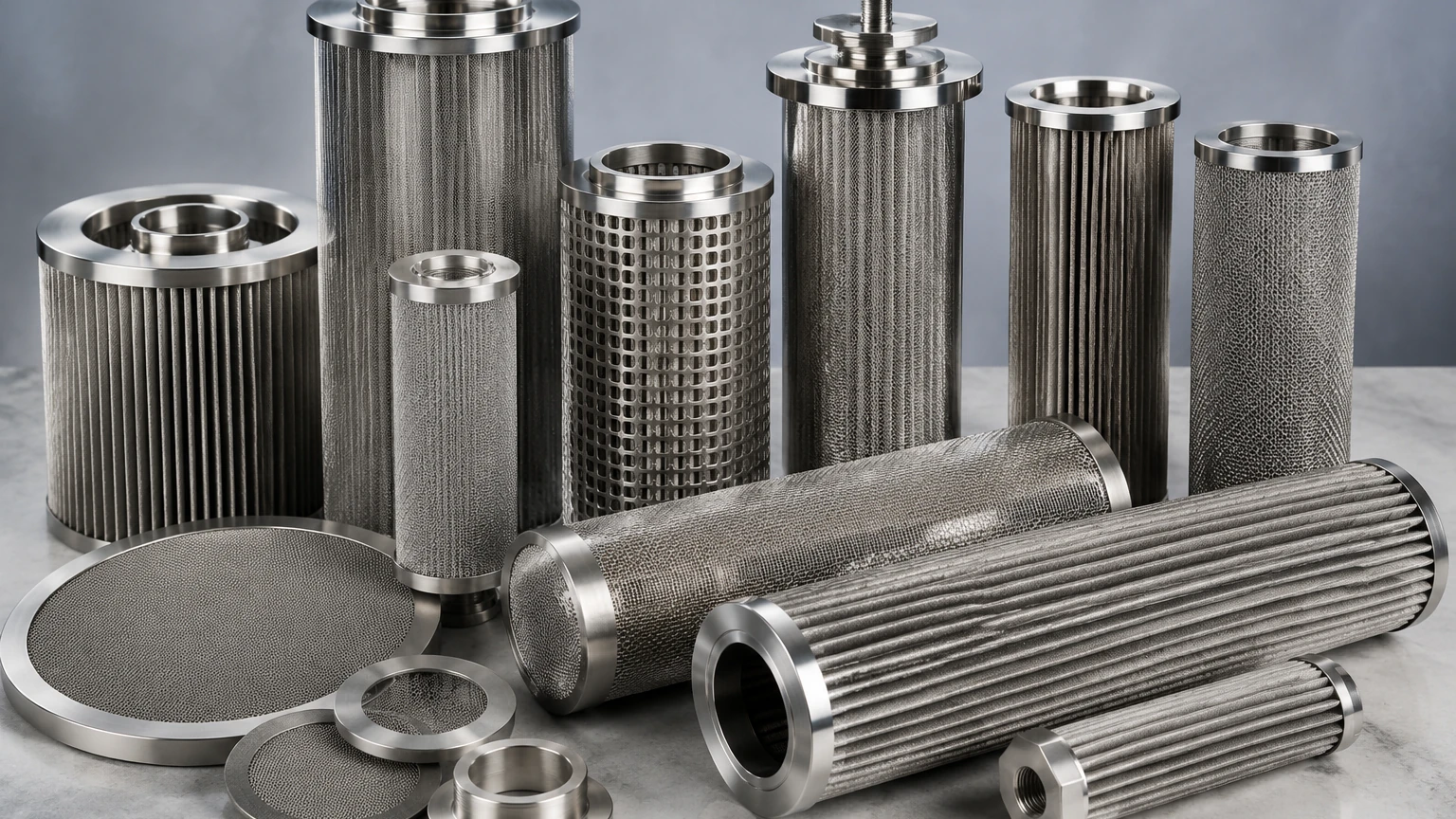
Manufacturing techniques determine the physical characteristics and performance limits of the filter. There are several primary structures used in industrial stainless steel filters:
Woven Wire Mesh
This is produced by weaving stainless steel wires into specific patterns, such as plain weave, twill weave, or Dutch weave. Dutch weaves, including Reverse Dutch Weave (RDW), allow for a higher density of wires, resulting in finer filtration ratings and greater mechanical strength. Woven mesh is highly predictable and provides a precise pore size, making it the standard for sieving and surface filtration.
Sintered Wire Mesh
Sintering is a process where multiple layers of woven wire mesh are bonded together using heat and pressure in a vacuum furnace. This creates a diffusion bond at every wire contact point, resulting in a robust, integrated structure. Sintered mesh combines the precision of woven mesh with the mechanical strength of a solid plate. It is resistant to migration (the shedding of media particles) and can withstand high differential pressures without deforming.
Sintered Metal Powder
In this process, stainless steel powder is pressed into a shape and then sintered. The result is a porous, rigid structure with a complex internal geometry. Sintered powder filters are excellent for gas filtration and high-viscosity liquids, offering absolute filtration ratings down to sub-micron levels.
Wedge Wire
Wedge wire filters consist of V-shaped profiles resistance-welded onto support rods. This design creates a continuous slot that widens inwardly, which minimizes clogging and facilitates easy cleaning via backpulsing or mechanical scraping. These are commonly used in water treatment and pulp and paper industries where high flow rates and heavy solids loading are present.
Key Performance Metrics for Industrial Specification
When evaluating a stainless steel filter, engineers must look beyond the basic dimensions. Several technical metrics determine whether a filter will succeed in a specific application.
Micron Rating: Absolute vs. Nominal
* Nominal Rating: This indicates the ability of the filter to retain a certain percentage (usually 60% to 90%) of particles of a specific size. It is an estimate and does not guarantee that larger particles will not pass through.
* Absolute Rating: This is the diameter of the largest hard spherical particle that will pass through the filter under specified test conditions. For critical applications in the pharmaceutical or semiconductor industries, absolute ratings are mandatory to ensure process safety.
Clean Pressure Drop (Delta P)
The pressure drop is the difference in pressure between the upstream and downstream sides of the filter. A high initial pressure drop reduces the available energy for the process and shortens the time between cleaning cycles. Factors influencing Delta P include the filter's effective filtration area, the fluid's viscosity, and the flow velocity.
Dirt Holding Capacity
This refers to the total mass of contaminants the filter can trap before the pressure drop reaches a predetermined terminal limit. A filter with a high dirt-holding capacity requires less frequent maintenance, which is vital for continuous processing lines.
Structural Integrity and Collapse Pressure
In high-pressure systems, such as hydraulic circuits, the filter must be able to withstand significant differential pressure without collapsing. The collapse pressure rating must exceed the maximum possible pressure surge of the system to prevent catastrophic failure and downstream contamination.
Maintenance, Cleaning, and Longevity
One of the primary advantages of a stainless steel filter is its ability to be cleaned and reused. However, the cleaning method must be compatible with both the filter structure and the type of contaminant.
Ultrasonic Cleaning
For sintered media or fine mesh where particles are deeply embedded, ultrasonic cleaning is highly effective. High-frequency sound waves create cavitation bubbles that implode, dislodging particles from the internal pores of the metal. This method is often used in laboratory settings or specialized cleaning facilities.
Backwashing and Backpulsing
In automated systems, backwashing involves reversing the flow of the fluid to flush particles off the surface of the filter. This is common with wedge wire and coarse mesh filters. Backpulsing uses a sudden burst of high-pressure gas or liquid to shock the contaminants loose from the media.
Chemical Cleaning
If the contaminants are organic or scale-based, chemical solvents or detergents may be used. It is imperative to ensure that the cleaning agents do not cause stress corrosion cracking or general corrosion of the stainless steel grade used in the filter.
Determining Replacement Cycles
While stainless steel filters are durable, they are not infinite. Repeated cleaning cycles can eventually lead to fatigue or permanent blinding (where pores are irreversibly blocked). Monitoring the rate at which the pressure drop increases after each cleaning cycle helps engineers predict the end-of-life for the component.
Customization and OEM Considerations for Industrial Applications
Off-the-shelf filtration products often fail to meet the specific spatial or performance requirements of complex industrial machinery. Customization is a core component of successful filtration integration. When working with a manufacturer like Kaifil, several variables can be tailored to the application:
* End Fittings: Filters can be equipped with various connectors, including NPT threads, flanges, BSP, or specialized quick-connect fittings to ensure a leak-proof seal within existing housing.
* Pleating: To increase the effective filtration area without increasing the outer dimensions of the cartridge, the stainless steel mesh can be pleated. This significantly improves flow rates and dirt-holding capacity.
* Support Cores: For high-pressure applications, internal perforated cores or external shrouds are added to provide additional mechanical support to the filter media.
* Layer Configuration: In sintered mesh, the number and type of layers can be customized (e.g., combining a fine filtration layer with multiple coarse support and drainage layers) to optimize both strength and permeability.
By collaborating with a manufacturer that understands these engineering nuances, purchasing teams can ensure they receive a product that is optimized for their specific operating conditions, rather than a generic compromise.
Conclusion
The selection of a stainless steel filter is a technical decision that impacts the entire lifecycle of an industrial process. From choosing the correct alloy to prevent corrosion to specifying the exact micron rating for product purity, every detail matters. Stainless steel's unique properties—durability, high-temperature tolerance, and cleanability—provide a reliable solution for the most challenging filtration tasks.
For engineers and procurement professionals looking to optimize their filtration performance, technical expertise and manufacturing precision are the keys to success. To explore specific product configurations, material certifications, and engineering support for your next project, you can review the comprehensive resources available on the Main Page of the Kaifil website. Reliable filtration starts with a deep understanding of the application and a commitment to quality manufacturing.
