


Stainless Steel Filters
In industrial processing, the integrity of the filtration system is a critical factor in determining product quality, equipment longevity, and operational efficiency. Stainless steel filters represent a specialized class of filtration solutions designed to withstand extreme environments where polymer-based or disposable filters fail. As a professional manufacturer, Kaifil specializes in engineering these components to meet the rigorous demands of chemical processing, food and beverage production, and hydraulic systems. Understanding the technical nuances of material selection, structural design, and performance metrics is essential for engineers and procurement teams tasked with optimizing industrial fluid and gas streams.
Material Science and Corrosion Resistance in Industrial Filtration
The primary advantage of stainless steel filters is their inherent resistance to corrosion, oxidation, and thermal degradation. However, "stainless steel" is a broad category, and selecting the correct alloy is the first step in engineering a successful filtration solution. The most common materials used in the production of industrial filters are AISI 304, 316, and 316L.
Type 304 stainless steel is suitable for basic applications where moisture and mild chemicals are present. However, for more aggressive environments, Type 316 is the industry standard due to the addition of molybdenum, which enhances resistance to chlorides and pitting. In applications involving high-temperature welding or highly corrosive chemical processing, 316L (low carbon) is preferred to prevent carbide precipitation and ensure the structural integrity of the filter mesh and housing. For specialized environments, such as those involving high-salinity or extreme acids, exotic alloys like Monel, Inconel, or Hastelloy may be utilized to provide the necessary chemical stability.
Comparing Filter Media: Woven Wire Mesh vs. Sintered Metal
Stainless steel filters are available in several media types, each offering distinct advantages based on the filtration mechanism required. The choice between surface filtration and depth filtration often dictates the media selection.
Woven Wire Mesh
This is the most common form of stainless steel media. It consists of wires woven into specific patterns, such as plain weave, twill weave, or dutch weave. Plain weave provides a straightforward, square opening suitable for high-flow, low-pressure applications. Dutch weave, characterized by a higher density of shute wires, allows for much finer filtration ratings while maintaining high mechanical strength. Woven mesh is primarily a surface filtration medium, making it easy to clean via backwashing or ultrasonic methods.
Sintered Metal Media
Sintered metal filters are created by fusing multiple layers of wire mesh or metal powders through a high-temperature diffusion bonding process. This creates a porous, monolithic structure that offers exceptional mechanical strength and pressure resistance. Sintered mesh laminates provide a stable pore structure that does not shift under high differential pressure, making them ideal for high-pressure hydraulic systems and polymer melt filtration. Sintered powder media, on the other hand, provides a tortuous path for depth filtration, capturing particles within the thickness of the material.
Wedge Wire
For applications involving high-viscosity fluids or heavy solid loads, wedge wire (V-wire) filters are used. These consist of profile wires welded onto support rods. The V-shaped opening minimizes clogging and facilitates efficient cake discharge in automatic self-cleaning filters.
Understanding Filtration Efficiency and Micron Ratings
When evaluating stainless steel filters, engineers must distinguish between nominal and absolute micron ratings. A nominal rating refers to the filter's ability to retain a majority percentage of particles of a specific size, but it does not guarantee 100% retention. In contrast, an absolute rating indicates the pore size at which the filter will capture 99.9% (or higher) of particles, usually determined through a bubble point test or glass bead challenge.
Filtration efficiency is also influenced by the flow velocity and the physical properties of the contaminant. In high-precision industries like pharmaceuticals, absolute-rated 316L sintered mesh is often required to ensure that no bypass occurs. Conversely, in a cooling water loop, a nominal-rated woven mesh may be more cost-effective. It is also important to consider the "clean pressure drop" (ΔP). An oversized filter might reduce the initial pressure drop but increase the footprint and cost, while an undersized filter will reach its terminal pressure drop too quickly, leading to frequent maintenance cycles.
Customization and Engineering of Filter Cartridges
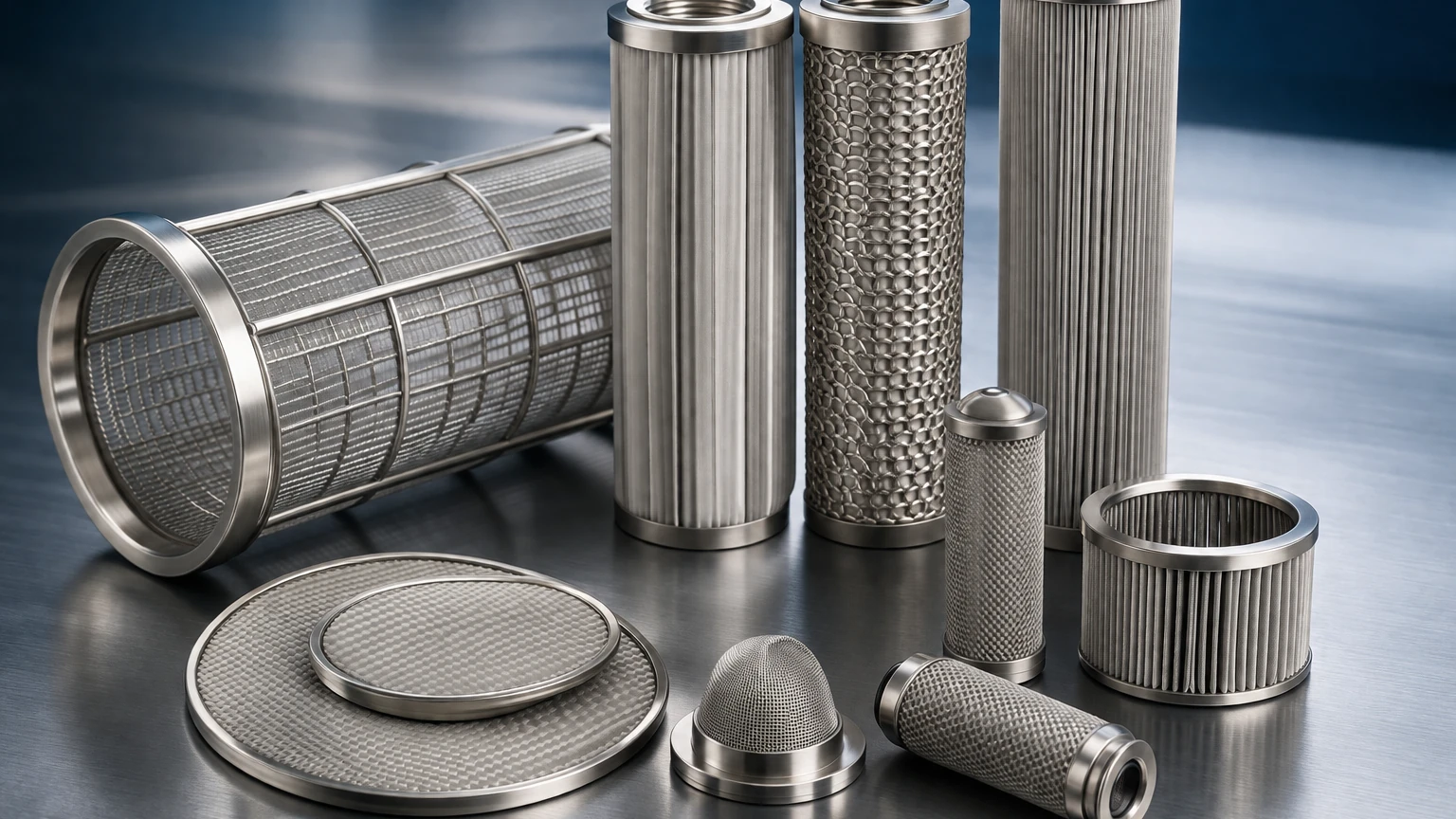
Industrial applications rarely follow a one-size-fits-all approach. Customization is a core component of Kaifil’s manufacturing process, ensuring that the filter interface integrates seamlessly with existing housing and piping. Key areas of customization include:
* End Fittings: Filter cartridges can be configured with various end caps, such as Double Open End (DOE), Code 7 (226 o-ring with bayonet), or Code 3 (222 o-ring). The selection depends on the required seal integrity and the housing design.
* Reinforcement: In high-pressure applications, the filter media may be supported by an internal core and an external shroud (perforated metal) to prevent collapse or bursting.
* Pleating: To increase the effective filtration area within a standard cartridge size, the stainless steel mesh can be pleated. This reduces the flux (flow per unit area), which lowers the pressure drop and significantly extends the service life of the filter between cleanings.
* Dimensions: Custom lengths and diameters are often necessary for OEM equipment where standard off-the-shelf components do not fit the spatial constraints.
For more information on specific configurations, you can visit the Main Page to review product options and application support.
Operational Longevity: Cleaning and Maintenance Protocols
One of the most significant advantages of stainless steel filters over disposable alternatives is their cleanability. While the initial capital expenditure for a stainless steel system is higher, the total cost of ownership (TCO) is often lower due to the elimination of recurring replacement costs and the reduction in waste disposal.
Cleaning methods for stainless steel filters include:
1. Backpulsing/Backwashing: Using a reverse flow of fluid or gas to dislodge particles from the surface of the mesh. This is common in automated systems.
2. Ultrasonic Cleaning: Placing the filter in an ultrasonic bath where high-frequency sound waves create cavitation bubbles that remove fine particles trapped deep within the mesh or sintered structure.
3. Chemical Cleaning: Utilizing acids, alkalis, or solvents to dissolve organic or inorganic fouling. Because stainless steel is chemically robust, it can withstand aggressive cleaning agents that would destroy polymer filters.
4. Burn-off/Pyrolysis: For filters used in polymer processing, high-temperature ovens can be used to burn off residual plastic, leaving the metal filter ready for reuse.
Engineers should establish a maintenance schedule based on the terminal pressure drop. Operating a filter beyond its rated ΔP can lead to media deformation or "breakthrough," where the pressure forces contaminants through the filter pores.
Application-Specific Requirements Across Key Industries
The versatility of stainless steel filters allows them to be deployed across diverse sectors, each with unique technical requirements.
* Chemical and Petrochemical: Here, the focus is on chemical compatibility and high-temperature stability. Filters must handle aggressive solvents, catalysts, and hot gases without corroding or losing structural integrity.
* Food and Beverage: In this sector, hygiene and clean-in-place (CIP) capabilities are paramount. Stainless steel filters must be manufactured with smooth surface finishes (often electropolished) to prevent bacterial growth and ensure compliance with food safety standards.
* Pharmaceuticals: Precision is the priority. Sintered metal filters are used for steam filtration (SIP), vent filtration, and the recovery of expensive active pharmaceutical ingredients (APIs). The ability to withstand repeated sterilization cycles is a key requirement.
* Hydraulics and Lubrication: Stainless steel mesh filters protect sensitive valves and pumps from wear particles. They are chosen for their high collapse pressure ratings and ability to maintain performance in high-viscosity oil environments.
Technical Selection Criteria for Procurement and Engineering
Before finalizing a purchase order for stainless steel filters, technical teams should confirm a specific set of parameters to ensure the product is fit for purpose. Relying on vague specifications can lead to premature failure or suboptimal filtration.
1. Fluid Characteristics: What is the chemical composition, viscosity, and density of the fluid? Is it a liquid or a gas?
2. Operating Conditions: What are the maximum and normal operating temperatures and pressures? Are there pressure spikes (water hammer) that the filter must withstand?
3. Contaminant Profile: What is the particle size distribution? Are the contaminants hard, soft, or gelatinous? What is the expected solids loading (ppm)?
4. Flow Rate: What is the required flow rate, and what is the maximum allowable pressure drop across the filter?
5. Compliance: Does the application require specific certifications, such as FDA compliance for food contact or PED (Pressure Equipment Directive) for high-pressure vessels?
By addressing these factors during the design phase, companies can ensure they receive a filtration solution that provides reliable performance and long-term durability. Kaifil’s engineering team works closely with clients to translate these requirements into high-performance metal filtration components tailored to the specific needs of the application.
In summary, stainless steel filters are an essential component of modern industrial infrastructure. Their ability to operate in conditions where other materials fail—combined with their sustainability through cleaning and reuse—makes them a superior choice for demanding applications. Whether it is a standard wire mesh cartridge or a complex sintered metal component, the focus remains on precision engineering and material integrity to achieve optimal filtration results.
