


Stainless Steel Mesh Filter Cartridge
In the landscape of industrial filtration, the selection of a filter medium is a critical engineering decision that directly impacts operational efficiency, product purity, and long-term maintenance costs. The stainless steel mesh filter cartridge stands as a premier solution for demanding environments where polymer-based filters fail due to temperature, pressure, or chemical incompatibility. As a specialized component designed for high-performance liquid and gas filtration, these cartridges leverage the inherent strength and corrosion resistance of stainless steel to provide a reliable, cleanable, and durable filtration interface.
For engineers and procurement teams, understanding the technical nuances of a stainless steel mesh filter cartridge is essential for optimizing system performance. Whether the application involves high-viscosity resins, steam filtration, or aggressive chemical processing, the structural integrity and precision of the mesh determine the success of the separation process. To explore the full range of custom engineering capabilities, technical professionals often refer to the Main Page of specialist manufacturers to align product specifications with specific industrial requirements.
Engineering Principles of Stainless Steel Mesh Filtration
The primary function of a stainless steel mesh filter cartridge is surface filtration. Unlike depth filters that trap particles within a thick matrix of fibers, a wire mesh cartridge captures contaminants on a single, precisely controlled plane. This mechanism allows for predictable performance and, more importantly, the ability to recover the filter through backwashing or ultrasonic cleaning.
Material Composition and Grades
The performance of these cartridges begins with metallurgy. The two most common materials used are Grade 304 and Grade 316L stainless steel.
* Grade 304: Suitable for general industrial use, offering good corrosion resistance and mechanical strength. It is commonly used in food processing and water treatment where chloride levels are low.
* Grade 316L: The "L" denotes low carbon content, which prevents carbide precipitation during welding, ensuring the structural integrity of the filter seams. 316L contains molybdenum, providing superior resistance to pitting and crevice corrosion in chloride-rich environments and acidic solutions.
Weave Types and Their Impact
The geometry of the mesh determines the filtration accuracy (micron rating) and the flow resistance. Common weave patterns include:
1. Plain Weave: A simple over-under pattern that provides a high percentage of open area, ideal for high-flow applications with low particle loading.
2. Twill Weave: Each shute wire passes over and under two warp wires. This allows for the use of heavier wires in a given mesh count, increasing the mechanical strength of the cartridge.
3. Dutch Weave (Plain and Twill): This weave uses different wire diameters for the warp and shute. The result is a dense, high-strength mesh with small, triangular openings. Dutch weaves are the standard for fine filtration, capable of achieving absolute ratings down to 5 microns.
Key Performance Criteria for Selection
When specifying a stainless steel mesh filter cartridge, engineers must evaluate several performance metrics to ensure the component survives the operating environment while meeting filtration targets.
Micron Rating: Nominal vs. Absolute
In the context of wire mesh, the micron rating refers to the pore size of the weave.
* Nominal Rating: Indicates the ability of the filter to retain the majority of particles of a specified size (typically 60-90%).
* Absolute Rating: Refers to the diameter of the largest hard spherical particle that will pass through the filter under specified test conditions. For critical applications in the pharmaceutical or chemical sectors, absolute ratings are mandatory to ensure process consistency.
Differential Pressure and Flow Rates
The clean pressure drop ($ΔP$) is a function of the fluid's viscosity, the flow velocity, and the open area of the mesh. A stainless steel mesh filter cartridge is designed to withstand significant differential pressures—often up to 30-50 bar depending on the internal support core. However, operating at high $ΔP$ for extended periods can lead to particle bypass or structural deformation if the cartridge is not correctly reinforced.
Temperature and Chemical Compatibility
One of the primary advantages of stainless steel is its thermal stability. These cartridges can typically operate in temperatures ranging from -200°C to over 500°C, depending on the sealing materials used (such as PTFE or metal gaskets). Chemically, they are resistant to a wide array of solvents, alkalis, and organic acids, making them indispensable in petrochemical and polymer production.
Structural Design and Customization Options
Industrial filtration requirements are rarely "one size fits all." The design of a stainless steel mesh filter cartridge can be modified to balance surface area, structural rigidity, and ease of cleaning.
Pleated vs. Cylindrical Designs
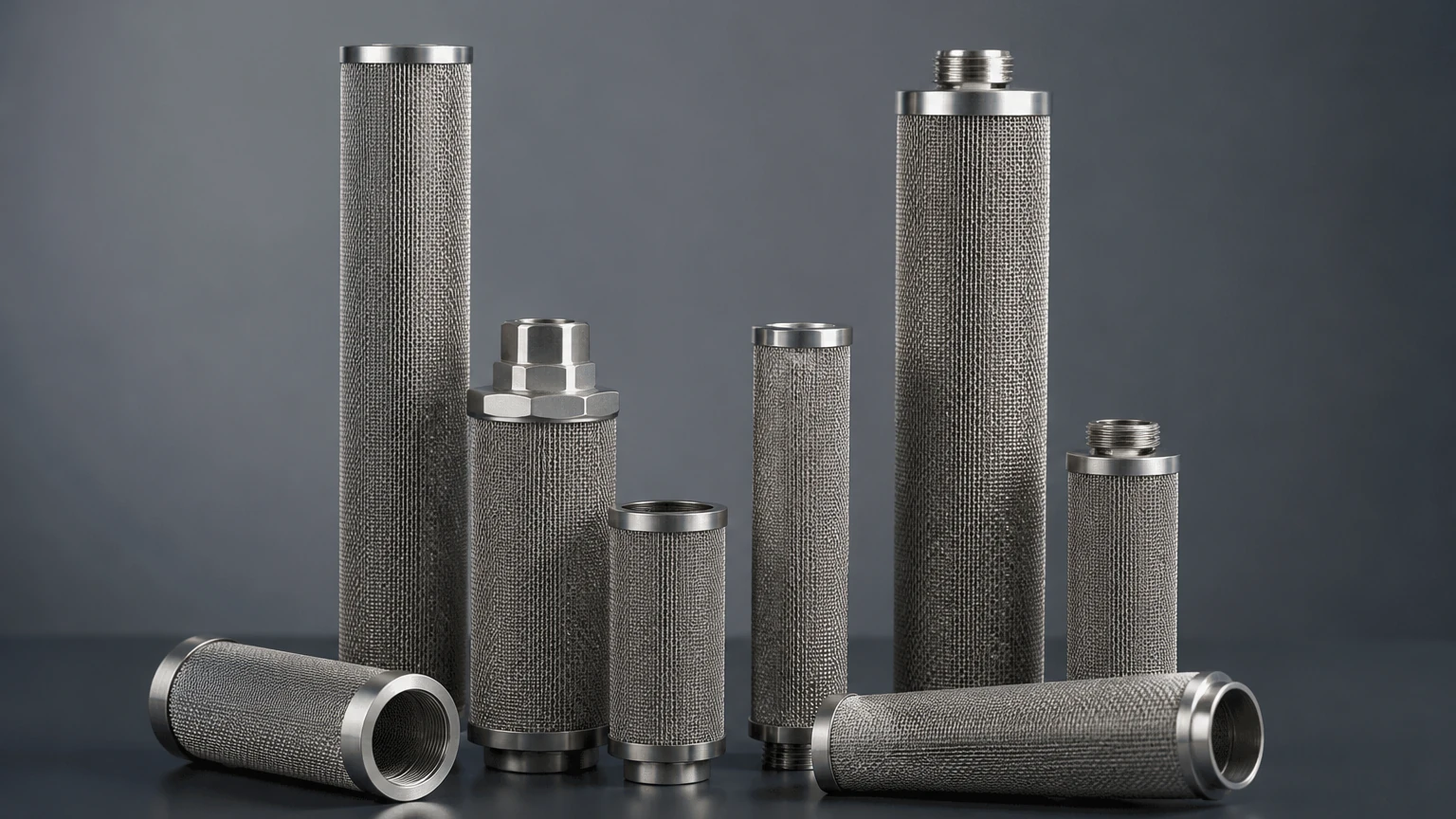
* Cylindrical Cartridges: These consist of a single or multi-layer mesh wrapped around a perforated support core. They are easier to clean and are ideal for high-viscosity fluids where cake buildup is expected.
* Pleated Cartridges: By pleating the mesh, the effective filtration surface area is increased by 2 to 4 times compared to a cylindrical design of the same dimensions. This results in lower flux rates, lower initial pressure drop, and higher dirt-holding capacity, extending the time between cleaning cycles.
Reinforcement and Support
To prevent the fine filtration mesh from collapsing under pressure, it is often sandwiched between coarser support meshes. This multi-layer construction provides mechanical stability while maintaining the precision of the inner filtration layer. For high-pressure hydraulic applications, a heavy-duty inner core and outer shroud are added to protect the mesh from pressure surges.
End Cap Configurations
Compatibility with existing filter housings is achieved through various end cap designs. Common standards include:
* DOE (Double Open End): Requires flat gaskets at both ends.
* SOE (Single Open End) with Code 7: Features a 226 locking tab and a fin end, ensuring a high-integrity seal for critical applications.
* Code 3 (222 O-ring): A common standard for industrial housings requiring a secure double O-ring seal.
Applications Across Demanding Industries
The versatility of the stainless steel mesh filter cartridge makes it a staple in sectors where process reliability is non-negotiable.
Chemical and Petrochemical Processing
In these environments, filters must handle aggressive solvents and high-temperature catalysts. Stainless steel cartridges are used for monomer filtration, catalyst recovery, and the removal of impurities from corrosive chemical intermediates.
Food and Beverage Production
Compliance with FDA and EU food contact regulations is vital. Stainless steel mesh is naturally non-shedding and can be passivated to ensure it does not impart metallic tastes or contaminants into the product. Common uses include the filtration of edible oils, beverage syrups, and culinary steam.
Pharmaceutical and Biotechnology
For sterile air filtration and the removal of particulates from active pharmaceutical ingredients (APIs), the cleanability of stainless steel is a major asset. These cartridges can be sterilized in place (SIP) using high-pressure steam without degrading the filter medium.
Hydraulic and Lube Oil Systems
High-pressure hydraulic systems require filters that can withstand rapid pressure fluctuations and protect sensitive valves from metal wear particles. Stainless steel mesh provides the necessary fatigue resistance and high-collapse pressure ratings required for these systems.
Maintenance, Cleaning, and Total Cost of Ownership (TCO)
While the initial purchase price of a stainless steel mesh filter cartridge is higher than that of a disposable polypropylene or glass fiber cartridge, the Total Cost of Ownership (TCO) is often significantly lower due to its reusability.
Cleaning Methodologies
The ability to regenerate the filter medium is the cornerstone of its value proposition. Common cleaning methods include:
* Backwashing: Reversing the flow of the fluid to dislodge surface contaminants. This is often automated in continuous process systems.
* Ultrasonic Cleaning: Using high-frequency sound waves in a cleaning solvent to remove fine particles trapped deep within the mesh pores.
* Chemical Cleaning: Using surfactants, acids, or alkalis to dissolve organic or inorganic scaling.
* Burn-off (Pyrolysis): For polymer applications, the cartridge can be heated in a vacuum oven to carbonize organic buildup, which is then removed via ultrasonic cleaning.
Longevity and Waste Reduction
A well-maintained stainless steel cartridge can last for several years. This reduces the frequency of procurement cycles and significantly lowers the environmental impact by eliminating the waste stream associated with frequent disposable filter changes.
Procurement Considerations for Engineers
Before finalizing a purchase order for a stainless steel mesh filter cartridge, technical teams should confirm several factors with the manufacturer to ensure the component is fit for purpose.
1. Operating Pressure and Temperature: Specify both the normal operating conditions and the maximum potential excursions.
2. Fluid Characteristics: Provide data on viscosity, density, and chemical composition. High-viscosity fluids may require a larger surface area (pleated design) to maintain acceptable flow rates.
3. Contaminant Profile: Understanding the nature of the solids (hard, soft, fibrous, or gelatinous) helps in selecting the correct weave and micron rating.
4. Cleaning Infrastructure: Ensure that the facility has the equipment (ultrasonic baths or backwash valves) necessary to maintain the cartridges.
5. Certification Requirements: For regulated industries, confirm that the manufacturer provides material certificates (MTRs) and compliance documentation for food or medical standards.
By focusing on these technical parameters, engineers can ensure that they select a filtration solution that provides consistent performance and long-term reliability. For detailed specifications on custom dimensions and material options, visiting the Main Page of an experienced manufacturer like Kaifil provides the necessary technical data to support informed decision-making in industrial filtration projects.
