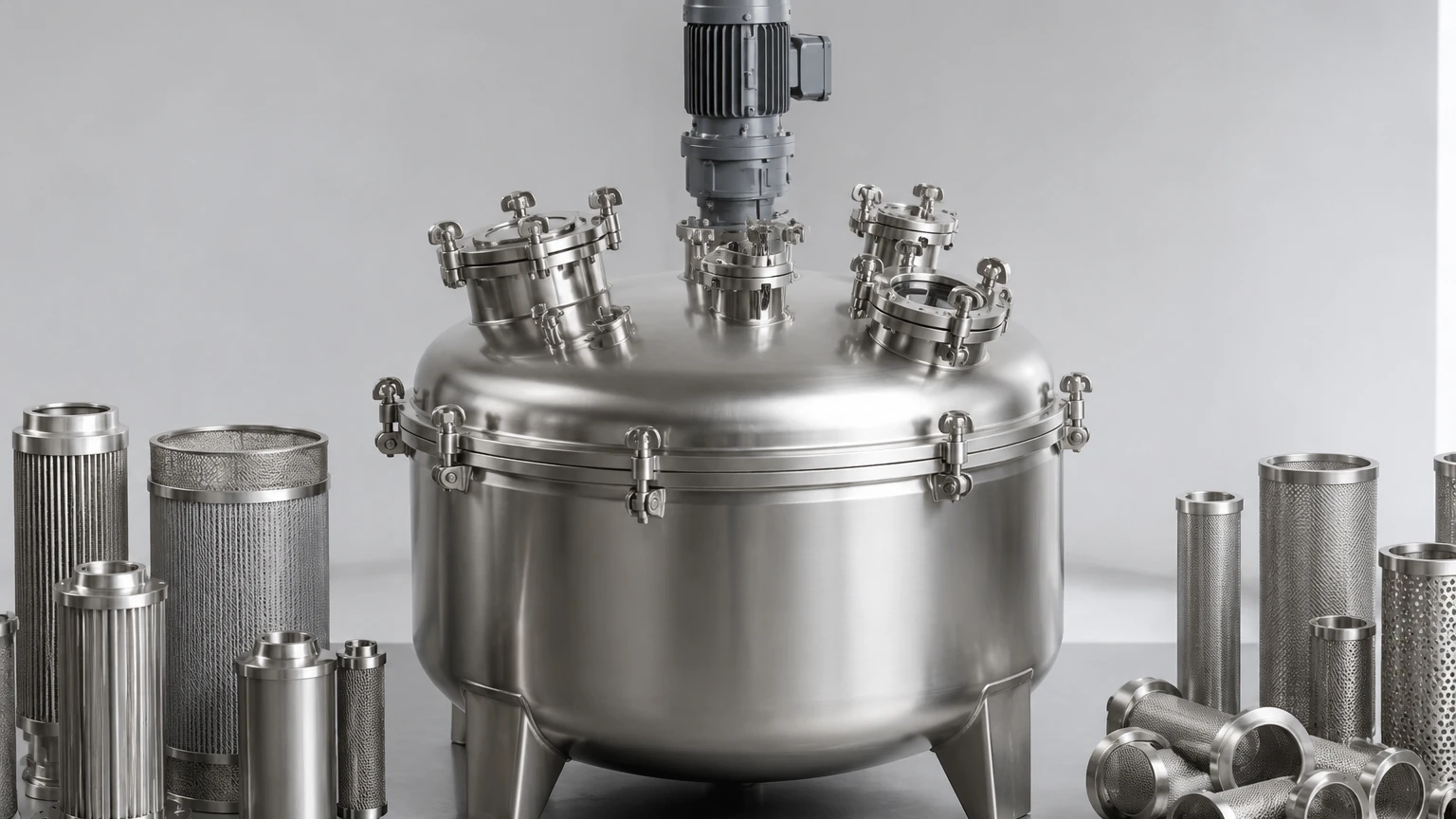
Stainless Steel Reactor
In the landscape of industrial processing, the stainless steel reactor serves as a fundamental vessel for chemical synthesis, polymerization, distillation, and mixing. These units are engineered to withstand rigorous thermal and mechanical stresses while maintaining the purity of the medium. For engineers and procurement specialists, selecting or designing a reactor system involves a complex evaluation of metallurgy, pressure vessel standards, and integrated filtration requirements. Because these reactors often handle corrosive substances or high-purity pharmaceutical ingredients, the choice of materials and the quality of internal components—particularly filtration elements—directly impact the efficiency and safety of the production cycle.
The Engineering Foundation of Stainless Steel Reactors
A stainless steel reactor is more than just a storage tank; it is a controlled environment designed to facilitate specific physical or chemical changes. The construction typically involves high-grade alloys, with Type 304 and Type 316L being the most prevalent. Type 316L is frequently specified for its superior resistance to chloride-induced pitting and its ability to withstand organic acids and high temperatures, making it the standard for pharmaceutical and fine chemical applications.
From an engineering perspective, the reactor's design must account for:
* Pressure and Vacuum Ratings: Reactors must be designed to handle internal pressures generated during exothermic reactions or the vacuum required for solvent recovery. This involves precise calculations of wall thickness and reinforcement around nozzles and manways.
* Thermal Management: Most reactors utilize a jacketed design (dimple jacket, half-pipe coil, or conventional jacket) to circulate heating or cooling media. The efficiency of heat transfer is critical for maintaining reaction kinetics and preventing thermal runaway.
* Agitation Systems: The choice of impeller—whether anchor, turbine, or propeller—depends on the viscosity of the fluid and the need for gas dispersion or solid suspension. The seal assembly, often a mechanical seal, is a critical point of failure that must be engineered for long-term reliability.
The Critical Role of Filtration in Reactor Operations
While the vessel itself provides the environment for the reaction, the success of the process often depends on what happens during and after the reaction. This is where high-performance filtration components become indispensable. In a stainless steel reactor setup, filtration serves several technical functions:
1. Catalyst Recovery: Many chemical processes rely on expensive precious metal catalysts. Integrated filtration systems allow for the retention and recovery of these catalysts within the reactor or during discharge, preventing loss and reducing operating costs.
2. Product Purification: Removing impurities or unreacted solids is essential for meeting the stringent quality standards of the pharmaceutical and food industries. Sintered metal filters or wire mesh cartridges are often employed to achieve precise micron-level separation.
3. Vent Filtration: During the charging or discharging of the reactor, or during heating cycles, gas must be vented. Vent filters prevent the escape of hazardous vapors and protect the reactor contents from atmospheric contamination.
4. Downstream Protection: Filtration at the reactor outlet ensures that no particulate matter enters heat exchangers, pumps, or sensitive analytical equipment located further down the production line.
Material Selection for Filtration Components
When integrating filtration into a stainless steel reactor, the material of the filter must match or exceed the specifications of the reactor vessel. Using a lower-grade filter in a high-grade reactor creates a localized point of vulnerability.
Stainless Steel Wire Mesh: For general-purpose filtration, multi-layer wire mesh provides a balance of permeability and mechanical strength. It is highly customizable, allowing engineers to specify weave types (such as plain, twill, or dutch weave) based on the required flow rate and particle retention.
Sintered Metal Filters: In high-pressure or high-temperature reactor environments, sintered metal filter elements are preferred. These are created by fusing layers of wire mesh or metal powder under heat and pressure, resulting in a porous structure that is extremely rigid and resistant to thermal shock. These components can withstand the aggressive cleaning cycles (CIP/SIP) common in sterile manufacturing.
Customization and OEM Integration
Standard off-the-shelf filtration products rarely meet the specific needs of a custom-designed stainless steel reactor. Engineering teams must often collaborate with specialized manufacturers like Kaifil to develop bespoke solutions. Customization options typically include:
* Geometric Adaptation: Filters must be designed to fit specific nozzle sizes, dip tubes, or internal housings without creating dead zones where product can accumulate and degrade.
* Micron Rating Precision: Depending on the molecular weight of the product or the size of the catalyst, filtration accuracy may need to range from sub-micron levels to several hundred microns.
* Surface Finishes: In the pharmaceutical industry, the surface roughness (Ra) of all wetted parts, including filter housings and mesh, must be minimized to prevent bacterial growth and facilitate cleaning.
For those looking to optimize their reactor systems, you can Review product options and application support on the Kaifil Main Page to understand how custom metal filtration components can be tailored to specific industrial requirements.
Evaluating Performance and Total Cost of Ownership
When specifying a stainless steel reactor and its associated filtration system, the initial purchase price is only one part of the equation. Engineers must consider the Total Cost of Ownership (TCO), which includes maintenance, replacement cycles, and energy consumption.
* Pressure Drop: A poorly designed filter will cause a significant pressure drop, forcing pumps to work harder and increasing energy costs. High-porosity wire mesh designs help maintain flow rates while achieving the necessary filtration depth.
* Cleanability: Permanent stainless steel filters, unlike disposable cartridges, can be cleaned and reused. The ability to backwash or ultrasonically clean a filter element extends its service life and reduces the waste stream, which is a significant factor in large-scale chemical processing.
* Durability: In a reactor that operates 24/7, the mechanical fatigue of filter components due to pressure fluctuations or vibration from the agitator can lead to failure. Choosing high-strength sintered materials reduces the risk of unplanned downtime.
Common Risks and Mitigation Strategies
Operating a stainless steel reactor involves inherent risks, particularly when dealing with high-pressure or volatile substances. Filtration-related risks include filter blinding (clogging), which can lead to over-pressurization of the vessel. To mitigate this, systems should be equipped with differential pressure sensors that alert operators when a filter needs cleaning or replacement.
Another risk is chemical incompatibility. While stainless steel is highly resistant, certain concentrated acids or high-temperature halogenated compounds can cause stress corrosion cracking. It is vital to confirm that both the reactor lining and the internal filtration mesh are compatible with the entire range of chemicals used in the process, including cleaning agents.
Industry-Specific Requirements
The application of a stainless steel reactor varies significantly across sectors, dictating the filtration strategy:
* Pharmaceuticals: Requires high-grade 316L or even exotic alloys like Hastelloy. Filtration must be absolute and capable of sterilization. The focus is on preventing cross-contamination between batches.
* Food and Beverage: Focuses on sanitary design. Filters must be easily removable for inspection and comply with FDA or EHEDG standards.
* Chemical Processing: Often involves high-volume throughput and aggressive catalysts. Here, the durability of the wire mesh and the ability to handle high solids loading are the primary concerns.
Conclusion
The integration of a stainless steel reactor into a production line is a significant capital investment that requires careful technical planning. By focusing on the synergy between the vessel's design and its internal filtration components, engineers can ensure a process that is not only productive but also sustainable and safe. High-quality stainless steel filtration, tailored to the specific demands of the reaction environment, remains a cornerstone of modern industrial engineering. For more detailed technical specifications and to explore custom filtration solutions for your reactor projects, visit the Kaifil Main Page.