


Filtration in Water Treatment Plant
Filtration serves as a critical mechanical process within a water treatment plant, designed to remove suspended solids, particulate matter, and biological contaminants from raw water sources. In industrial and municipal settings, the efficiency of the filtration system directly impacts the longevity of downstream equipment, such as reverse osmosis (RO) membranes, high-pressure pumps, and heat exchangers. For engineers and procurement specialists, understanding the technical nuances of filtration in water treatment plant operations is essential for optimizing system performance and controlling operational costs.
Industrial water treatment typically involves a multi-stage approach where filtration acts as both a primary barrier and a secondary polishing step. The selection of filtration media—ranging from traditional sand beds to advanced stainless steel wire mesh and sintered metal cartridges—depends on the specific water chemistry, the required micron rating, and the volume of water being processed.
The Fundamental Role of Filtration in Water Treatment Plant Operations
In a standard water treatment plant, filtration is tasked with the removal of physical impurities that cannot be eliminated by sedimentation or coagulation alone. These impurities include silt, clay, organic matter, and microorganisms. The process is generally categorized into several stages:
1. Pre-filtration (Intake Protection): This stage utilizes coarse screens or strainers to remove large debris, such as leaves, twigs, and stones, protecting pumps and piping from mechanical damage.
2. Primary Filtration: Often involving multi-media filters or coarse wire mesh, this stage targets particles in the 50 to 100-micron range.
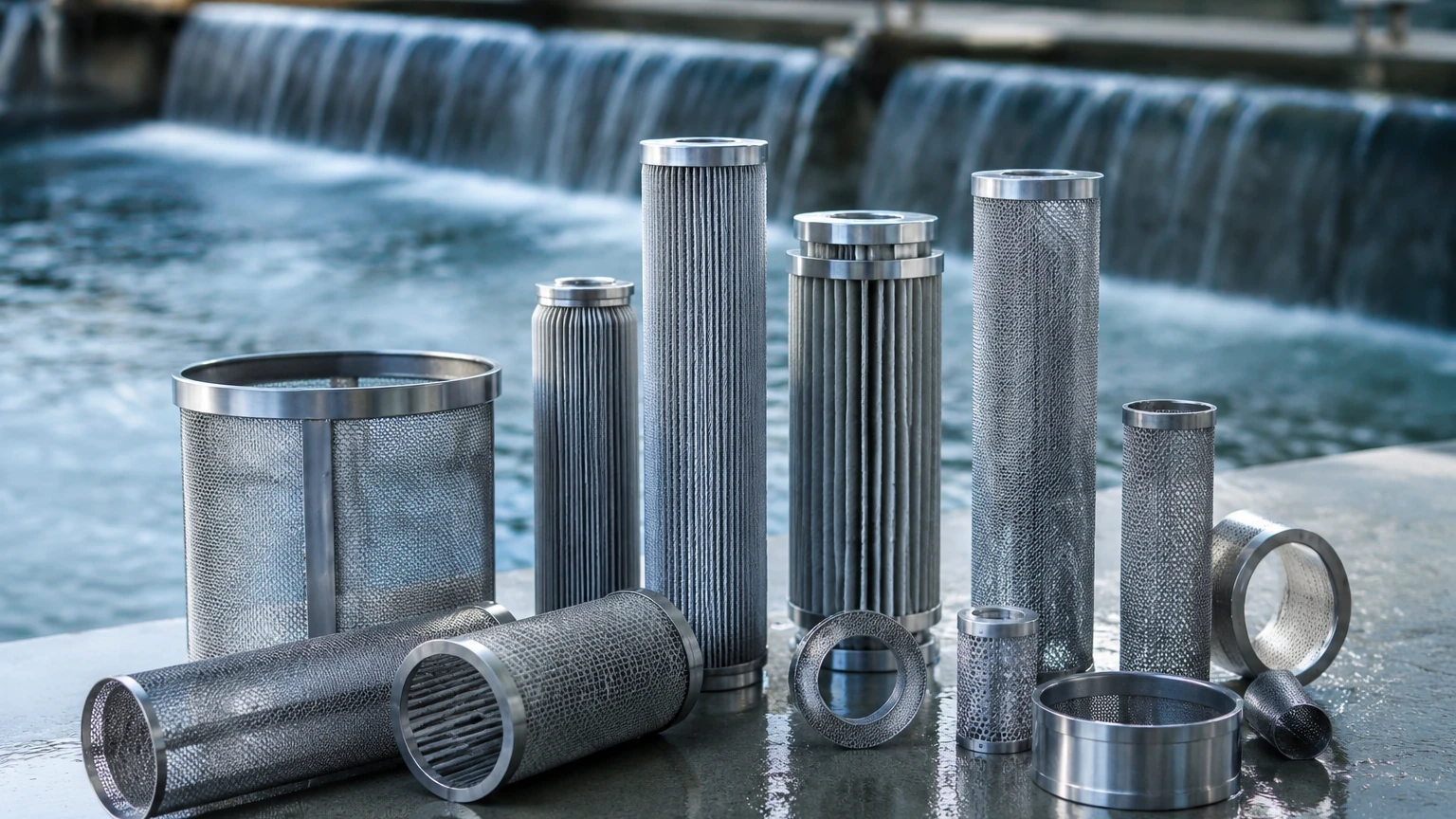
3. Secondary and Fine Filtration: This is where precision components, such as stainless steel filter cartridges, are employed to achieve filtration levels down to 1-5 microns. This stage is crucial for protecting sensitive equipment like RO units from fouling.
4. Polishing: The final stage of filtration ensures the water meets specific purity standards for industrial processes, pharmaceutical production, or food and beverage manufacturing.
Effective filtration in water treatment plant design ensures that the turbidity of the effluent remains within permissible limits, thereby reducing the chemical demand for disinfection and preventing the buildup of scale and biofilm in distribution networks.
Technical Comparison: Surface vs. Depth Filtration
When selecting filtration components, engineers must distinguish between surface filtration and depth filtration, as each serves a distinct purpose in the water treatment lifecycle.
Surface Filtration
Surface filtration occurs when particles are trapped on the surface of the filter medium. Stainless steel wire mesh is the primary example of a surface filter. The pore size is precisely controlled by the weave pattern (e.g., plain weave, twill weave, or Dutch weave). Surface filters are ideal for applications with a high concentration of uniform particles and are often preferred in water treatment plants because they can be cleaned via backwashing or ultrasonic methods, offering a longer service life compared to disposable alternatives.
Depth Filtration
Depth filtration involves a thick medium, such as sintered metal or multi-layered mesh, where particles are trapped within the tortuous paths of the material. This method is highly effective for removing a wide range of particle sizes and provides a higher dirt-holding capacity. In a water treatment plant, depth filters are frequently used as secondary filters to capture finer contaminants that bypass primary surface strainers.
Engineering Considerations for Material Selection
The choice of material for filtration components is a primary factor in the total cost of ownership (TCO). While polymer-based filters are common in low-pressure, ambient-temperature applications, industrial water treatment often demands the durability of stainless steel.
Stainless Steel 304 vs. 316L
Stainless steel is the industry standard for high-performance filtration due to its mechanical strength and resistance to corrosion.
* Type 304: Suitable for general water treatment applications where the water is relatively non-corrosive.
* Type 316L: Contains molybdenum, which provides superior resistance to chlorides and pitting. This is the preferred material for filtration in water treatment plant environments dealing with brackish water, seawater desalination, or high-chlorine disinfection processes.
Advantages of Metal Filtration Components
Unlike plastic or fabric media, stainless steel filter cartridges and wire mesh filters can withstand significant pressure differentials without deforming. They are also compatible with high-temperature sterilization (SIP) and chemical cleaning (CIP) protocols, which are essential in the pharmaceutical and food and beverage sectors. For a detailed look at specific material grades and configurations, you can visit the Main Page of our technical catalog.
Evaluating Micron Ratings and Flow Rates
One of the most common challenges in designing filtration in water treatment plant systems is balancing the micron rating with the required flow rate.
Absolute vs. Nominal Micron Ratings
* Nominal Rating: Refers to the ability of the filter to retain a major percentage (usually 60-90%) of particles of a specific size. This is often used for pre-filtration.
* Absolute Rating: Refers to the diameter of the largest hard spherical particle that will pass through the filter under specified test conditions. In critical water treatment stages, absolute-rated filters are necessary to ensure consistent water quality.
Pressure Drop (ΔP)
As a filter accumulates debris, the pressure drop across the medium increases. Engineers must calculate the "clean pressure drop" to ensure the system pump can handle the resistance. A high initial pressure drop limits the effective service life of the filter before cleaning or replacement is required. Optimizing the surface area of the filter—often achieved through pleated designs—can significantly lower the pressure drop and increase flow capacity.
Maintenance and Operational Efficiency
Maintenance cycles are a significant component of the operational expenditure (OPEX) in any water treatment facility. The ability to clean and reuse filtration components is a major advantage of stainless steel media.
Backwashing and Cleaning
In many water treatment plants, automated backwashing systems are employed. When the differential pressure reaches a pre-set limit, the flow is reversed, dislodging the accumulated "filter cake" from the surface of the wire mesh. If the contaminants are particularly adhesive, chemical cleaning or ultrasonic baths may be required to restore the filter’s original permeability.
Replacement Cycles
While stainless steel filters are durable, they are not infinite. Factors that influence replacement cycles include:
* Mechanical Fatigue: Repeated pressure surges can eventually lead to wire breakage or seam failure.
* Chemical Degradation: Exposure to highly acidic or basic cleaning agents over several years can thin the metal fibers.
* Irreversible Fouling: In some cases, sub-micron particles can become embedded deep within sintered structures, making them impossible to remove.
Monitoring the rate of pressure increase after each cleaning cycle allows plant operators to predict when a filter cartridge has reached the end of its functional life.
Customization and OEM Solutions in Water Treatment
No two water treatment plants are identical. Variations in source water quality, space constraints, and specific effluent requirements often necessitate customized filtration solutions. Customization can involve:
* Custom Dimensions: Tailoring the length, diameter, and end-cap configuration of filter cartridges to fit existing housings.
* Reinforced Structures: Adding internal support cores or external cages to handle high-pressure hydraulic shocks.
* Multi-Stage Integration: Combining different mesh counts into a single sintered component to provide graduated filtration in a compact footprint.
For manufacturers like Kaifil, providing OEM solutions involves working closely with plant engineers to analyze water samples and system schematics, ensuring the filtration hardware is perfectly aligned with the operational goals of the facility.
Addressing Common Risks in Industrial Filtration
Failure to properly specify filtration components can lead to several risks within a water treatment plant:
1. Bypass Leakage: If the filter seal or end-cap is not properly designed, contaminated water can bypass the filter media entirely. Using high-quality gaskets (EPDM, Viton, or PTFE) and precision-machined fittings is essential.
2. Media Migration: In lower-quality filters, fibers or particles of the filter media itself can break off and enter the effluent stream. Sintered stainless steel is particularly resistant to this, as the metal fibers are fused together at a molecular level.
3. Corrosion Pitting: In seawater applications, the use of inadequate material grades can lead to rapid pitting, resulting in holes that compromise the micron rating.
By conducting a thorough risk assessment during the procurement phase, engineers can select filtration solutions that mitigate these issues, ensuring long-term reliability.
Conclusion: Optimizing the Total Cost of Ownership
Filtration in water treatment plant design is not merely about removing particles; it is about doing so in a way that is sustainable, cost-effective, and reliable. While the initial investment in stainless steel filtration components may be higher than disposable alternatives, the reduction in replacement frequency, the ability to clean the media, and the superior protection provided to downstream equipment result in a lower total cost of ownership over the life of the plant.
When evaluating filtration options, technical professionals should confirm the chemical compatibility of the media, the absolute micron rating required for their specific process, and the structural integrity of the filter under peak load conditions. For more information on high-performance metal filtration components and customized engineering support, please visit the Main Page to explore our full range of solutions.
