


Stainless Steel Sparger
In industrial process engineering, the efficient introduction of gas into a liquid medium is a critical requirement for various chemical, biological, and mechanical operations. A stainless steel sparger serves as the primary component for achieving this gas-liquid mass transfer. By utilizing porous metal technology, these components transform a bulk gas stream into thousands of discrete, fine bubbles, significantly increasing the interfacial surface area between the two phases.
For engineers and procurement teams, selecting the correct sparging solution involves understanding the fluid dynamics, material compatibility, and structural requirements of the specific application. As a specialized manufacturer, Kaifil provides precision-engineered filtration and sparging components designed to meet the rigorous demands of industrial environments. This article explores the technical considerations, design parameters, and application-specific requirements for industrial stainless steel spargers.
The Engineering Principles of Gas Sparging
Gas sparging is governed by the principles of mass transfer. The rate at which a gas dissolves into a liquid is directly proportional to the total surface area of the gas bubbles. A standard open-pipe injector produces large, buoyant bubbles that rise rapidly to the surface, resulting in low residence time and poor absorption efficiency. In contrast, a porous stainless steel sparger creates a "bubble curtain" of micro-bubbles.
Bubble Dynamics and Surface Area
When gas is forced through the microscopic pores of a sintered stainless steel element, the resulting bubbles are typically in the range of 10 to 100 microns, depending on the pore size and liquid velocity. Because the surface-area-to-volume ratio of a sphere increases as its diameter decreases, a fine-pore sparger can provide hundreds of times more contact area than a traditional drilled pipe for the same volume of gas. This efficiency is vital in processes such as fermentation, where dissolved oxygen levels must be maintained within narrow margins to support microbial growth.
Pressure Drop and Flow Control
Operating a sparger requires overcoming the "bubble point" pressure—the minimum pressure needed to force gas through the liquid-saturated pores. Once this threshold is met, the flow rate is determined by the differential pressure across the porous media. Engineers must calculate the pressure drop to ensure the gas delivery system can maintain the required flow without exceeding the mechanical limits of the sparger or the vessel.
Material Selection and Structural Integrity
Stainless steel is the industry standard for sparging components due to its mechanical strength, thermal stability, and corrosion resistance. In most industrial settings, Type 316L stainless steel is preferred over Type 304 due to its superior resistance to pitting and crevice corrosion, particularly in environments containing chlorides or acidic process fluids.
Sintered Metal Technology
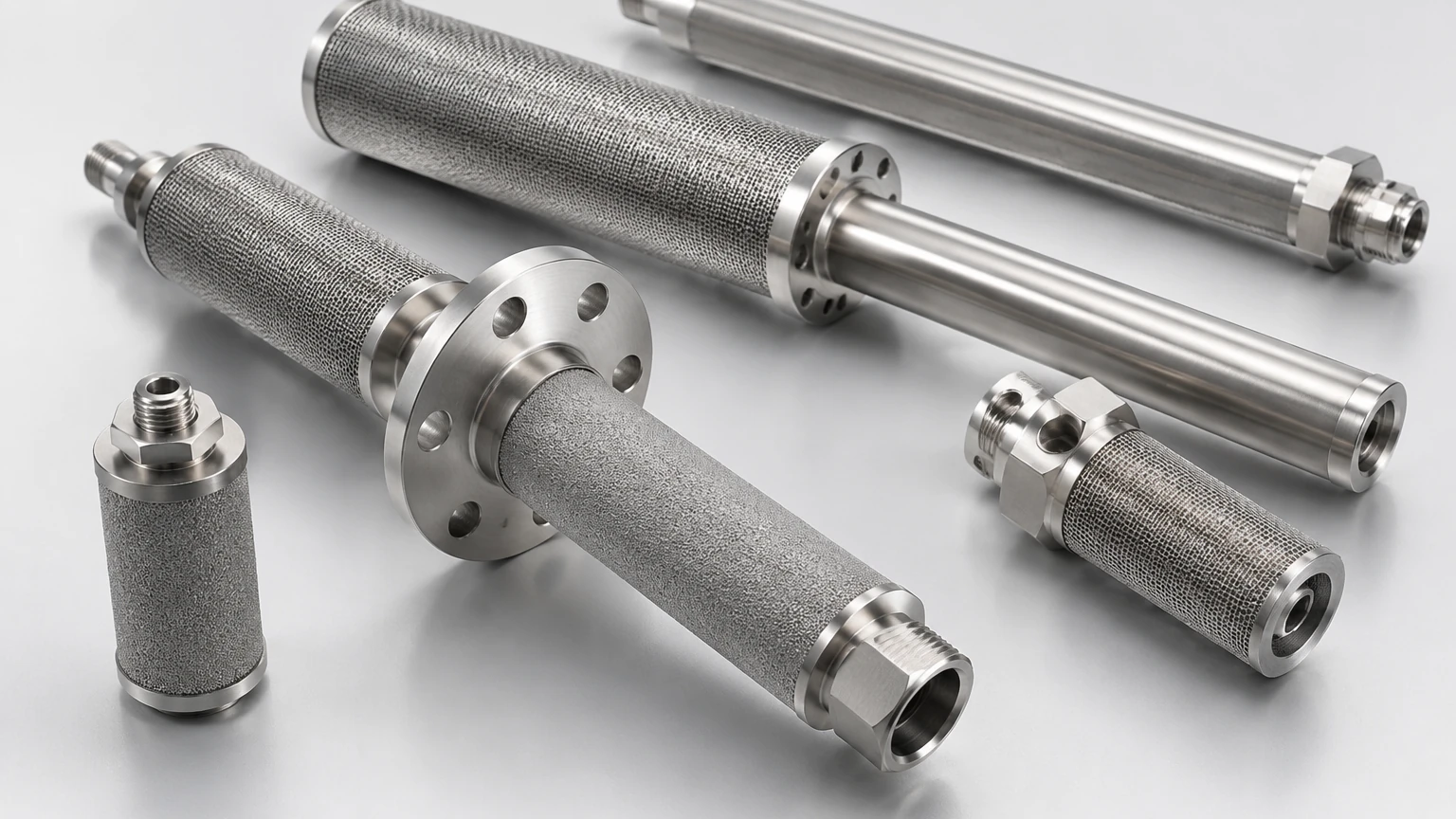
The performance of a stainless steel sparger is largely determined by the manufacturing process of the porous element. Sintered metal spargers are produced by compacting stainless steel powder or fine wire mesh and heating it in a controlled-atmosphere furnace. This process bonds the metal particles at their contact points without melting them, creating a rigid, porous structure with highly uniform pore distribution. This uniformity is essential for preventing "channeling," where gas escapes through a few large openings rather than across the entire surface of the sparger.
Temperature and Pressure Resilience
Unlike polymer-based diffusers, stainless steel components can operate at temperatures exceeding 400°C (750°F) and withstand high differential pressures. This makes them suitable for high-pressure reactors and steam-sterilizable environments common in the pharmaceutical and biotechnology sectors.
Key Performance Metrics: Pore Size and Bubble Dynamics
Selecting the appropriate pore size is the most critical decision in sparger design. While smaller pores produce smaller bubbles and better mass transfer, they also result in higher pressure drops and a greater susceptibility to fouling.
1. Fine Pore Sizes (0.5 to 10 Microns): Used for applications requiring maximum gas absorption, such as carbonation in the beverage industry or oxygenation in bioreactors. These require clean gas streams to prevent internal clogging.
2. Medium Pore Sizes (10 to 40 Microns): Often used in general industrial mixing, pH adjustment (CO2 injection), and stripping operations where a balance between efficiency and flow volume is required.
3. Coarse Pore Sizes (40 to 100+ Microns): Suitable for high-viscosity liquids or applications where the primary goal is agitation or gas stripping rather than total dissolution.
Engineers must also consider the "exit velocity" of the gas. If the velocity is too high, small bubbles may coalesce into larger ones immediately upon leaving the sparger surface, negating the benefits of the fine-pore structure.
Industrial Applications of Stainless Steel Spargers
The versatility of the stainless steel sparger allows it to be integrated into a wide range of industrial processes. Each application presents unique challenges regarding hygiene, chemical reactivity, and maintenance.
Biotechnology and Pharmaceuticals
In bioreactors and fermenters, spargers are used to deliver oxygen to cell cultures and remove metabolic byproducts like carbon dioxide. These components must be manufactured to high sanitary standards, often requiring electro-polished surfaces and the ability to withstand repeated Steam-in-Place (SIP) sterilization cycles. The precision of the pore structure ensures that oxygen transfer rates (OTR) are consistent across production batches.
Food and Beverage Processing
Carbonation and nitrogenation are primary uses in this sector. For example, in the brewing industry, a stainless steel sparger is used to inject CO2 into finished beer. The fine bubbles ensure the gas is quickly and uniformly absorbed, maintaining the desired carbonation level without causing excessive foaming or agitation that could degrade the product.
Chemical Processing and Refining
Spargers are used in hydrogenation, oxidation, and stripping operations. In these environments, the sparger must often withstand aggressive solvents and high temperatures. Sintered metal spargers are frequently used to inject steam for direct heating or to strip volatile organic compounds (VOCs) from process streams.
Water and Wastewater Treatment
Ozone injection for disinfection and air sparging for volatile contaminant removal are common in water treatment. The durability of stainless steel is essential here, as the components are often submerged in large tanks where maintenance access is limited and the environment may be mildly corrosive.
Design and Customization for Specific Process Requirements
Industrial filtration and sparging are rarely "one-size-fits-all" solutions. Effective gas-liquid contact often requires custom geometry to fit specific vessel dimensions and flow patterns. As a professional manufacturer, Kaifil specializes in providing customized filtration and sparging solutions that align with specific engineering drawings and performance targets.
Configuration Options
* Static Spargers: These are fixed in place, often at the bottom of a tank or integrated into a pipe (in-line spargers). In-line spargers are particularly effective for continuous flow processes where gas is injected directly into a moving liquid stream.
* Dynamic/Agitated Spargers: In some reactor designs, the sparger is mounted near an impeller to use mechanical shear to further break down bubbles and enhance distribution.
* Manifold Systems: For large-scale tanks, multiple sparger elements may be arranged on a manifold to ensure even gas distribution across the entire cross-section of the vessel.
Connection Types
To ensure seamless integration into existing piping systems, spargers can be manufactured with various fittings, including NPT or BSP threaded connections, flange mounts, or sanitary Tri-clamp fittings. The choice of connection often depends on the required pressure rating and the frequency of removal for cleaning.
Maintenance, Cleaning, and Longevity
While a stainless steel sparger is highly durable, its porous nature makes it susceptible to fouling over time. Fouling can occur from particulate matter in the gas stream (internal fouling) or from solids and biological growth in the liquid (external fouling).
Cleaning Protocols
* Clean-in-Place (CIP): Many systems allow for chemical cleaning without removing the sparger. This involves circulating caustic or acidic cleaning agents through the system to dissolve organic or mineral deposits.
* Backwashing: Forcing liquid or gas in the reverse direction through the sparger can help dislodge particles trapped on the surface or within the pores.
* Ultrasonic Cleaning: For severe fouling, the sparger element can be removed and placed in an ultrasonic bath. This is the most effective method for restoring the original permeability of sintered metal components.
Preventing Contamination
To maximize the lifespan of the sparger, the gas supply should be filtered to remove oil, moisture, and particulates. Using a high-quality stainless steel filter upstream can prevent internal clogging of the sparger’s micro-pores, significantly extending the time between maintenance cycles.
Factors to Consider Before Procurement
Before initiating a purchase or a custom design project, engineers and purchasing teams should confirm several technical parameters to ensure the sparger will perform as expected. This data allows manufacturers to recommend the optimal material and pore structure.
* Gas and Liquid Properties: Identify the chemical composition, viscosity, and density of both phases. This determines material compatibility and bubble formation characteristics.
* Flow Rates: Specify the minimum and maximum gas flow rates (e.g., SCFM or SLPM). This is used to calculate the required surface area and pore size.
* Operating Environment: Define the operating temperature and pressure, as well as any cleaning chemicals that will be used.
* Vessel Geometry: Provide the dimensions of the tank or pipe where the sparger will be installed to ensure proper bubble distribution and avoid "dead zones."
* Desired Outcome: Is the goal complete gas dissolution, a specific dissolved oxygen level, or simple agitation?
By addressing these factors early in the design phase, organizations can avoid costly retrofits and ensure their filtration and sparging systems operate at peak efficiency. For detailed technical specifications and to explore custom manufacturing capabilities for your specific application, you can visit the Main Page of Kaifil’s website to review product options and application support.
Conclusion
The stainless steel sparger is an essential tool for achieving high-efficiency gas-liquid mass transfer in demanding industrial sectors. Whether the application involves delicate biological cultures in a bioreactor or aggressive chemical reactions in a refinery, the choice of a sintered metal sparger provides the mechanical strength and precision required for consistent performance. By understanding the relationship between pore size, bubble dynamics, and material properties, engineering teams can select a solution that optimizes process yields while minimizing energy consumption and maintenance downtime. Working with an experienced manufacturer like Kaifil ensures that these critical components are designed and produced to the highest technical standards, providing reliable service in the most challenging environments.
