


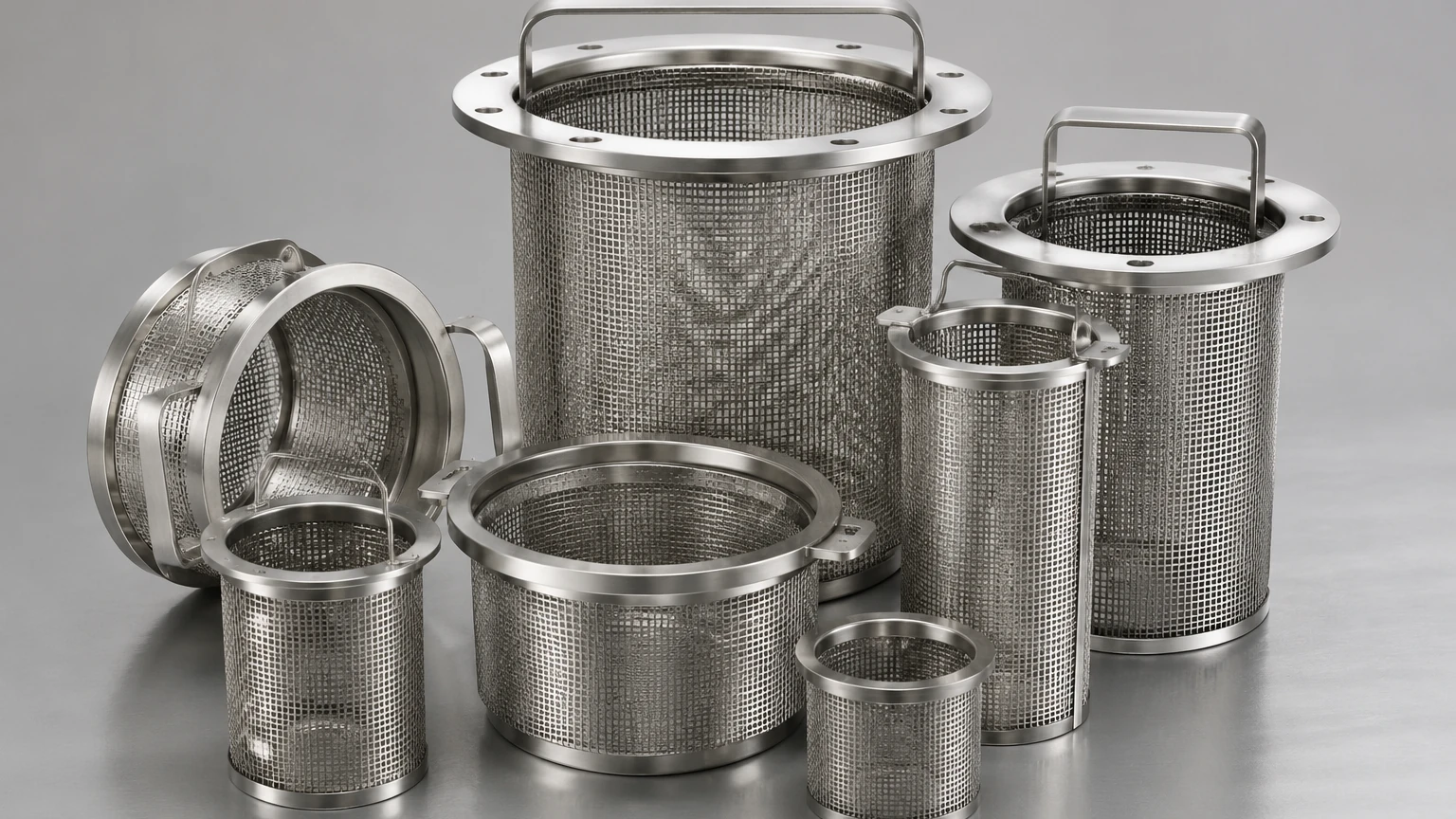
Stainless Steel Strainer Basket Industrial
In industrial fluid handling and processing, the integrity of downstream equipment such as pumps, heat exchangers, valves, and spray nozzles depends heavily on the efficiency of mechanical separation. The stainless steel strainer basket industrial standard represents a critical component in these systems, designed to remove unwanted solids from liquids, gases, or steam. Unlike disposable filter elements, these baskets are engineered for durability, high flow capacity, and reusability, making them a cornerstone of cost-effective industrial filtration.
Selecting the appropriate strainer basket requires a deep understanding of material science, fluid dynamics, and mechanical engineering. This guide explores the technical specifications, design considerations, and application-specific requirements that engineers and procurement teams must evaluate when sourcing industrial-grade stainless steel strainer baskets.
Engineering Fundamentals of Industrial Strainer Baskets
The primary function of an industrial strainer basket is to provide a high-surface-area barrier that captures particulates while allowing the fluid to pass through with minimal resistance. In a typical basket strainer housing, the fluid enters the top or side of the basket, flows through the mesh or perforated walls, and exits through the bottom or side, leaving the debris trapped inside the basket for easy removal.
Straining vs. Filtration
While the terms are often used interchangeably, "straining" typically refers to the removal of larger particles (usually 40 microns and above) using a rigid metal medium. Industrial strainer baskets are designed for high-volume applications where the solid loading is significant. The use of stainless steel ensures that the basket can withstand the mechanical stresses of high flow rates and the potential impact of heavy debris without deforming or bypassing.
Structural Integrity and Pressure Differentials
An industrial strainer basket must be designed to withstand the maximum expected differential pressure (ΔP). As the basket collects debris, the open area decreases, leading to an increase in pressure drop. If the basket is not structurally reinforced, the pressure can cause the mesh to tear or the entire basket to collapse. Engineering specifications often include a "burst pressure" rating, which is the maximum pressure differential the basket can handle before mechanical failure occurs.
Material Properties and Chemical Compatibility
The choice of material is perhaps the most critical factor in ensuring the longevity of a stainless steel strainer basket industrial application. Stainless steel is preferred due to its inherent corrosion resistance, mechanical strength, and ability to withstand extreme temperatures.
Grade 304 vs. Grade 316 Stainless Steel
- Grade 304: The most common industrial stainless steel, containing approximately 18% chromium and 8% nickel. It offers excellent resistance to many atmospheric environments and fresh water. It is a cost-effective choice for general-purpose industrial applications where highly corrosive chemicals are not present.
- Grade 316: Contains an addition of 2% to 3% molybdenum, which significantly enhances its resistance to pitting and crevice corrosion, particularly in chloride-rich environments (such as seawater or de-icing salts) and acidic solutions. For chemical processing and marine applications, 316 is the industry standard.
- Grade 316L: A low-carbon version of 316, used primarily in applications involving extensive welding. The lower carbon content prevents carbide precipitation during the welding process, which maintains the corrosion resistance of the heat-affected zones.
Temperature and Chemical Resistance
Stainless steel maintains its structural integrity at temperatures ranging from cryogenic levels up to 800°F (427°C) or higher, depending on the specific alloy and pressure. When dealing with aggressive chemicals, engineers must consult compatibility charts to ensure the fluid will not cause stress corrosion cracking or general thinning of the metal. For a comprehensive look at material options and technical support for specific environments, engineers often refer to the Main Page of specialized manufacturers to evaluate custom alloy availability.
Structural Design: Perforated Metal vs. Wire Mesh
Industrial strainer baskets are rarely made of a single layer of material. Instead, they utilize a multi-layered construction to balance filtration precision with mechanical strength.
Perforated Support Cages
The outer structure of the basket is typically a "support cage" made from perforated stainless steel plate. This plate provides the necessary rigidity to resist the force of the fluid flow. Common perforation patterns include staggered round holes, which offer the best balance of open area and structural strength. The thickness of the perforated plate is determined by the diameter of the basket and the expected operating pressure.
Wire Mesh Linings
For finer filtration requirements, a woven wire mesh is lined inside the perforated cage. The mesh count (the number of openings per linear inch) determines the micron rating. In industrial settings, mesh can range from coarse 20-mesh (approx. 840 microns) to ultra-fine 400-mesh (approx. 37 microns). The mesh is typically spot-welded or seam-welded to the support cage to ensure it remains in place under flow conditions.
Open Area Ratio
A critical metric for engineers is the "Open Area Ratio." This is the ratio of the total area of the holes in the basket to the cross-sectional area of the inlet pipe. A high-quality industrial strainer basket typically offers an open area ratio of at least 6:1. A higher ratio means the strainer can operate longer between cleaning cycles and results in a lower initial pressure drop.
Customization Parameters for OEM Applications
Off-the-shelf strainer baskets often fail to meet the specific demands of specialized industrial machinery. Customization is frequently required to optimize performance and ensure a perfect fit within existing housings.
Dimensional Precision
Custom baskets can be manufactured to exact diameters and heights to ensure a tight seal within the strainer housing. This prevents "bypass," where fluid escapes around the edges of the basket without being filtered. Flange designs—such as slanted flanges, flat flanges, or O-ring groove flanges—are customized to match the seating surface of the housing.
Handle and Lifting Configurations
In large-scale industrial operations, the ease of maintenance is paramount. Baskets can be equipped with various handle types:
- Bail Handles: Traditional arched handles for manual removal.
- Slant Handles: Designed for housings with side-entry lids.
- Threaded Taps: Allowing for the attachment of specialized lifting tools for heavy, debris-laden baskets in large-bore piping systems.
Reinforced Bottoms and Pleating
For applications with high solids loading, the bottom of the basket can be reinforced with solid plate or additional bracing. Furthermore, if the required flow rate exceeds the capacity of a standard cylindrical basket, the mesh can be pleated. Pleating significantly increases the surface area within the same footprint, reducing the frequency of maintenance shutdowns.
Performance Metrics: Micron Rating and Flow Capacity
When specifying a stainless steel strainer basket industrial component, engineers must distinguish between nominal and absolute filtration ratings.
Nominal vs. Absolute Ratings
Most strainer baskets are rated nominally, meaning they will retain a majority of particles of a specific size. However, in critical applications—such as protecting high-pressure fuel injectors or pharmaceutical processing—an absolute rating may be required. This ensures that no particle larger than the specified micron size can pass through the medium. Achieving absolute ratings often requires specialized multi-layered sintered mesh, which bonds multiple layers of wire cloth into a single, rigid structure.
Calculating Flow Capacity
The flow capacity is influenced by the viscosity of the fluid, the specific gravity, and the percentage of open area. High-viscosity fluids (like heavy oils or syrups) require larger baskets or coarser mesh to maintain acceptable flow rates. Engineers use flow coefficient (Cv) values to calculate the pressure drop across the strainer. It is standard practice to size a strainer so that the initial clean pressure drop does not exceed 2 PSI (0.14 bar).
Maintenance and Operational Life Cycle
The durability of stainless steel is a major advantage, but the operational life of the basket depends on proper maintenance protocols.
Cleaning Procedures
Unlike disposable filters, industrial stainless steel baskets are designed for repeated cleaning. Common methods include:
- Manual Wash: Using high-pressure water or air to dislodge trapped particles from the outside in (back-flushing).
- Ultrasonic Cleaning: Using high-frequency sound waves in a solvent bath to remove fine particulates trapped deep within the mesh pores. This is particularly effective for sintered mesh or fine wire cloth.
- Chemical Cleaning: Using mild acids or caustic solutions to dissolve organic or mineral buildup, provided the chemical is compatible with the specific grade of stainless steel.
Inspection for Wear and Bypass
Regular inspection is necessary to identify signs of mechanical fatigue. Engineers should look for:
- Wire Shifting: In woven mesh, high-velocity flow can cause wires to shift, creating larger-than-specified openings.
- Seam Failure: Inspecting the welds between the mesh and the support cage or the flange.
- Deformation: Any bowing or crushing of the perforated support indicates that the basket has been subjected to pressure differentials exceeding its design limit.
Selecting a Manufacturer for Industrial Filtration
For technical professionals, the choice of a manufacturing partner is as important as the product specifications. A reliable manufacturer should offer more than just production; they should provide engineering support and material traceability.
When sourcing a stainless steel strainer basket industrial solution, it is essential to confirm that the manufacturer can provide Mill Test Reports (MTRs) to verify the chemical composition of the steel. Furthermore, for industries like food and beverage or pharmaceuticals, the manufacturer must adhere to specific surface finish requirements (measured in Ra) to ensure the baskets are sanitary and easy to sterilize.
Kaifil specializes in these types of high-precision, custom-engineered solutions. By focusing on the specific needs of the chemical processing, hydraulic, and water treatment sectors, they provide components that meet rigorous industrial standards. For those in the early stages of project planning or looking to replace failing OEM components, visiting the Main Page allows access to technical resources and customization options that ensure optimal filtration performance and long-term durability.
In conclusion, the industrial strainer basket is a vital component that requires careful selection based on flow dynamics, material compatibility, and structural design. By prioritizing high-quality stainless steel construction and precise engineering, industrial facilities can protect their equipment, reduce downtime, and maintain the purity of their processes.
Download Stainless Steel Strainer Basket Industrial as a PDF
