


Stainless Steel Well Screen
In industrial water extraction, geothermal energy production, and chemical processing, the integrity of the intake system determines the overall efficiency and lifespan of the operation. A stainless steel well screen serves as the primary interface between the aquifer or fluid source and the pumping system. Its role is twofold: to allow the maximum volume of fluid to enter the well with minimal pressure drop while simultaneously excluding formation solids like sand and silt that could damage downstream equipment.
For engineers and procurement professionals, selecting a stainless steel well screen is not merely a matter of choosing a pipe with holes. It requires a deep understanding of metallurgy, structural mechanics, and fluid dynamics. As a specialized manufacturer of custom filtration solutions, Kaifil emphasizes that the performance of these components is a direct result of precise engineering and material selection tailored to specific environmental conditions.
Engineering Fundamentals of Stainless Steel Well Screens
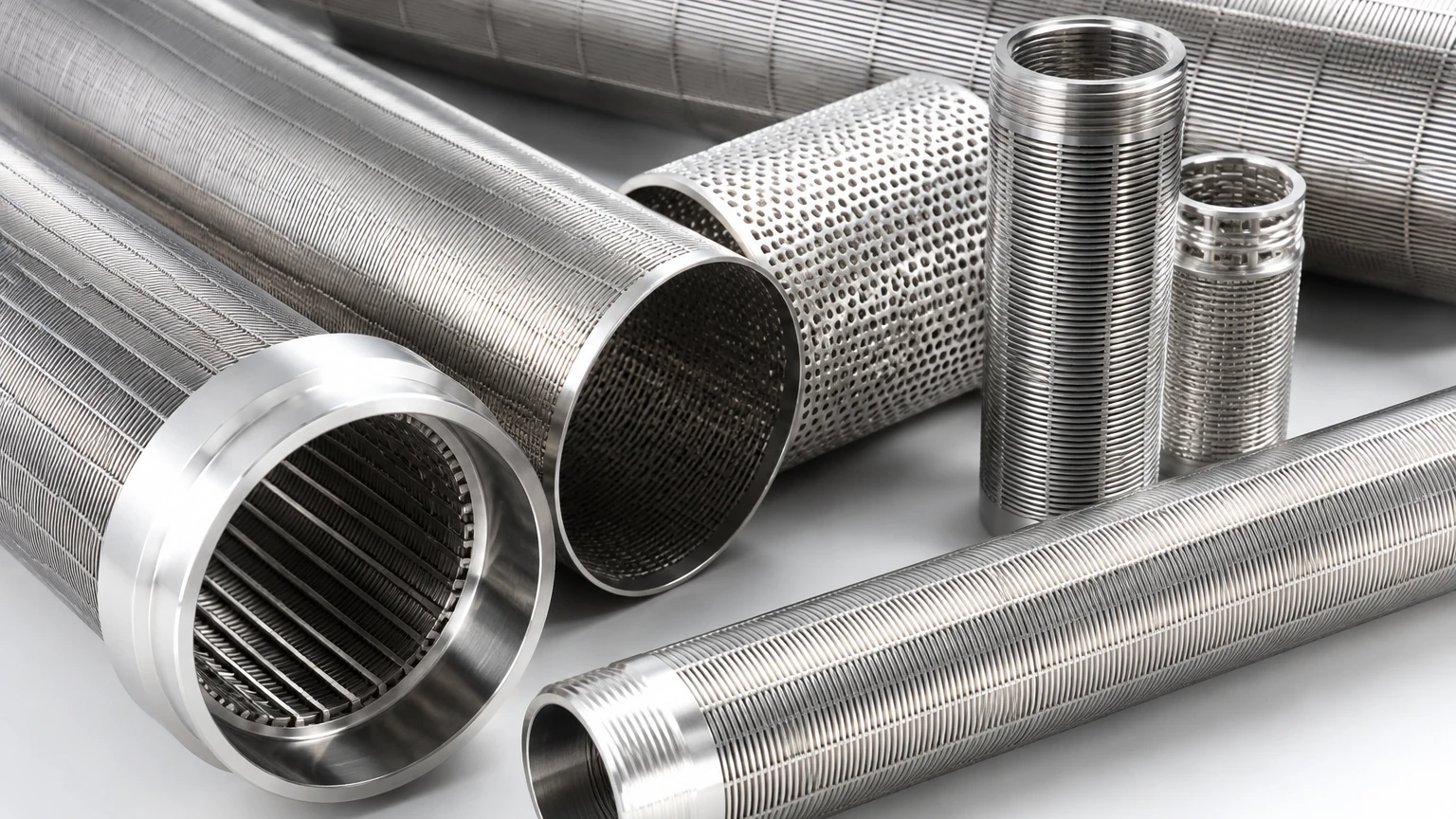
The most prevalent design in high-performance industrial applications is the continuous-slot, wire-wrapped screen. This design utilizes a V-shaped profile wire (often referred to as wedge wire) that is helically wrapped around a circular array of internal longitudinal support rods. Every intersection of the wire and rod is resistance-welded, creating a robust, cage-like structure.
The V-shaped profile is critical for several reasons. First, the inward-opening slot is narrower at the outer face and wider toward the interior. This geometry creates a "two-point contact" for any particles attempting to pass through. If a particle is small enough to pass the outer edges of the slot, it will easily clear the wider interior opening rather than becoming wedged, which is a common failure mode in perforated pipe or mesh-lined screens. This self-cleaning characteristic is vital for maintaining consistent flow rates over decades of service.
Furthermore, the continuous-slot design provides significantly more open area per square foot compared to other screen types. This high percentage of open area reduces the entrance velocity of the fluid. Low entrance velocity is essential because it minimizes friction loss, reduces the potential for encrustation, and prevents the migration of fine sands from the surrounding formation into the wellbore.
Material Selection for Corrosive and High-Pressure Environments
One of the primary advantages of utilizing stainless steel over carbon steel or thermoplastic materials is its superior resistance to corrosion and mechanical stress. However, "stainless steel" is a broad category, and the specific grade chosen must align with the geochemistry of the site.
1. Grade 304/304L: This is the standard choice for most freshwater applications. It offers excellent structural strength and basic corrosion resistance at a cost-effective price point. The "L" variant (low carbon) is preferred for welded structures to prevent sensitizing the steel to intergranular corrosion during the manufacturing process.
2. Grade 316/316L: For environments containing chlorides, such as brackish water or chemical processing streams, Grade 316 is the industrial benchmark. The addition of molybdenum enhances resistance to pitting and crevice corrosion, which are common in stagnant or high-salinity fluids.
3. Super Austenitic and Duplex Alloys: In extreme cases, such as deep-sea intake or high-temperature geothermal wells, specialized alloys may be required to withstand the combination of high hydrostatic pressure and aggressive chemical agents.
When evaluating materials, engineers must also consider the potential for galvanic corrosion. If a stainless steel well screen is connected to a carbon steel riser pipe, the resulting electrochemical reaction can lead to rapid failure of the carbon steel components. Proper insulation or the use of compatible alloys throughout the string is a standard engineering requirement.
Key Performance Indicators: Open Area and Flow Velocity
The efficiency of an industrial well is often measured by its specific capacity—the yield per unit of drawdown. The design of the stainless steel well screen directly influences this metric.
Calculating Open Area
The open area is the percentage of the screen's surface that is actually open to flow. In a wedge wire screen, this is determined by the width of the slot and the width of the profile wire. For example, a screen with a 0.020-inch slot and a 0.060-inch wire width has an open area of approximately 25%. Increasing the open area allows for a higher volume of water to enter the well at a lower velocity.
The Importance of Entrance Velocity
Industry standards generally recommend keeping the entrance velocity below 0.1 feet per second (0.03 meters per second). Exceeding this threshold can lead to:
* Turbulent Flow: Increases energy consumption and promotes the precipitation of minerals (encrustation).
* Sand Pumping: High-velocity water can carry abrasive particles through the screen, leading to pump wear and eventual well failure.
* Accelerated Corrosion: High velocity can strip away the protective oxide layer on the stainless steel, exposing the base metal to faster chemical attack.
By consulting the Main Page of a technical manufacturer, engineers can access detailed charts that correlate slot size, wire profile, and diameter to help calculate the optimal screen length required to maintain these low velocities.
Structural Integrity and Collapse Resistance
Industrial wells often reach depths where the hydrostatic and formation pressures are immense. A stainless steel well screen must be engineered to withstand these external loads without collapsing. The collapse strength of a screen is a function of the material’s yield strength, the diameter of the screen, the size and spacing of the internal support rods, and the thickness of the wrap wire.
In deep-well applications, the "heavy-duty" variant of the screen is often employed. This involves using larger diameter support rods and a tighter wrap pitch. Engineers must perform a collapse analysis that accounts for the maximum expected pressure differential, particularly during well development or high-drawdown pumping cycles. Unlike PVC, which can become brittle or deform under thermal stress, stainless steel maintains its structural integrity across a wide temperature range, making it the preferred choice for geothermal and industrial steam applications.
Customization and OEM Solutions in Well Screen Design
Standard off-the-shelf products rarely meet the rigorous demands of specialized industrial sectors like pharmaceutical manufacturing or high-purity water treatment. This is where the capability for customization becomes a critical factor in procurement.
Kaifil specializes in providing OEM and customized filtration components that go beyond standard well screen dimensions. Customization options typically include:
* Variable Slot Sizes: In formations with stratified layers of different grain sizes, a single screen can be manufactured with different slot openings at different depths to optimize filtration.
* End Fittings: Screens can be equipped with various threaded connections (NPT, API), weld rings, or custom flanges to integrate seamlessly with existing infrastructure.
* Reinforced Cores: For high-pressure hydraulic applications, a stainless steel well screen can be constructed over a perforated pipe base to combine the high open area of wedge wire with the extreme collapse resistance of heavy-wall pipe.
* Surface Treatments: Electropolishing or passivating the stainless steel can further enhance corrosion resistance and reduce the adhesion of biofilms in food and beverage or pharmaceutical applications.
Maintenance and Longevity in Industrial Applications
While a stainless steel well screen is designed for a long service life—often exceeding 30 to 50 years—performance can degrade over time due to physical, chemical, or biological fouling.
Encrustation and Biofouling
Mineral scaling (calcium carbonate or iron deposits) and iron-oxidizing bacteria can eventually bridge the slots of the screen. Because stainless steel is chemically resilient, these screens can be cleaned using aggressive methods that would destroy other materials. Acid treatment (using hydrochloric or sulfamic acid) is a common technique to dissolve mineral scales. The mechanical strength of the steel also allows for high-pressure jetting and surging, which are effective at dislodging silt and biological growth.
Replacement Cycles
The decision to replace a screen usually follows a significant drop in well efficiency that cannot be rectified by cleaning. However, by selecting the correct grade of stainless steel and ensuring proper installation (including the use of a correctly sized gravel pack), the total cost of ownership is significantly lower than that of cheaper alternatives that require frequent replacement or cause premature pump failure.
Procurement Considerations for Engineering Teams
When sourcing a stainless steel well screen, technical professionals should confirm several key details with the manufacturer to ensure the product is fit for purpose:
1. Sieve Analysis Data: The slot size should be selected based on a sieve analysis of the formation material or the filter media being used in the process.
2. Hydrostatic Load Requirements: Provide the manufacturer with the maximum depth and expected drawdown to ensure the collapse rating is sufficient.
3. Chemical Compatibility: Disclose the presence of H2S, CO2, or high chloride levels to determine if Grade 304, 316, or a more exotic alloy is required.
4. Certification and Standards: Ensure the manufacturing process adheres to relevant industrial standards for welding and material traceability.
For those seeking reliable, high-performance filtration components, it is advisable to Review product options and application support to understand how customized manufacturing can address specific site challenges. By focusing on precision engineering and material quality, facilities can ensure their water and fluid intake systems remain operational and efficient for the long term.
