


Stainless Steel Well Screens
In the realm of groundwater extraction, industrial water intake, and environmental monitoring, the efficiency of a well system is fundamentally determined by the performance of its intake zone. Stainless steel well screens serve as the critical interface between the aquifer and the pump, designed to facilitate the entry of water while excluding sand and sediment. Unlike traditional perforated pipes or plastic alternatives, stainless steel well screens offer the structural integrity and chemical resistance required for high-capacity industrial applications and long-term service life.
For engineers and procurement professionals, selecting the appropriate well screen involves a detailed analysis of metallurgy, hydraulic performance, and mechanical strength. As a specialized manufacturer of custom filtration solutions, Kaifil provides the technical expertise necessary to navigate these variables, ensuring that every component is optimized for its specific geological and chemical environment. To explore the full range of customization and engineering support available, technical teams can visit the Main Page for comprehensive product specifications.
The Role of Stainless Steel Well Screens in Industrial Filtration
The primary function of stainless steel well screens is to stabilize the borehole and act as a primary filter. In industrial settings—ranging from food and beverage processing to chemical manufacturing—the quality of the raw water source is paramount. A failing or inefficient well screen can lead to sand pumping, which causes premature wear on pumps, clogs downstream filtration systems, and potentially contaminates the final product.
Stainless steel is the material of choice for these applications due to its superior strength-to-weight ratio and its ability to maintain precise slot openings under high pressure. The use of stainless steel well screens ensures that the well remains productive for decades, minimizing the total cost of ownership (TCO) by reducing the frequency of well rehabilitation and pump repairs.
Material Selection: Balancing Corrosion Resistance and Mechanical Strength
Material science is at the heart of well screen engineering. The chemical composition of the groundwater—specifically its pH, dissolved oxygen levels, chloride content, and the presence of hydrogen sulfide—dictates the grade of stainless steel required.
Grade 304 Stainless Steel
Type 304 is the standard for most freshwater applications. It provides excellent corrosion resistance and mechanical properties at a cost-effective price point. However, in environments with high chloride concentrations (exceeding 200 mg/L), 304 may be susceptible to pitting corrosion.
Grade 316 and 316L Stainless Steel
The addition of molybdenum in Grade 316 significantly enhances its resistance to chloride-induced pitting and crevice corrosion. Grade 316L (low carbon) is often preferred for welded structures, as it minimizes the risk of intergranular corrosion in the heat-affected zones of the welds. These materials are essential for coastal wells, brackish water extraction, and industrial processes involving aggressive chemicals.
Advanced Alloys
In extreme environments, such as geothermal wells or highly acidic mining applications, duplex stainless steels or high-nickel alloys may be specified. These materials offer exceptional yield strength and resistance to stress corrosion cracking, ensuring the screen remains intact under extreme thermal and mechanical loads.
Engineering Design: The V-Wire Advantage and Slot Configuration
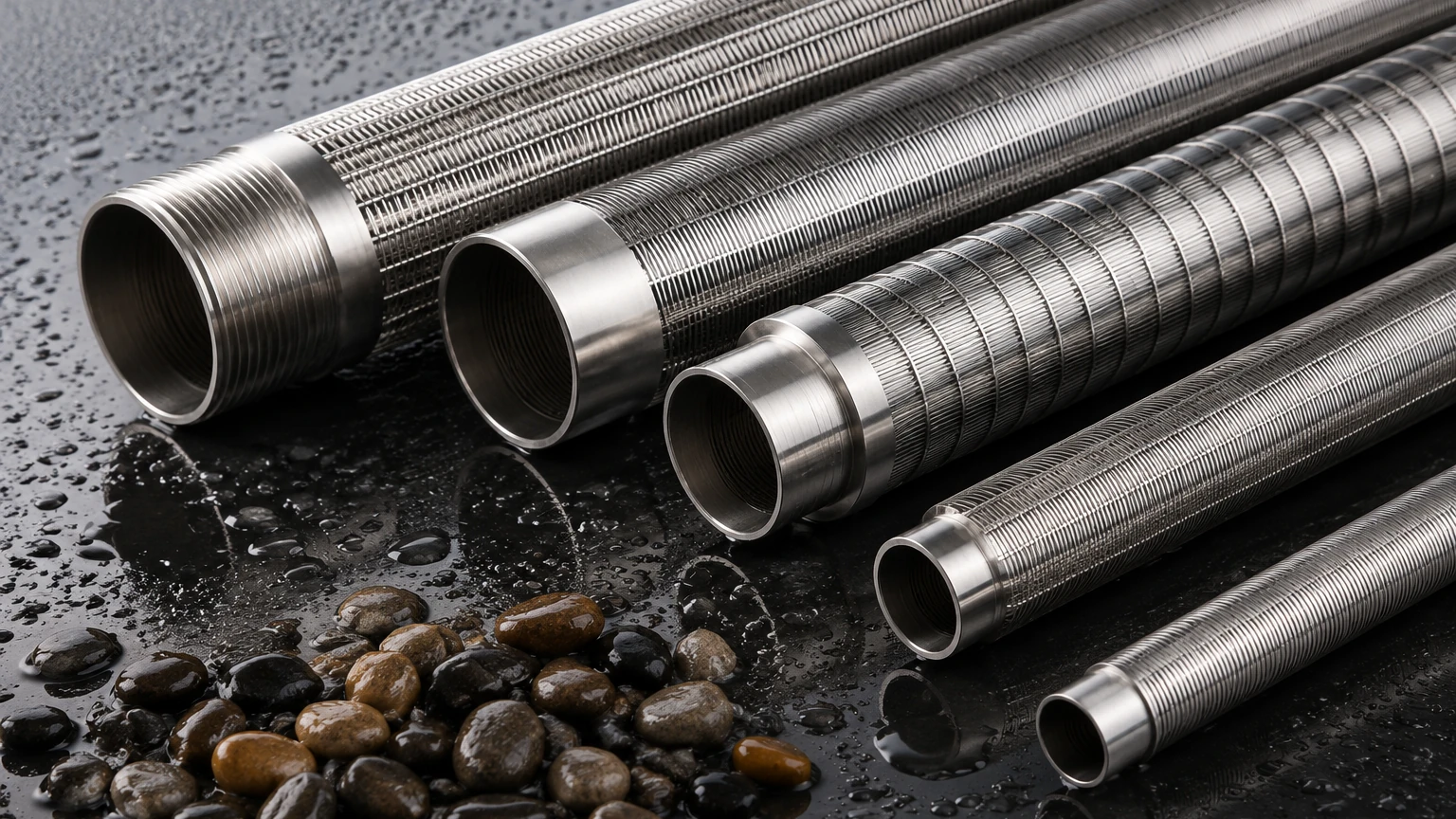
The most prevalent design for industrial stainless steel well screens is the continuous slot, wire-wrapped configuration, often referred to as wedge wire or V-wire screens. This design consists of a V-shaped profile wire that is helically wrapped around a circular array of internal support rods.
Non-Clogging Geometry
The V-shaped wire is oriented so that the narrowest part of the slot is at the exterior of the screen. As particles move through the slot, the opening widens inwardly. This geometry ensures that any particle capable of passing through the outer slot will continue through the screen without becoming wedged, a common failure mode in perforated or mesh-lined pipes.
Precision Slot Sizing
Slot sizes are typically specified in thousandths of an inch (e.g., 10-slot, 20-slot). The selection of the slot size is based on a sieve analysis of the aquifer material or the gravel pack. Engineers must balance the need for a small enough slot to exclude fines with the need for a large enough open area to maintain hydraulic efficiency.
Hydraulic Considerations: Optimizing Flow and Minimizing Entrance Velocity
Hydraulic efficiency is measured by the screen's "open area"—the percentage of the total surface area that consists of openings. Stainless steel well screens can achieve an open area significantly higher than plastic or shutter-style screens, often exceeding 30% to 50%.
The Importance of Low Entrance Velocity
High open area allows for a lower entrance velocity of the water as it passes through the screen. Industry standards typically recommend an entrance velocity of no more than 0.1 feet per second (0.03 meters per second). Maintaining low velocity is critical for several reasons:
1. Reduced Head Loss: Lower friction results in higher pumping levels and reduced energy costs.
2. Minimized Encrustation: High velocities can cause localized pressure drops that trigger the precipitation of minerals (like calcium carbonate) or the growth of iron bacteria, which clog the screen.
3. Prevention of Corrosion: High-velocity flow can strip away the protective passive layer of the stainless steel, accelerating localized corrosion.
Structural Integrity and Collapse Resistance in Deep Well Applications
As wells go deeper, the screens must withstand increasing hydrostatic pressure and the weight of the overlying formation. The collapse strength of a stainless steel well screen is a function of the support rod diameter, the spacing of the rods, and the profile of the wrap wire.
Calculating Collapse Pressure
Engineers use standardized formulas (such as those provided by the American Water Works Association) to calculate the required collapse resistance. In deep-well applications, "pipe-based" screens may be used. These consist of a wire-wrapped screen jacket fitted over a perforated heavy-wall base pipe. The base pipe provides the necessary longitudinal and collapse strength, while the outer jacket provides the filtration precision.
Longitudinal Strength
The screen must also support its own weight during installation and the weight of any pipe string suspended below it. The integrity of the welds between the wrap wire and the support rods is paramount here. Kaifil utilizes advanced resistance welding techniques to ensure each intersection is fused with maximum strength, providing a rigid, durable structure.
Customization and Specification for OEM Projects
Industrial filtration requirements are rarely one-size-fits-all. Customization is often necessary to integrate the screen into existing infrastructure or to meet specific process parameters. When specifying stainless steel well screens, engineers should confirm the following technical details:
* End Connections: Options include NPT threaded couplings, weld rings (beveled for field welding), or specialized flange connections.
* Overall Length and Diameter: Screens can be manufactured in sections ranging from a few feet to 20 feet or more, with diameters tailored to the borehole size.
* Gravel Pack Compatibility: For wells using an artificial filter pack, the screen must be designed to work in tandem with the specific grain size of the silica sand or glass beads used.
Kaifil’s manufacturing capabilities allow for the production of specialized components, including header-lateral systems, intake screens for surface water, and resin traps for ion exchange systems, all utilizing the same high-performance stainless steel construction.
Maintenance and Longevity: Maximizing the Lifecycle of Well Screens
While stainless steel well screens are designed for durability, their performance can be impacted over time by biological fouling or mineral scaling. However, the material properties of stainless steel allow for aggressive rehabilitation techniques that would destroy PVC or low-carbon steel screens.
Chemical Cleaning
Stainless steel is resistant to the strong acids (such as hydrochloric or sulfamic acid) and chlorine-based biocides used to dissolve mineral scale and kill iron-reducing bacteria. This allows for effective "in-situ" cleaning, restoring the well's specific capacity without removing the screen.
Mechanical Development
Techniques such as high-pressure jetting and surging are used during initial well development and subsequent maintenance. The high fatigue strength of stainless steel ensures that the screen can withstand the intense pressure pulses required to clear the aquifer of fine sediments and optimize the flow paths.
Conclusion: Making Informed Procurement Decisions
Selecting stainless steel well screens is a strategic investment in the reliability of an industrial water supply or process system. By prioritizing high-grade materials, precision engineering, and hydraulic optimization, technical teams can ensure long-term performance and minimal maintenance requirements.
When evaluating suppliers, it is essential to partner with a manufacturer that understands the complexities of filtration physics and metallurgical performance. Kaifil provides the engineering support and manufacturing precision needed to deliver high-performance filtration components for the most demanding environments. For more information on custom designs and technical specifications, please refer to the Main Page to connect with our technical team and review our full suite of industrial filtration solutions.
