


Stainless Steel Wire Mesh Filters
In industrial processing, the efficiency of a system often hinges on the reliability of its filtration components. Stainless steel wire mesh filters represent a critical technology for liquid and gas separation, offering a unique combination of mechanical strength, thermal resistance, and precise pore geometry. Unlike disposable polymer-based filters, these metallic components are engineered for durability and reusability in demanding environments such as chemical processing, pharmaceutical manufacturing, and high-pressure hydraulic systems.
For engineers and procurement specialists, selecting the appropriate filtration media requires a deep understanding of weave patterns, material grades, and flow dynamics. This guide examines the technical specifications and operational considerations necessary to optimize the performance of stainless steel wire mesh filters in industrial applications. For a comprehensive overview of available configurations, technical professionals can visit the Main Page to review product options and application support.
Engineering Characteristics of Stainless Steel Wire Mesh
The performance of stainless steel wire mesh filters is primarily determined by the weave type and the precision of the wire diameter. The weave pattern dictates the aperture size (pore size) and the structural integrity of the filter element.
Common Weave Patterns
1. Plain Weave: This is the most common and straightforward weave, where each warp wire crosses over and under each weft wire. It provides a high degree of transparency and a consistent aperture size, making it ideal for general-purpose particulate removal.
2. Twill Weave: In this configuration, the wires are woven in a staggered pattern (e.g., two over and two under). This allows for the use of heavier wire diameters than plain weave for a given mesh count, resulting in a stronger mesh that can withstand higher mechanical loads.
3. Plain Dutch Weave: This design utilizes a larger diameter warp wire and a smaller diameter weft wire woven closely together. The result is a dense, wedge-shaped opening that offers high flow rates and excellent mechanical strength, often used for high-pressure filtration.
4. Twill Dutch Weave: Combining the twill and dutch techniques, this weave provides the finest filtration levels. It creates a tortuous path for particles, effectively acting as a surface filter with depth-loading characteristics, suitable for critical applications requiring sub-micron or low-micron accuracy.
Mesh Count and Micron Rating
Mesh count refers to the number of openings per linear inch. While higher mesh counts generally indicate finer filtration, the actual micron rating is influenced by the wire diameter. Engineers must distinguish between "nominal" and "absolute" micron ratings. A nominal rating indicates the ability of the filter to retain a majority of particles of a specific size, whereas an absolute rating defines the largest spherical particle that can pass through the mesh under laboratory conditions. For high-precision industrial processes, specifying absolute ratings is essential to ensure process consistency.
Material Selection and Chemical Compatibility
The longevity of stainless steel wire mesh filters is heavily dependent on the alloy selected. While "stainless steel" is a broad term, the specific grade determines the filter’s resistance to corrosion, oxidation, and temperature extremes.
* Grade 304: The standard industrial grade, offering good corrosion resistance and cost-effectiveness. It is suitable for water treatment, food processing, and general industrial air filtration where aggressive chemicals are not present.
* Grade 316: Contains molybdenum, which significantly enhances resistance to chlorides and acids. This grade is the industry standard for marine environments, chemical processing, and pharmaceutical applications where pitting corrosion is a concern.
* Grade 316L: The low-carbon version of 316, preferred for filter elements that require extensive welding. The lower carbon content prevents carbide precipitation during the welding process, maintaining the corrosion resistance of the heat-affected zones.
* Specialty Alloys: For extreme environments involving high-temperature oxidation or highly caustic fluids, alloys such as Inconel, Monel, or Hastelloy may be integrated into the wire mesh design.
When evaluating compatibility, engineers should consider the pH levels, operating temperatures, and the presence of specific ions (like chlorides) in the process fluid. Selecting a higher-grade alloy initially often reduces the total cost of ownership by extending the replacement cycle.
Performance Evaluation: Pressure Drop and Flow Rates
A critical factor in filter selection is the clean pressure drop (ΔP). This is the difference in pressure between the inlet and outlet of the filter when the fluid is clean. A high initial pressure drop limits the available "dirt-holding capacity" before the filter reaches its terminal pressure drop and requires cleaning or replacement.
Factors Influencing Flow Dynamics
* Open Area Percentage: This is the ratio of the total area of the apertures to the total area of the mesh. A higher open area results in lower flow resistance and lower pressure drop but may compromise the structural strength of the mesh.
* Fluid Viscosity: Higher viscosity fluids require larger surface areas or coarser mesh to maintain efficient flow rates without excessive pressure buildup.
* Surface Area Optimization: To mitigate pressure drop in compact systems, wire mesh is often pleated. Pleating increases the effective filtration area by 3 to 5 times compared to a standard cylindrical element, significantly extending the time between maintenance intervals.
Customization Options for Industrial Applications
Industrial filtration rarely follows a one-size-fits-all approach. Customization is often required to integrate stainless steel wire mesh filters into existing hardware or to meet specific process requirements. Kaifil specializes in these tailored solutions, providing OEM support for complex filtration needs.
Structural Reinforcement
For applications involving high-pressure surges or back-pulsing, the wire mesh may be supported by a perforated metal core or an external cage. In extreme cases, multiple layers of mesh are "sintered" (diffusion-bonded) together. Sintered wire mesh combines the filtration precision of fine mesh with the mechanical strength of heavy-duty support layers, creating a monolithic structure that will not delaminate or shift under pressure.
Component Geometry
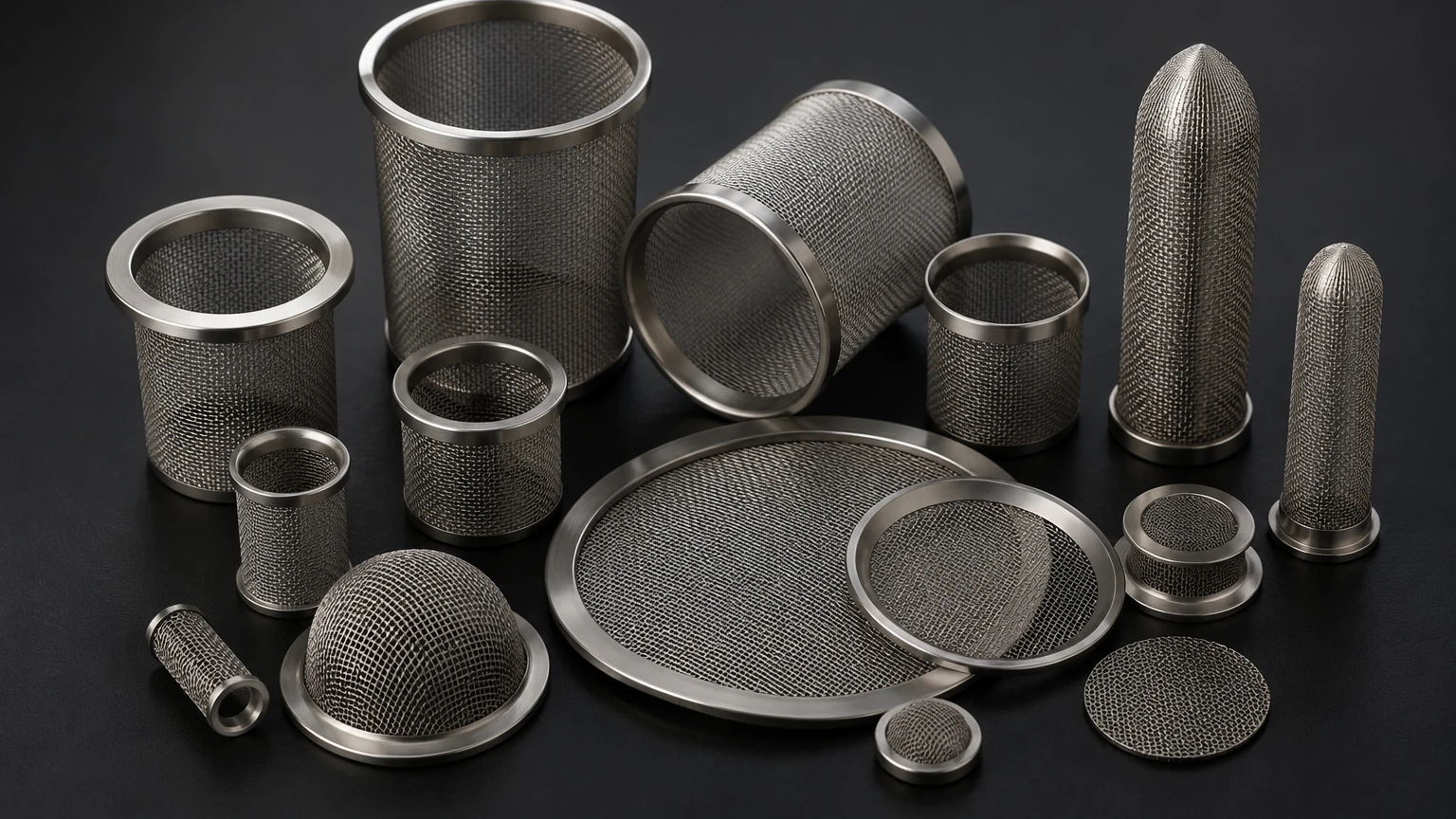
Beyond standard cartridges, wire mesh can be fabricated into various forms:
* Filter Discs and Washers: Used in extruder screens and valve protection.
* Conical and Basket Filters: Common in piping systems for large-scale debris removal.
* Custom Manifolds: Multi-stage filtration units designed for specific flow paths.
Operational Considerations: Maintenance and Replacement Cycles
One of the primary advantages of stainless steel wire mesh filters is their cleanability. However, the effectiveness of the cleaning process depends on the nature of the contaminant and the mesh structure.
Cleaning Methodologies
1. Backwashing: Reversing the flow of the fluid to dislodge particles from the surface of the mesh. This is effective for surface-loading weaves like plain or dutch weaves.
2. Ultrasonic Cleaning: Using high-frequency sound waves in a solvent bath to remove fine particles trapped deep within the weave. This is the preferred method for complex twill dutch weaves or sintered media.
3. Chemical Cleaning: Using acids or alkalis to dissolve organic or mineral scaling. It is vital to ensure the cleaning agent is compatible with the stainless steel grade to avoid embrittlement or corrosion.
Determining Replacement Cycles
While reusable, stainless steel filters eventually reach the end of their service life. Signs that a filter requires replacement rather than cleaning include:
* Permanent Pressure Drop: When the "clean" pressure drop after maintenance is significantly higher than the original specification, indicating "blinding" (permanent pore blockage).
* Structural Fatigue: Evidence of wire displacement, broken wires, or compromised weld seams.
* Media Migration: In non-sintered meshes, high-pressure cycles can cause wires to shift, altering the aperture size and compromising filtration accuracy.
Total Cost of Ownership (TCO) in Filtration
When procuring filtration solutions, focusing solely on the initial purchase price can be misleading. Stainless steel wire mesh filters often have a higher upfront cost than polymer or paper alternatives, but their TCO is frequently lower due to several factors:
* Reduced Downtime: High-strength metal filters are less prone to catastrophic failure, preventing unscheduled system shutdowns.
* Waste Reduction: The ability to clean and reuse the filter reduces the costs associated with hazardous waste disposal and the procurement of consumables.
* Energy Efficiency: By optimizing the mesh design to maintain a low pressure drop, facilities can reduce the energy consumption of pumps and compressors.
* Process Consistency: The rigid structure of metal mesh ensures consistent pore size even under fluctuating temperatures and pressures, protecting downstream equipment and ensuring product quality.
Conclusion for Engineering and Purchasing Teams
Successful implementation of stainless steel wire mesh filters requires a balance between filtration fineness, mechanical durability, and chemical compatibility. By understanding the nuances of weave patterns and material properties, engineers can specify solutions that not only meet the immediate needs of the process but also contribute to long-term operational efficiency.
When moving toward procurement, it is essential to confirm the specific operating conditions—including peak flow rates, maximum pressure, and chemical exposure—with the manufacturer. For those seeking technical guidance or customized OEM components, exploring the resources available on the Main Page provides a starting point for developing high-performance filtration systems tailored to specific industrial demands.
