


Stirred Tank Bioreactors
Stirred tank bioreactors (STBRs) serve as the backbone of modern bioprocessing, providing the controlled environment necessary for the cultivation of microorganisms and mammalian cells. These systems are engineered to optimize mass transfer, heat exchange, and nutrient distribution, ensuring high yields in pharmaceutical, chemical, and food production. In industrial applications, the performance of a bioreactor is inextricably linked to the quality of its peripheral components—specifically the filtration and aeration systems that maintain sterility and facilitate gas exchange.
For engineers and technical professionals, selecting and maintaining the right components for stirred tank bioreactors requires a deep understanding of fluid dynamics, material science, and sterile processing requirements. As a manufacturer specializing in precision metal filtration, Kaifil provides the technical infrastructure needed to support these complex systems through high-performance stainless steel components.
The Engineering Fundamentals of Stirred Tank Bioreactors
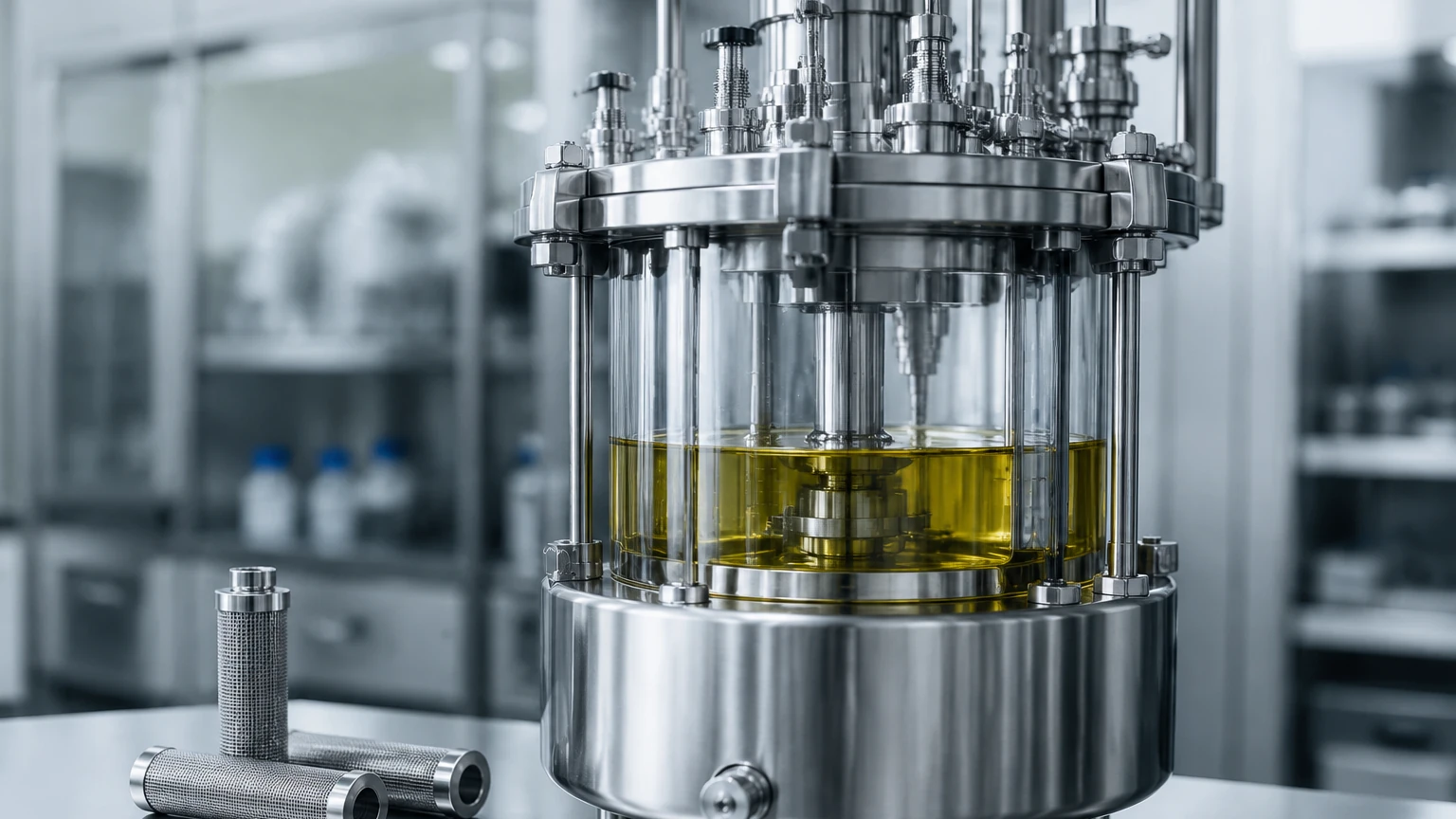
A stirred tank bioreactor typically consists of a cylindrical vessel equipped with a central shaft and one or more impellers. The primary function of the impeller is to provide agitation, which achieves two critical goals: homogenizing the culture medium and breaking down air bubbles into smaller diameters to increase the surface area for oxygen transfer.
Key design elements include:
* Agitation System: Comprising the motor, shaft, and impellers (such as Rushton turbines or hydrofoil impellers), this system dictates the shear stress levels and mixing efficiency.
* Baffles: Vertical plates attached to the vessel wall that prevent the formation of a central vortex and promote axial mixing.
* Sparging System: The mechanism through which air or oxygen is introduced into the vessel. This is a critical area where precision metal filtration components, such as sintered spargers, play a vital role in determining gas holdup and oxygen mass transfer coefficients ($k_La$).
* Thermal Control: Jackets or internal coils that manage the exothermic heat generated by microbial metabolism.
In these high-stakes environments, even minor deviations in gas flow or contamination can lead to batch failure. Therefore, the integration of reliable filtration solutions is not merely an option but a technical necessity.
Critical Role of Stainless Steel Filtration in Bioprocessing
Filtration in stirred tank bioreactors is categorized into three primary areas: inlet gas sterilization, exhaust gas filtration, and liquid media processing. Stainless steel is the material of choice for these applications due to its mechanical strength and compatibility with rigorous sterilization protocols.
Inlet Air and Gas Sparging
Microorganisms require a constant supply of sterile air or specific gas mixtures (O2, CO2, N2). Sintered stainless steel spargers are used to introduce these gases into the medium. Unlike traditional drilled pipes, sintered metal components offer controlled porosity, which produces uniform, fine bubbles. This increases the interfacial area between the gas and liquid phases, significantly enhancing the oxygen transfer rate (OTR) without requiring excessive agitation speeds that might damage shear-sensitive cells.
Exhaust Gas Filtration
As gases exit the bioreactor, they carry moisture and potential aerosols containing the biological agent. Exhaust filters must prevent the release of these agents into the environment while also preventing back-contamination. Stainless steel filter cartridges are preferred here because they can withstand the high moisture levels and pressure fluctuations associated with fermentation without the risk of media migration or structural collapse.
Media and Buffer Filtration
Before entering the bioreactor, liquid media must be clarified and sterilized. While polymer membranes are common for final sterilization, stainless steel wire mesh filters are often used for pre-filtration to remove larger particulates, protecting downstream equipment and extending the life of more expensive membrane filters.
To explore the full range of industrial filtration components suitable for these applications, engineers can visit the Main Page for detailed technical specifications.
Material Selection: Why 316L Stainless Steel Dominates
In the context of stirred tank bioreactors, the choice of material is dictated by the need for corrosion resistance and the ability to undergo repeated sterilization. 316L stainless steel is the industry standard for several reasons:
1. Corrosion Resistance: The addition of molybdenum in 316L provides superior resistance to pitting and crevice corrosion, especially in media containing chlorides or organic acids.
2. Surface Finish: Stainless steel components can be electropolished to achieve a low Ra (Roughness Average) value. A smooth surface is essential to prevent biofilm accumulation and to ensure the effectiveness of Clean-in-Place (CIP) procedures.
3. Thermal Stability: Bioreactors frequently undergo Steam-in-Place (SIP) cycles, where components are exposed to saturated steam at temperatures typically ranging from 121°C to 135°C. Stainless steel maintains its structural integrity and filtration accuracy under these conditions, unlike many thermoplastic alternatives.
4. Durability: In large-scale industrial stirred tank bioreactors, components are subject to mechanical vibrations and pressure surges. The high fatigue strength of metal filters ensures a long service life and reduces the total cost of ownership.
Technical Evaluation Criteria for Bioreactor Filters
When specifying filtration components for a bioreactor project, engineers must evaluate several performance metrics to ensure system compatibility and process efficiency.
Filtration Accuracy and Pore Size Distribution
For sparging applications, the mean pore size determines the initial bubble size. For sterilization applications, the absolute micron rating is critical. It is essential to confirm that the filter manufacturer provides a consistent pore size distribution to avoid "channeling," where gas or liquid bypasses the intended filtration path through larger-than-average pores.
Pressure Drop (Delta P)
High pressure drop across a filter can lead to increased energy consumption and may limit the maximum flow rate of air or media. Sintered metal filters from Kaifil are designed with optimized porosity to provide high flow permeability while maintaining strict particle retention standards.
Chemical and Biological Compatibility
The filter must be inert to the culture media and the metabolic byproducts produced during the fermentation cycle. It must also resist the harsh chemicals used during CIP, such as sodium hydroxide (NaOH) and phosphoric acid.
Scalability
As a process moves from a laboratory-scale stirred tank bioreactor to a pilot plant and eventually to full-scale production, the filtration requirements change. Working with a manufacturer that offers custom sizing and OEM capabilities allows for a seamless transition, ensuring that the filtration characteristics remain consistent across different scales of operation.
Common Risks and Mitigation Strategies
Operating stirred tank bioreactors involves inherent risks, particularly concerning contamination and mechanical failure. Understanding these risks allows for better system design.
* Biofouling: Over time, proteins and cellular debris can accumulate on filter surfaces. If not managed, this leads to increased pressure drop and reduced oxygen transfer. Using electropolished stainless steel filters and implementing validated cleaning cycles can mitigate this risk.
* Filter Blinding: In exhaust systems, foam-overs can lead to the "blinding" of the exhaust filter, causing a rapid pressure buildup within the vessel. High-quality stainless steel cartridges can be cleaned and reused, whereas disposable filters would require immediate replacement and potentially a batch termination.
* Seal Integrity: The interface between the filter cartridge and the bioreactor housing is a common point of failure. Engineers should ensure that O-ring materials (such as EPDM or Viton) are compatible with both the process media and the sterilization temperatures.
Customization and OEM Solutions in Bioprocessing
No two bioprocesses are identical. The requirements for a vaccine production facility differ significantly from those of a wastewater treatment plant or a food-grade fermentation suite. This variability necessitates customized filtration solutions.
Kaifil specializes in the development of bespoke filtration components tailored to the specific geometry and operational parameters of industrial stirred tank bioreactors. This includes:
* Custom Sparger Geometries: Designing ring spargers, pipe spargers, or porous plates that fit specific vessel dimensions to optimize gas distribution.
* Specialized End Fittings: Ensuring that filter cartridges integrate perfectly with existing housing designs, whether using 222, 226, or custom threaded connections.
* Variable Porosity: Adjusting the sintering process to achieve specific flow characteristics required for high-density cell cultures.
By focusing on the technical requirements of the application, Kaifil helps engineering teams achieve more predictable and repeatable results in their fermentation and cell culture processes.
Conclusion: Ensuring Operational Excellence
The efficiency of stirred tank bioreactors is a product of precise engineering and high-quality component selection. By prioritizing durable, high-performance stainless steel filtration and sparging components, facilities can ensure sterility, optimize mass transfer, and reduce downtime associated with component failure.
For technical professionals seeking to optimize their bioreactor systems, confirming the material grades, filtration ratings, and structural limits of their components is the first step toward operational excellence. For more information on custom stainless steel filtration solutions and to view our full product range, please visit our Main Page. Through advanced manufacturing and engineering support, Kaifil remains a committed partner in the advancement of industrial bioprocessing technology.
