


Strainers vs Filters Industrial Water Treatment Systems
In industrial water treatment, the terms "strainer" and "filter" are often used interchangeably by those outside the engineering field. However, for process engineers and facility managers, the distinction is critical. Choosing between strainers vs filters industrial water treatment systems determines the efficiency of downstream equipment protection, the frequency of maintenance cycles, and the total cost of ownership for a filtration installation.
At its core, the difference lies in the size of the particles removed and the mechanism used to capture them. While both components serve the primary function of removing solids from a liquid stream, their roles within an industrial water treatment circuit are distinct and often complementary. Understanding these nuances is essential for optimizing system performance and ensuring the longevity of sensitive components like high-pressure pumps, spray nozzles, and membranes.
Distinguishing Between Industrial Strainers and Filters
The primary technical differentiator between a strainer and a filter is the particle size they are designed to handle. Generally, any device designed to remove particles larger than 40 microns (the lower limit of human visibility) is classified as a strainer. Conversely, devices designed to remove particles smaller than 40 microns are classified as filters.
The Role of Industrial Strainers
Strainers are typically installed as the first line of defense in a water treatment system. Their primary purpose is to protect downstream equipment from large debris such as scale, rust, pebbles, or organic matter that could cause mechanical damage or clogging. Because they handle larger solids, strainers are designed for high flow rates with minimal pressure drop. They are often constructed from robust materials like stainless steel wire mesh or perforated plate to withstand high-velocity impacts from heavy debris.
The Role of Industrial Filters
Filters are utilized for the removal of microscopic suspended solids, bacteria, and fine particulates. While a strainer protects a pump from a stone, a filter protects a reverse osmosis (RO) membrane from colloidal silica or silt. Filters often utilize depth media or fine-denier synthetic fibers to trap particles throughout the thickness of the material, rather than just on the surface. In many industrial water treatment systems, a strainer is placed upstream of a filter to extend the filter's service life by removing the "heavy lifting" of large particle loads.
The Mechanics of Particle Removal
To effectively evaluate strainers vs filters industrial water treatment systems, one must look at the filtration mechanism: surface filtration versus depth filtration.
Surface Filtration (Strainers)
Strainers operate almost exclusively via surface filtration. The media—usually a stainless steel wire mesh or a wedge wire screen—acts as a mechanical barrier. Any particle larger than the opening in the mesh is captured on the upstream side. This mechanism allows for easy cleaning, either through backwashing or manual removal of the basket. Because the debris is held on the surface, the pressure drop across the strainer remains relatively stable until the surface area is significantly blinded.
Depth Filtration (Filters)
Many industrial filters, particularly cartridge-style filters, utilize depth filtration. The fluid travels through a thick layer of media, and particles are trapped within the tortuous path of the fibers. This allows filters to hold a higher volume of very fine contaminants before requiring replacement. However, unlike stainless steel strainers, many depth filters are disposable. Once the internal structure is saturated with contaminants, the differential pressure rises sharply, and the element must be replaced.
Performance Metrics in Water Treatment Systems
When specifying components for industrial water treatment, engineers must balance three primary metrics: filtration accuracy, flow capacity, and pressure drop.
1. Micron Rating and Mesh Count: Strainers are often defined by mesh count (the number of openings per linear inch), while filters are defined by micron ratings. It is vital to distinguish between nominal and absolute ratings. An absolute-rated stainless steel filter cartridge ensures that 99.9% of particles at the specified micron size are captured, which is critical for pharmaceutical or food-grade water applications.
2. Differential Pressure (ΔP): This is the difference in pressure between the inlet and outlet of the housing. A high-quality industrial strainer is engineered to maintain a low initial ΔP. As the screen collects debris, ΔP increases. In automated systems, a specific ΔP threshold triggers a backwash cycle.
3. Flow Velocity: High-velocity water can cause "particle bypass" in low-quality filters, where pressure forces contaminants through the media. Industrial-grade stainless steel components are designed to maintain structural integrity under these stresses, ensuring consistent water quality even during flow surges.
Material Selection: The Case for Stainless Steel
In the context of strainers vs filters industrial water treatment systems, material selection is a non-negotiable factor for durability. Industrial water environments are often corrosive, particularly in desalination, chemical processing, or high-temperature boiler feed systems.
* 304 Stainless Steel: Suitable for general industrial water applications where cost-effectiveness is a priority and the environment is not excessively corrosive.
* 316L Stainless Steel: The industry standard for demanding water treatment. The addition of molybdenum provides superior resistance to chlorides and pitting, making it ideal for brackish water or chemical-laden process streams.
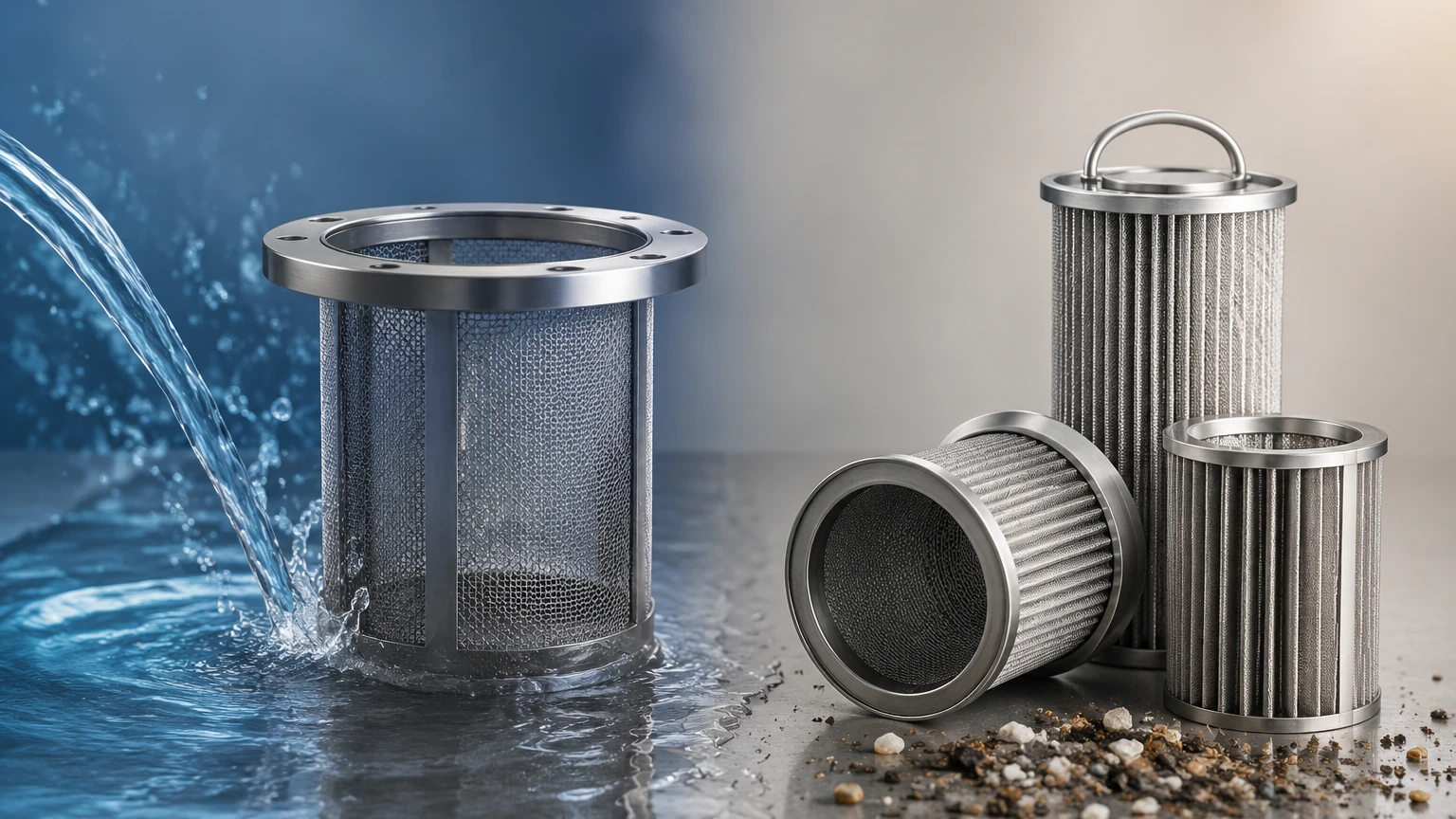
* Durability and Reusability: One of the greatest advantages of stainless steel filtration components is their ability to be cleaned and reused. Unlike plastic or paper-based media, stainless steel wire mesh can withstand high-pressure cleaning, ultrasonic baths, and chemical sterilization without losing its pore geometry.
Maintenance and Operational Lifecycles
The total cost of a filtration system is not just the purchase price; it is the sum of maintenance labor, replacement parts, and downtime.
Strainer Maintenance
Strainers are designed for longevity. In a well-maintained system, a stainless steel strainer basket can last for years. Maintenance typically involves monitoring the pressure gauge and cleaning the basket when the differential pressure reaches a predetermined limit (usually 5-10 psi). In many industrial water treatment systems, duplex strainers are used, allowing one side to be cleaned while the other remains in operation, ensuring zero downtime.
Filter Maintenance
Filter maintenance is more frequent due to the finer nature of the particles being captured. If the system uses disposable cartridges, the cost of consumables can become significant over time. This is why many engineers are moving toward cleanable stainless steel filter cartridges. These components offer the fine filtration of a filter with the structural permanence of a strainer, providing a sustainable solution for high-volume industrial processes.
Selecting the Right Solution for Industrial Applications
Choosing the correct equipment requires a thorough analysis of the influent water quality and the required effluent standards.
* Pre-filtration for RO Systems: Here, a multi-stage approach is common. A coarse strainer (200-500 microns) removes large solids, followed by a fine strainer (50-100 microns), and finally, a 5-micron absolute-rated filter to protect the membranes.
* Cooling Tower Water: Cooling water often contains scale and biological growth. A self-cleaning strainer is usually sufficient to protect heat exchangers from clogging, as the goal is to prevent mechanical blockage rather than achieve high purity.
* Process Water for Food & Beverage: This requires high-precision filtration. Stainless steel filters are preferred here because they do not shed fibers into the water stream and can be easily sanitized using steam-in-place (SIP) protocols.
Engineering Custom Filtration Components
Standard off-the-shelf solutions often fail to meet the specific spatial or hydraulic requirements of a complex water treatment plant. Customization allows for the optimization of the filtration area, which directly impacts the cleaning frequency. For instance, increasing the surface area of a stainless steel wire mesh filter can significantly reduce the pressure drop and extend the interval between maintenance cycles.
When designing custom components, engineers consider factors such as:
* Housing Compatibility: Ensuring the filter element fits existing vessels without bypass leaks.
* Structural Reinforcement: Adding internal supports or outer cages to prevent the mesh from collapsing under high differential pressure.
* End Cap Configurations: Customizing gaskets (EPDM, Viton, or PTFE) to ensure chemical compatibility with the treated water.
Conclusion: Optimizing Your Water Treatment Strategy
Deciding between strainers vs filters industrial water treatment systems is not an "either-or" proposition but rather a strategic engineering choice based on particle size, flow requirements, and maintenance goals. By integrating robust stainless steel strainers for coarse protection and precision metal filters for fine polishing, industrial facilities can achieve a reliable, low-maintenance water treatment process.
For engineers and purchasing teams looking to enhance their system performance, selecting high-quality, durable components is the most effective way to reduce long-term operational costs. To explore technical specifications and customized hardware for these applications, please visit our Main Page for detailed product information and engineering support.
By focusing on material integrity and precise micron control, Kaifil provides the industrial sector with the components necessary to manage the most demanding water treatment challenges. Whether you require a standard strainer basket or a custom-engineered stainless steel filter cartridge, understanding the technical requirements of your specific application is the first step toward a successful filtration solution.
Download Strainers vs Filters Industrial Water Treatment Systems as a PDF
