


String Wound Filter
In the landscape of industrial liquid filtration, the string wound filter remains one of the most widely utilized components for sediment removal and pre-filtration. Despite the emergence of newer technologies, the specific structural advantages and cost-effectiveness of wound cartridges make them indispensable in sectors ranging from municipal water treatment to complex chemical processing. For engineers and procurement specialists, understanding the technical nuances of these filters—including winding patterns, material compatibility, and performance limitations—is essential for optimizing process efficiency and protecting downstream equipment.
As a depth filtration solution, the string wound filter operates on the principle of capturing particles throughout the entire thickness of the filter media, rather than just on the surface. This article provides a technical deep dive into the engineering considerations, selection criteria, and operational realities of string wound filtration in industrial environments.
Understanding the Mechanics of String Wound Filtration
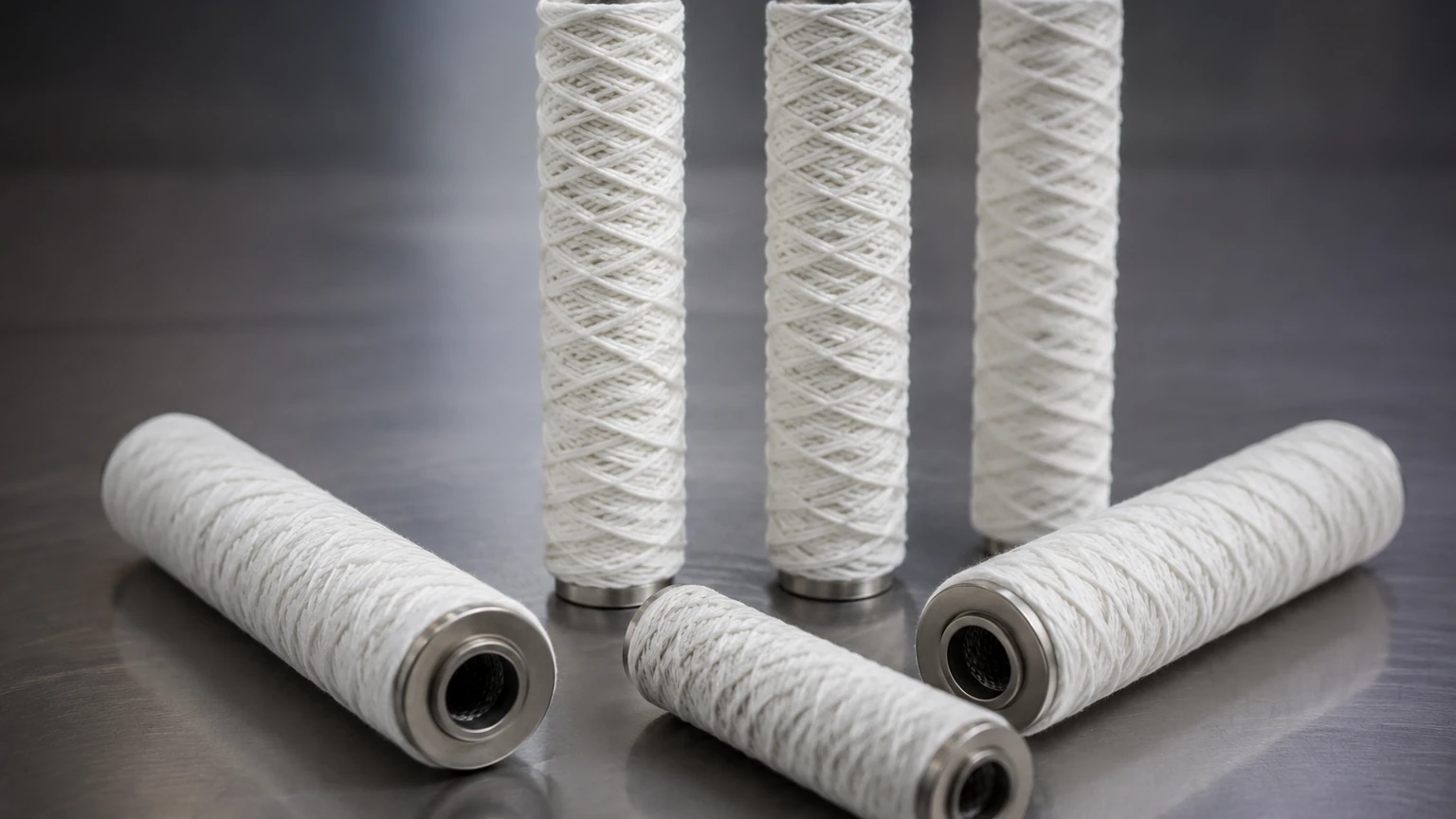
The performance of a string wound filter is defined by its manufacturing process. These cartridges are produced by winding continuous yarns of textile fibers around a perforated central core. The winding process is not random; it is a precision-engineered operation where the speed of the winding head and the rotation of the core are synchronized to create a specific geometric pattern, often referred to as a "diamond pattern."
Depth Filtration and Gradient Density
The primary advantage of the string wound design is its ability to provide gradient density. By adjusting the winding tension and the spacing between the yarns, manufacturers can create a filter that is "looser" on the outer layers and increasingly "tighter" toward the core.
This gradient structure allows larger particles to be trapped in the outer sections of the filter, while finer particles penetrate deeper and are captured closer to the core. This prevents the surface from blinding prematurely, which is a common failure mode in surface-type filters. By utilizing the full depth of the media, the string wound filter achieves a high dirt-holding capacity, extending the service life of the cartridge and reducing the frequency of maintenance intervals.
The Tortuous Path
As fluid passes through the layers of yarn, it follows a "tortuous path." This means the liquid must navigate a complex network of interstices created by the overlapping fibers. This path increases the probability that a particle will come into contact with a fiber and become trapped via mechanical straining, impingement, or adsorption. The quality of the winding is critical here; inconsistent winding can lead to "channeling," where the fluid finds a path of least resistance, bypassing the filter media and allowing contaminants to pass through to the downstream side.
Material Selection and Chemical Compatibility
The choice of yarn and core material is the most significant factor in determining the suitability of a string wound filter for a specific application. Industrial processes often involve aggressive chemicals, high temperatures, or strict purity requirements that dictate material selection.
Yarn Materials
1. Polypropylene (PP): The most common material due to its broad chemical resistance and low cost. It is suitable for water, alkalis, salts, and many acids. However, it is limited by a maximum operating temperature of approximately 140°F (60°C).
2. Cotton: Often used for filtering oils, fuels, and solvents. When treated to meet FDA standards, bleached cotton is also used in food and beverage applications. Cotton can withstand higher temperatures than polypropylene, typically up to 250°F (121°C).
3. Glass Fiber: Reserved for high-temperature applications (up to 750°F or 400°C) and aggressive chemical environments where synthetic fibers would degrade. Glass fiber is highly resistant to most acids but can be brittle.
4. Polyester and Nylon: These materials offer specialized chemical resistance profiles, particularly for specific hydrocarbons and solvents where PP or cotton might fail.
Core Materials
The central core provides the structural integrity necessary to withstand the differential pressure across the filter.
* Polypropylene cores are standard for general-purpose water and chemical applications.
* Tin-plated steel or Stainless Steel cores (304 or 316) are required for high-temperature applications or where high structural strength is needed to prevent core collapse under heavy sediment loading. For those seeking advanced metal-based filtration components for the most demanding environments, reviewing the technical specifications on the Main Page can provide insights into permanent stainless steel alternatives.
Performance Metrics: Flow Rate and Pressure Drop
When specifying a string wound filter, engineers must balance filtration efficiency (micron rating) with flow requirements and pressure drop.
Micron Ratings and Efficiency
String wound filters are typically "nominal" rated. A nominal rating indicates that the filter will capture a high percentage (usually 60% to 90%) of particles at the specified micron size. Because of the nature of the yarn and the winding process, these filters are not intended for absolute filtration. If a process requires 99.9% efficiency at a specific micron level, a pleated membrane or a precision-engineered metal filter may be more appropriate.
Differential Pressure (ΔP)
The pressure drop across a filter is the difference between the inlet and outlet pressure. In a clean state, the initial pressure drop should be minimal. As the filter captures contaminants, the interstices become blocked, and the differential pressure increases.
Most industrial systems are designed with a "terminal pressure drop"—the point at which the filter is considered spent and must be replaced. For most string wound cartridges, this is typically between 25 and 35 PSI. Operating beyond this point risks "media migration" (where fibers from the filter break loose and enter the filtrate) or "unloading" (where captured particles are forced through the media due to high pressure).
String Wound vs. Melt-Blown and Pleated Filters
To make an informed purchasing decision, it is helpful to compare the string wound filter against other common industrial cartridges.
| Feature | String Wound | Melt-Blown | Pleated (Synthetic) |
| :— | :— | :— | :— |
| Filtration Type | Depth | Depth | Surface/Depth |
| Dirt-Holding Capacity | High | Medium | Low to Medium |
| Micron Accuracy | Nominal | Nominal to Near-Absolute | Absolute |
| Cost | Low | Low to Moderate | High |
| Media Migration | Possible if low quality | Low | Minimal |
| Structural Strength | High (with metal core) | Low to Medium | High |
String wound filters excel in high-sediment applications where low cost-per-gallon is the priority. Melt-blown filters offer a more consistent pore structure but often lack the structural rigidity of a wound filter with a metal core. Pleated filters offer the highest surface area and efficiency but are easily blinded by heavy sediment loads, making them better suited for final polishing stages rather than pre-filtration.
Industrial Applications and Selection Criteria
The versatility of the string wound filter allows it to serve various roles across multiple industries. However, the application dictates the specific configuration required.
Water Treatment and Desalination
In Reverse Osmosis (RO) systems, string wound filters are the standard pre-filter. They protect the expensive RO membranes from silt, sand, and scale. In these high-flow environments, the low pressure drop and high dirt-holding capacity of PP wound filters are critical for maintaining system uptime.
Chemical and Petrochemical Processing
For filtering acids, bases, and process water, the chemical compatibility of the yarn is paramount. Engineers must ensure that the yarn lubricants (often used during the spinning process) are compatible with the process fluid to avoid foaming or contamination. In many petrochemical applications, stainless steel cores are mandatory to handle the thermal stresses and potential pressure spikes.
Food and Beverage
In this sector, filters must comply with FDA Title 21 regulations. This usually involves using bleached cotton or virgin polypropylene that is free of binders, resins, or surfactants. Common applications include the filtration of edible oils, bottled water, and spirits.
Evaluating the Total Cost of Ownership (TCO)
While the unit price of a string wound filter is low, the Total Cost of Ownership involves more than just the purchase price. Procurement teams should consider:
1. Change-out Frequency: A cheaper filter that clogs twice as fast actually costs more in terms of labor and downtime.
2. Disposal Costs: Spent cartridges, especially those contaminated with hazardous chemicals or oils, can be expensive to dispose of. In high-volume applications, this often leads engineers to investigate cleanable, permanent filtration solutions.
3. Labor and Safety: Each filter change-out requires system depressurization and manual handling. Reducing the frequency of these events improves operational safety and reduces labor overhead.
For applications where the cost of frequent replacements and disposal becomes prohibitive, or where the process conditions exceed the limits of synthetic fibers, moving toward custom-engineered metal filtration solutions is a common transition. Detailed information on high-performance, reusable stainless steel filter cartridges can be found by visiting the Main Page.
Technical Checklist for Procurement
Before placing an order for string wound filters, engineers should confirm the following data points with their supplier:
* Fluid Chemistry: Confirm the pH and chemical composition to select the correct yarn and core.
* Operating Temperature: Ensure the material's softening point is well above the maximum process temperature.
* Flow Rate per Cartridge: Overloading a cartridge with too much flow will significantly decrease its efficiency and lifespan.
* Target Micron Rating: Determine if a nominal rating is sufficient for the downstream equipment's protection.
* End-Cap Configuration: Ensure the filter fits the existing housing (e.g., Double Open End, Code 7, or 222 O-rings).
* Quality Standards: For sensitive applications, verify that the manufacturer uses "continuous filament" yarn to minimize fiber migration.
Conclusion
The string wound filter remains a cornerstone of industrial filtration due to its unique ability to handle high sediment loads through gradient density depth filtration. While it is a relatively mature technology, the precision of the winding and the quality of the materials used are what differentiate a reliable industrial component from a substandard one. By carefully matching the yarn and core materials to the specific demands of the process, and by monitoring differential pressure to optimize change-out cycles, industrial operators can achieve effective and economical sediment control. For more specialized or permanent filtration requirements that go beyond the capabilities of disposable media, exploring advanced metal filtration options remains the next logical step in process optimization.
