


Titanium Baskets
In the realm of industrial processing and chemical engineering, the selection of materials for containment and filtration is a critical decision that directly impacts operational efficiency, product purity, and equipment longevity. Titanium baskets represent a specialized solution designed to withstand some of the most corrosive and demanding environments found in modern manufacturing. Primarily utilized in electroplating, chemical processing, and high-performance filtration, these components leverage the unique metallurgical properties of titanium to provide a level of durability that standard stainless steels cannot match.
For engineers and procurement professionals, understanding the technical nuances of titanium baskets—ranging from material grades and mesh configurations to structural design and current-carrying capacities—is essential for optimizing process performance. As a manufacturer specializing in custom filtration and metal components, Kaifil provides the engineering expertise required to navigate these complexities, ensuring that every basket is tailored to the specific chemical and mechanical demands of its application. You can explore more about specialized metal solutions on our Main Page.
Material Science: The Titanium Advantage
The primary reason for specifying titanium baskets is the material’s exceptional resistance to corrosion. Titanium is a reactive metal that spontaneously forms a tenacious, self-healing oxide film (TiO2) when exposed to oxygen or moisture. This passive layer is remarkably stable across a wide range of pH levels and temperatures, particularly in environments containing chlorides, which typically cause pitting and stress corrosion cracking in 300-series stainless steels.
Grades and Chemical Compatibility
In industrial applications, Commercially Pure (CP) Titanium is the standard.
* Grade 1: Offers the highest ductility and cold formability, often used where complex shaping is required, though it has lower strength compared to other grades.
* Grade 2: The "workhorse" of the industrial sector. It provides an optimal balance of high strength, excellent weldability, and superior corrosion resistance. Most titanium baskets used in electroplating and chemical filtration are constructed from Grade 2 titanium.
* Grade 7: Contains a small amount of palladium, which significantly enhances corrosion resistance in reducing acid environments and high-temperature brine solutions.
When selecting titanium baskets, engineers must confirm the chemical composition of the process fluid. While titanium is nearly inert in oxidizing environments (like nitric acid or chromic acid), it may require specific alloying or anodic protection in strongly reducing acids like hydrochloric or sulfuric acid at high concentrations.
Structural Design and Engineering Considerations
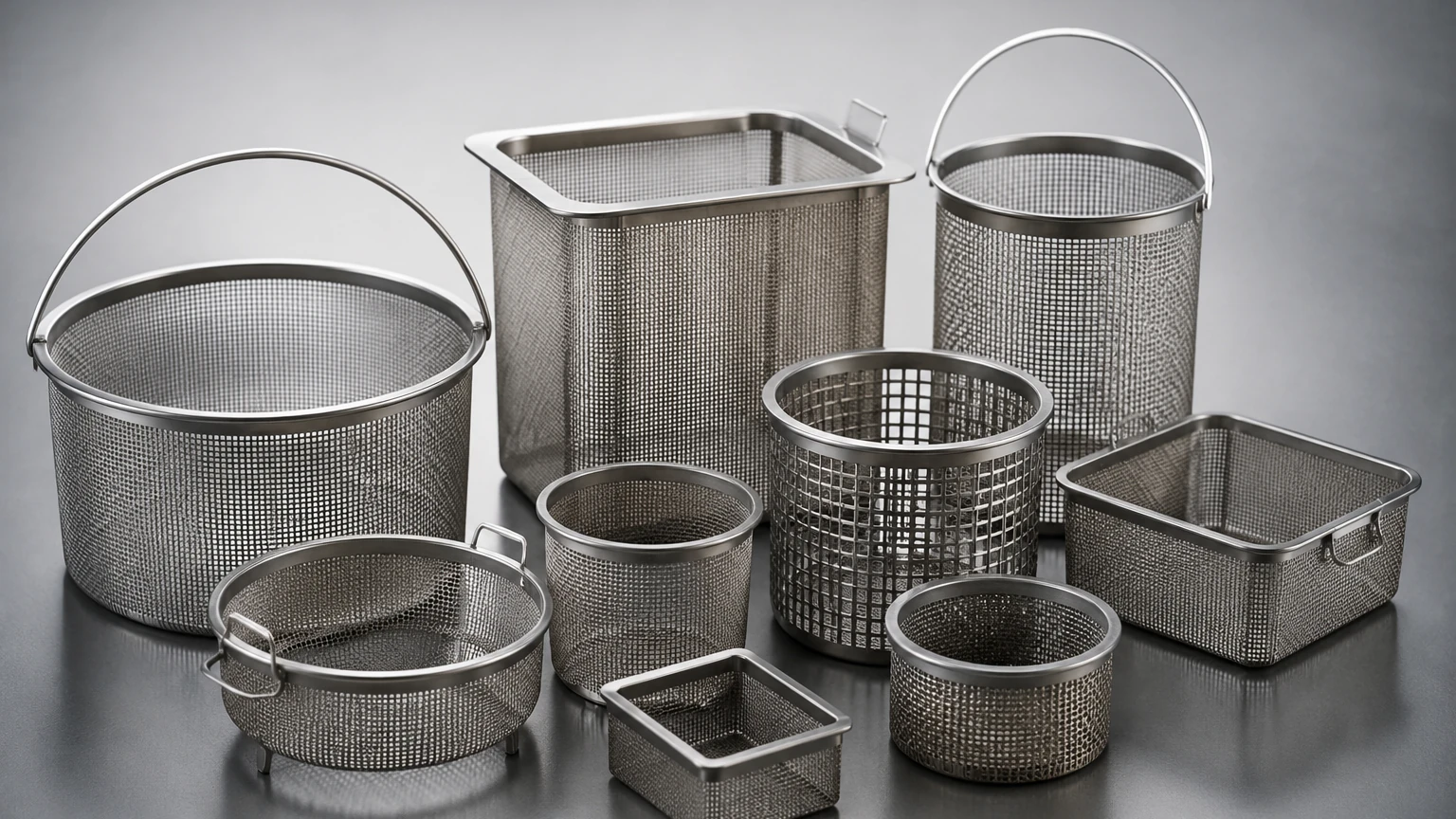
A titanium basket is more than just a container; it is a precision-engineered component that must balance structural integrity with process efficiency. The design process involves several critical variables.
Mesh and Perforation Types
The body of the basket is typically constructed from expanded metal, perforated sheet, or woven wire mesh.
1. Expanded Metal Mesh: This is the most common choice for anode baskets used in electroplating. The diamond-shaped openings allow for maximum surface area exposure and efficient electrolyte circulation while maintaining the structural rigidity needed to hold heavy metal nuggets or balls.
2. Perforated Sheet: Used when higher mechanical strength is required. Perforated titanium provides a more rigid structure, which is beneficial for large-scale baskets or those subjected to high-pressure cleaning cycles.
3. Woven Wire Mesh: For fine filtration applications, titanium wire mesh is integrated into the basket design. This allows for precise particle retention (micron-rated filtration) while benefiting from titanium’s chemical resistance. Kaifil specializes in integrating these fine meshes into robust basket frames for pharmaceutical and chemical processing.
Hook Design and Electrical Conductivity
In electroplating applications, the "hooks" of the titanium basket serve a dual purpose: they support the weight of the basket and its contents, and they act as the primary electrical contact point with the bus bar.
* Contact Efficiency: Titanium has lower electrical conductivity than copper or brass. To prevent overheating and ensure uniform current distribution, hooks are often designed with a copper core (titanium-clad copper). This combines the high conductivity of copper with the corrosion resistance of a titanium exterior.
* Hook Geometry: Hooks can be square, rectangular, or knife-edged. The choice depends on the shape of the bus bar and the need for a secure, low-resistance connection to prevent voltage drops and localized heating.
Reinforcement and Durability
Large titanium baskets, especially those used in heavy industrial cleaning or high-volume plating, require reinforcement ribs. These vertical or horizontal bands prevent the basket from bulging under the weight of the media (such as nickel or copper anodes). Proper welding is also paramount; TIG (Tungsten Inert Gas) welding in an inert argon atmosphere is required to prevent oxygen embrittlement of the welds, which would otherwise lead to premature structural failure.
Key Industrial Applications
1. Electroplating and Surface Finishing
Titanium baskets are most widely recognized as anode containers. In this role, they hold the plating metal (anode) while it dissolves into the electrolyte. Because titanium is insoluble in most plating baths, the basket maintains a constant geometry, ensuring consistent current density and uniform plating thickness on the workpiece. This is a significant advantage over consumable slab anodes, which change shape as they dissolve.
2. Chemical Processing and Heat Treatment
In chemical reactors, titanium baskets are used to hold catalysts or to contain parts during acid pickling and etching processes. Their ability to withstand boiling nitric acid and various organic acids makes them indispensable in the production of specialty chemicals and petrochemicals. In heat treatment, titanium baskets are used for quenching processes where parts are moved from high-temperature furnaces into corrosive cooling fluids.
3. Pharmaceutical and Food Processing
Due to its biocompatibility and resistance to sanitizing chemicals, titanium is an ideal material for baskets used in the pharmaceutical and food industries. These baskets are often used for centrifugal filtration or as dip-baskets for sterilizing components. The non-toxic nature of the titanium oxide layer ensures that no metallic contaminants leach into the product stream.
4. Marine and Desalination
In environments exposed to seawater, titanium is virtually immune to corrosion. Titanium baskets are used in sea strainers and filtration systems on offshore platforms and in desalination plants where even high-grade stainless steels like 316L eventually succumb to chloride-induced pitting.
Performance Evaluation and Selection Guide
When specifying titanium baskets for a new project or replacing existing equipment, engineers should evaluate the following criteria to ensure optimal performance and total cost of ownership.
Capacity and Load Calculations
The basket must be sized to accommodate the required volume of material without over-packing, which can restrict fluid flow. For anode baskets, the weight of the metal nuggets must be calculated to ensure the hooks and mesh can support the load without deformation. A safety factor of at least 2:1 is recommended for heavy-duty applications.
Filtration Accuracy
If the basket is used for solids recovery or fluid clarification, the micron rating of the mesh is the most important factor. Engineers must balance the need for fine filtration with the risk of pressure drop. A basket with too fine a mesh may clog (blind) quickly, requiring frequent maintenance, while too coarse a mesh will allow contaminants to pass through.
Current Density Requirements
For electrochemical applications, the total surface area of the basket and the conductivity of the hooks must be matched to the power supply’s output. Insufficient contact area leads to "hot spots," which can damage the bus bar or the basket hooks, leading to process interruptions.
Maintenance and Replacement Cycles
While titanium baskets have a much longer lifespan than those made of other materials, they are not maintenance-free.
* Cleaning: Periodic cleaning is required to remove "anode sludge" or mineral scale that can block the mesh openings.
* Inspection: Regular inspection of the hooks and welds for signs of mechanical wear or electrical arcing is essential.
* Repairability: One of the benefits of titanium is that it can often be repaired. Damaged mesh or broken hooks can be re-welded by specialists, extending the service life of the component significantly.
Customization: The Role of OEM Manufacturing
Standard off-the-shelf baskets rarely meet the specific needs of complex industrial systems. Customization is often necessary to account for unique tank dimensions, specific flow rates, or specialized handling equipment.
At Kaifil, we understand that every filtration and containment challenge is unique. Our manufacturing process begins with a technical consultation to determine the optimal mesh size, material grade, and structural design for your specific environment. By utilizing advanced TIG welding and precision metal forming, we produce titanium baskets that offer superior durability and performance. Whether you require a single custom basket for a pilot plant or a large-scale OEM production run for a global manufacturing facility, our focus remains on engineering excellence and material integrity.
Conclusion
Titanium baskets are a high-performance investment for any facility dealing with corrosive fluids or requiring high-purity processing. Their longevity, combined with the ability to maintain structural and chemical stability in harsh environments, provides a lower total cost of ownership compared to more frequent replacements of inferior materials. By focusing on correct material grading, robust structural engineering, and application-specific design, engineers can significantly improve the reliability of their industrial processes.
For more information on custom metal filtration and specialized industrial components, visit the Kaifil Main Page to explore our full range of capabilities and technical resources. Choosing the right partner for your titanium fabrication ensures that your equipment will stand up to the most rigorous industrial demands.
