


Titanium Woven Mesh
In the demanding landscape of industrial filtration and material science, titanium woven mesh stands out as a premier solution for environments where standard stainless steel fails. Known for its exceptional strength-to-weight ratio and unparalleled resistance to corrosive media, titanium mesh is a critical component in chemical processing, desalination, aerospace, and medical technology. For engineers and procurement specialists, understanding the technical nuances of titanium—from grade selection to weave patterns—is essential for optimizing system longevity and performance.
As a specialized manufacturer, Kaifil provides high-performance filtration solutions tailored to these rigorous requirements. By leveraging advanced manufacturing techniques, we ensure that every square inch of titanium woven mesh meets the precise mechanical and chemical specifications required for industrial-scale operations.
Material Science: Why Titanium?
Titanium is not merely a more expensive alternative to stainless steel; it is a distinct metallurgical choice driven by the need for chemical stability. The primary reason for titanium’s dominance in harsh environments is its ability to form a tenacious, self-healing oxide film (TiO2) instantaneously upon exposure to oxygen. This passive layer protects the underlying metal from a wide array of aggressive reagents.
Grade Selection for Woven Mesh
While titanium exists in many alloys, industrial woven mesh is most commonly produced using Commercially Pure (CP) grades. The choice of grade directly impacts the mesh's ductility, weldability, and corrosion resistance.
1. Grade 1: This is the most ductile and softest grade of titanium. It offers the highest cold formability, making it ideal for intricate weaving processes and applications where the mesh must be shaped into complex geometries.
2. Grade 2: Often referred to as the "workhorse" of the industrial titanium industry, Grade 2 offers a balance of moderate strength and excellent cold-forming properties. It is widely used in filtration because it provides superior weldability and is highly resistant to oxidation and corrosion.
3. Grade 5 (Ti-6Al-4V): Although less common in fine mesh weaving due to its high hardness and difficulty in wire drawing, Grade 5 is used when extreme structural strength is required. It is an alpha-beta alloy that is significantly stronger than CP grades but requires specialized manufacturing techniques.
Technical Specifications and Weave Types
The performance of titanium woven mesh is defined by its geometry. Engineers must specify the mesh count, wire diameter, and weave type to align with the particle retention requirements and pressure drop constraints of their system.
Plain Weave
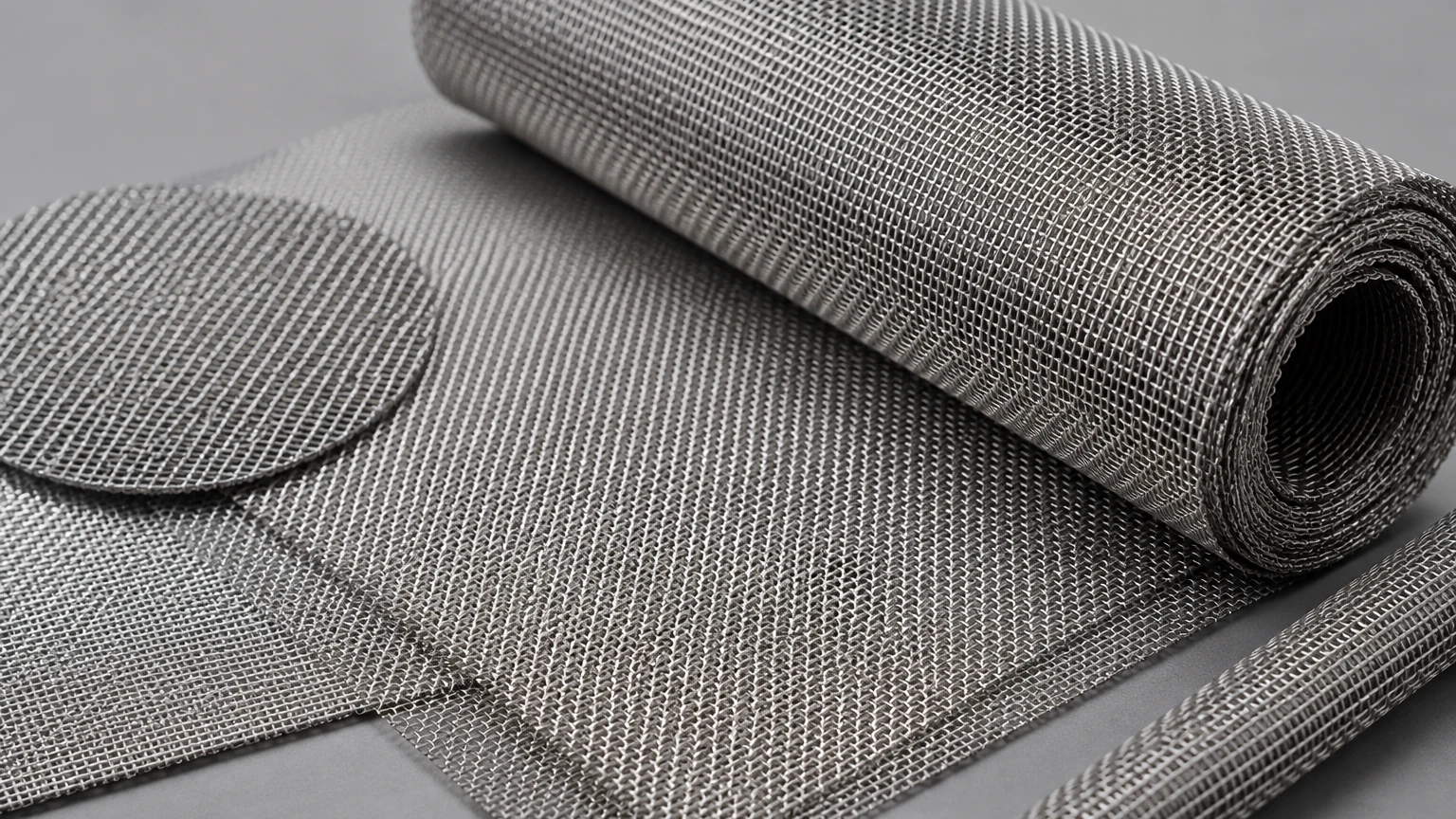
This is the most common weave pattern where each warp wire crosses over and under each successive weft wire. Plain weave titanium mesh provides a high degree of transparency and a predictable aperture size. It is typically used for general screening and medium-grade filtration where high flow rates are prioritized.
Twill Weave
In a twill weave, each warp wire passes over and under two successive weft wires. This allows for the use of heavier wire diameters in a given mesh count compared to plain weave. Twill weave is often selected when the mesh needs to withstand higher mechanical loads or when a finer mesh is required than what plain weaving can achieve with a specific wire thickness.
Dutch Weave (Plain and Twill)
Dutch weaves utilize different diameters for warp and weft wires. Usually, the warp wires are heavier, and the weft wires are thinner and driven closer together. This creates a dense, "tortuous path" for the fluid, resulting in very fine filtration ratings and high pressure resistance. Dutch weave titanium mesh is the standard for high-pressure hydraulic systems and fine chemical separation.
Corrosion Resistance in Aggressive Media
The primary driver for selecting titanium woven mesh is its performance in environments that would cause rapid pitting or stress corrosion cracking in 300-series or even 400-series stainless steels.
Chloride and Seawater Environments
Titanium is virtually immune to corrosion by seawater, brackish water, and marine atmospheres. In desalination plants and offshore oil and gas platforms, titanium mesh is used in intake screens and filtration units because it does not suffer from the crevice corrosion that often plagues stainless steel in high-chloride environments.
Acidic and Alkaline Resistance
Titanium exhibits excellent resistance to oxidizing acids, such as nitric acid, and solutions containing metal ions like ferric and cupric salts. It also performs exceptionally well in wet chlorine gas and chlorine dioxide solutions, making it indispensable for the pulp and paper industry and chlor-alkali chemical plants. However, engineers should note that titanium is susceptible to corrosion in reducing acids (like hydrofluoric or high-concentration sulfuric acid) unless specific inhibitors are present.
Industrial Applications of Titanium Woven Mesh
Chemical and Petrochemical Processing
In chemical reactors and storage tanks, titanium mesh serves as a catalyst support or a mist eliminator. Its ability to withstand high temperatures and aggressive chemical vapors ensures that the filtration media does not contaminate the process stream through metallic leaching.
Green Hydrogen Production (Electrolysis)
One of the most rapidly growing applications for titanium woven mesh is in Proton Exchange Membrane (PEM) electrolyzers. Titanium mesh is used as a liquid/gas diffusion layer (LGDL) or a current collector. Because the anode side of a PEM electrolyzer operates in a highly acidic and oxidizing environment at high voltages, titanium is one of the few materials that can maintain conductivity while resisting corrosion.
Medical and Pharmaceutical Manufacturing
Titanium is biocompatible and non-toxic. In pharmaceutical filtration, it is used to ensure that no heavy metal ions leach into the product. It is also used in the fabrication of medical implants and prosthetic devices where bone ingrowth or specialized fluid drainage is required.
Aerospace and Defense
Due to its high strength-to-weight ratio, titanium mesh is used in aircraft engine intake filters and hydraulic system components. It provides the necessary durability to withstand high-velocity debris impact while minimizing the overall weight of the aircraft.
Engineering Selection Criteria: What to Confirm Before Purchase
When specifying titanium woven mesh for an industrial project, engineers should evaluate several critical factors to ensure the longevity of the component and the efficiency of the overall system.
1. Filtration Rating vs. Flow Rate
There is always a trade-off between the fineness of the mesh (aperture size) and the flow rate (permeability). A finer mesh will capture smaller particles but will also result in a higher pressure drop across the filter. Engineers should use the "open area" percentage to calculate the expected flow dynamics. Kaifil assists technical teams in balancing these requirements by providing precise data on mesh geometry.
2. Mechanical Stress and Support
While titanium is strong, a fine mesh may lack the structural rigidity to withstand high-pressure differentials. In such cases, the titanium mesh should be pleated or supported by a coarser titanium perforated plate or a heavier mesh backup layer. This multi-layer approach ensures that the fine filtration layer does not deform or rupture under load.
3. Fabrication and Joining Methods
Titanium requires specialized welding techniques. Because it reacts strongly with oxygen at high temperatures, welding (such as TIG or laser welding) must be performed under a strict inert gas shield (usually Argon). When purchasing custom filter cartridges or components, it is vital to confirm that the manufacturer has the expertise to produce clean, contaminant-free welds that maintain the material's corrosion resistance.
4. Total Cost of Ownership (TCO)
While the initial capital expenditure for titanium woven mesh is higher than for stainless steel, the TCO is often lower in aggressive environments. Reduced downtime for maintenance, longer replacement cycles, and the prevention of process contamination contribute to a more cost-effective solution over the life of the equipment.
Comparison: Titanium vs. Stainless Steel and Nickel Alloys
To make an informed decision, it is helpful to compare titanium with other common filtration materials:
* Stainless Steel (316L): Lower cost and easier to fabricate, but susceptible to pitting in chloride-rich environments and general corrosion in strong acids.
* Nickel Alloys (Monel, Inconel): Excellent for high-temperature and specific alkaline environments, but often heavier than titanium and may not offer the same level of resistance in oxidizing acid service.
* Titanium: Highest resistance to chlorides and oxidizing acids, lowest weight, and excellent biocompatibility. It is the definitive choice for seawater and high-purity chemical applications.
Customization and Quality Assurance at Kaifil
At Kaifil, we understand that standard off-the-shelf mesh often fails to meet the unique demands of specialized industrial processes. Our manufacturing capabilities allow for extensive customization, including:
* Custom Mesh Counts: Weaving mesh to specific aperture requirements for precise particle retention.
* Edge Treatments: Providing finished edges to prevent fraying and facilitate easier installation into filter housings.
* Forming and Pleating: Engineering the mesh into cylinders, discs, or pleated cartridges to increase surface area and filtration capacity.
Quality assurance is at the core of our production. We ensure that the chemical composition of the titanium wire is verified and that the weave consistency is maintained throughout the roll. This level of precision is what makes Kaifil a trusted partner for global engineering firms.
Conclusion
Titanium woven mesh is an indispensable material for modern industry, providing a level of durability and chemical resistance that other metals cannot match. Whether it is used in the depths of a seawater desalination plant or at the heart of a hydrogen electrolyzer, its performance is a product of both superior material properties and precise engineering.
For engineers looking to optimize their filtration systems or develop new industrial components, selecting the right grade and weave of titanium is the first step toward a reliable solution. To explore our full range of custom metal filtration components and to discuss your specific application requirements with our technical team, please visit our Main Page.
By focusing on technical excellence and material integrity, Kaifil continues to support the most demanding industrial applications with high-quality titanium and stainless steel filtration solutions.
