


Tube Filtration
In industrial fluid and gas processing, tube filtration serves as a fundamental mechanism for ensuring product purity, protecting downstream equipment, and maintaining system efficiency. Unlike flat sheet filters or pleated cartridges, tube-style filters offer a specific geometry that is ideal for high-pressure environments, backwashing cycles, and integration into cylindrical housing systems. For engineers and procurement teams, selecting the right tube filtration component requires a deep understanding of material science, fluid dynamics, and the specific mechanical stresses of the application environment.
As a specialized manufacturer of stainless steel filtration solutions, Kaifil provides precision-engineered components designed to meet the rigorous demands of the chemical, pharmaceutical, and food and beverage sectors. This guide explores the technical considerations necessary for optimizing tube filtration performance.
Understanding the Fundamentals of Tube Filtration
Tube filtration refers to the use of cylindrical filter elements to remove solid particulates from a liquid or gaseous stream. The geometry of a tube allows for a high surface-area-to-volume ratio while maintaining structural rigidity. In most industrial applications, the fluid flows either from the outside in (O-I) or from the inside out (I-O), depending on the housing design and the method of cleaning required.
One of the primary advantages of the tubular form factor is its inherent strength under radial pressure. When a filter is subjected to high differential pressures, a cylindrical shape distributes the stress more evenly than a flat surface. This makes tube filtration particularly suitable for high-viscosity fluids or systems with high flow velocities where pressure spikes are common.
Material Selection: Why Stainless Steel Dominates Industrial Tube Filtration
While polymer-based tubes are common in low-temperature, low-pressure disposable applications, industrial-grade tube filtration almost exclusively relies on metallic media, specifically stainless steel. The choice of material is dictated by the chemical compatibility of the process fluid and the thermal requirements of the system.
1. 304 Stainless Steel: The standard choice for general industrial use, offering excellent strength and basic corrosion resistance. It is frequently used in water treatment and hydraulic oil filtration.
2. 316L Stainless Steel: The "L" denotes low carbon, which improves weldability and resistance to intergranular corrosion. This is the preferred material for the pharmaceutical and chemical industries, where exposure to corrosive agents or high-purity requirements is standard.
3. Specialty Alloys: In extreme environments involving high concentrations of chlorides or high-temperature acids, alloys like Hastelloy or Monel may be used to prevent pitting and stress corrosion cracking.
Stainless steel tube filters are favored not only for their durability but also for their "cleanability." Unlike disposable synthetic filters, metal tubes can be cleaned via ultrasonic baths, chemical cleaning, or backpulsing, significantly lowering the long-term cost of ownership.
Structural Design: From Wire Mesh to Sintered Metal
The performance of tube filtration is largely determined by the structure of the filter media. Engineers must choose between several construction methods based on the required filtration accuracy and the physical nature of the contaminants.
Woven Wire Mesh Tubes
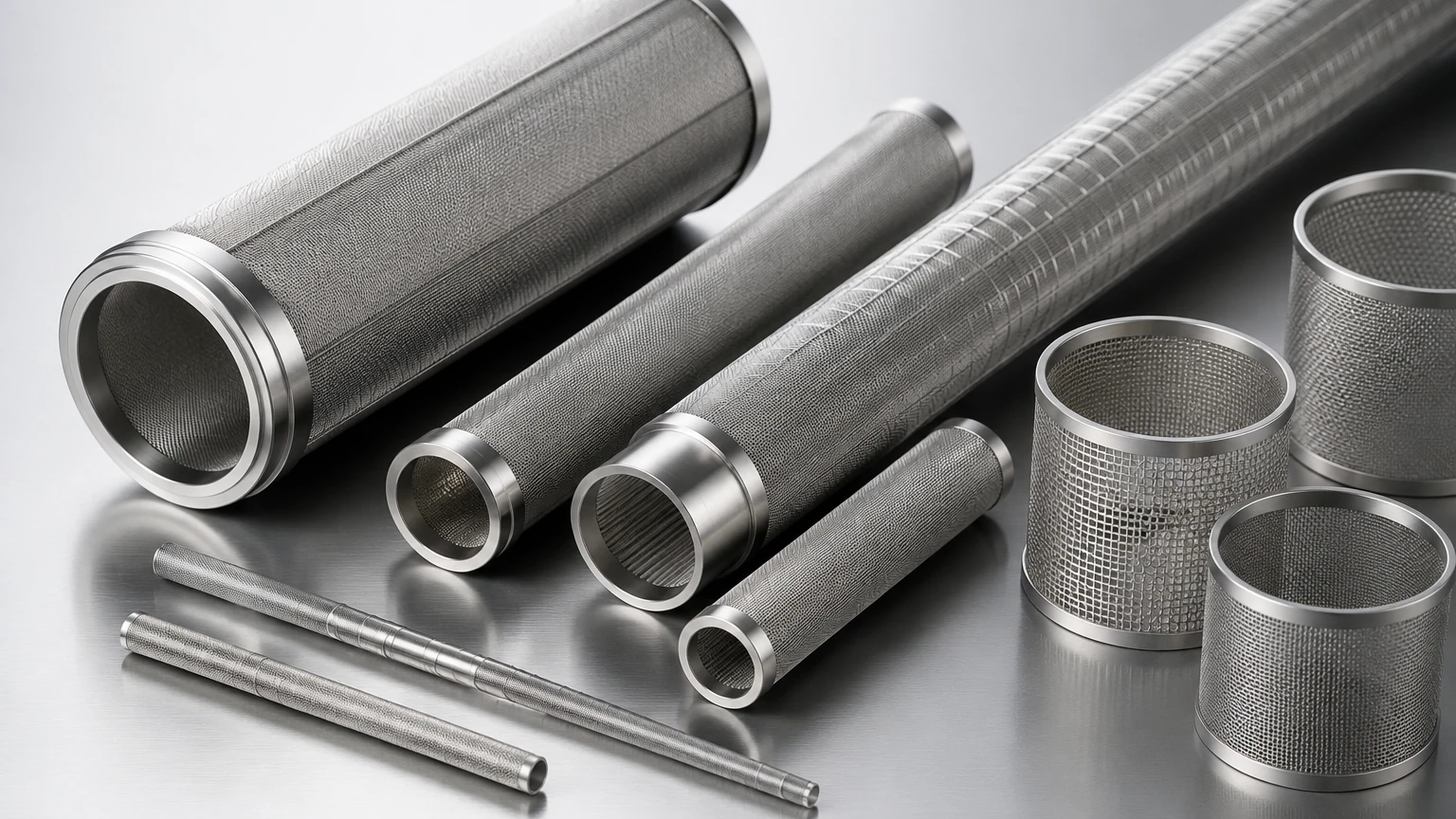
Woven wire mesh is the most versatile media for tube filtration. It consists of metallic wires woven into specific patterns (plain, twill, or dutch weave). This media provides precise pore sizes and a high open area, which translates to low initial pressure drops. Multi-layer mesh tubes, where several layers are sintered together, offer improved mechanical strength while maintaining high permeability.
Sintered Metal Tubes
Sintered metal filters are created by fusing metallic powder or fibers under high heat and pressure without melting them. This creates a porous, monolithic structure. Sintered tubes are the gold standard for high-pressure applications and fine filtration (down to sub-micron levels). They offer exceptional depth filtration capabilities, allowing them to trap particles within the complex tortuous path of the pores.
Perforated and Wedge Wire Tubes
For coarse filtration or as a support structure for finer mesh, perforated metal tubes or wedge wire screens are used. Wedge wire, in particular, is highly effective for "outside-in" filtration where the V-shaped profile of the wire prevents clogging and facilitates easy surface cleaning during backwashing.
Critical Selection Criteria: Micron Ratings and Pressure Drop
When specifying a filter on the Main Page of a technical requirement sheet, two metrics are paramount: the micron rating and the allowable pressure drop.
Nominal vs. Absolute Micron Ratings
Engineers must distinguish between nominal and absolute ratings. A nominal rating indicates the filter's ability to retain a majority of particles of a certain size (e.g., 90% of 10-micron particles). An absolute rating, common in high-precision stainless steel mesh, guarantees that 99.9% of particles above a specific size will be captured. For critical applications like catalyst recovery or pharmaceutical sterile air filtration, absolute ratings are mandatory.
Managing Differential Pressure (ΔP)
Every filter introduces a restriction to the flow. The initial clean pressure drop must be calculated to ensure the pump or compressor operates within its efficient range. As the filter cake builds up on the tube surface, the differential pressure increases. A well-designed tube filtration system will have a clearly defined "terminal ΔP," at which point the filter must be cleaned or replaced to prevent media collapse or bypass.
Customization and OEM Integration: Engineering for Specificity
Standard off-the-shelf filter tubes rarely meet the exact needs of specialized industrial machinery. Customization is often required in several key areas:
* End Fittings: Tubes can be configured with NPT/BSPT threads, flanges, O-ring seals (such as 222 or 226 configurations), or plain ends for welding. The seal integrity at the end fitting is just as critical as the filter media itself.
* Reinforcement: For high-pressure differentials, internal or external support cores (perforated or spiral-welded) are added to prevent the tube from bursting or collapsing.
* Multi-Stage Layers: Combining a coarse outer layer for large particle removal with a fine inner layer for final polishing can extend the service life of the filter element.
Kaifil specializes in these OEM requirements, ensuring that the tube filtration component integrates seamlessly into existing housings while meeting the specific flow rates and particle retention targets of the project.
Maintenance, Cleaning, and the Total Cost of Ownership
One of the most common questions engineers ask is regarding the replacement cycle. In many B2B industrial contexts, the goal is to move away from disposable elements toward permanent, cleanable stainless steel tubes. While the initial capital expenditure (CAPEX) for a stainless steel tube is higher than a plastic cartridge, the total cost of ownership (TCO) is often lower due to:
1. Reduced Waste: Eliminating the disposal costs of contaminated polymer filters.
2. Process Continuity: Many tube filtration systems are designed for in-situ cleaning (backwashing), which reduces downtime.
3. Durability: Stainless steel tubes can withstand aggressive cleaning chemicals and high-temperature steam sterilization (SIP), which would destroy synthetic media.
To maximize the lifespan of a tube filter, it is essential to monitor the pressure gauges and initiate cleaning cycles before the contaminant cake becomes "blinded" or compressed into the media pores, which can make cleaning much more difficult.
Application-Specific Requirements in Industrial Filtration
The requirements for tube filtration vary significantly across different sectors:
* Chemical Processing: Focuses on corrosion resistance and the ability to handle high-temperature solvents. Sintered 316L tubes are often used for catalyst protection.
* Food and Beverage: Requires "sanitary" designs. This means the tube must have smooth surfaces, no dead spaces where bacteria can grow, and must be compatible with Clean-in-Place (CIP) protocols.
* Hydraulic Systems: Prioritizes high-pressure fatigue resistance. Filter tubes in these systems must handle rapid fluctuations in flow and pressure without shedding media fibers.
* Water Treatment: Often utilizes wedge wire or coarse mesh tubes for pre-filtration to protect sensitive reverse osmosis (RO) membranes from large debris.
Conclusion
Selecting the appropriate tube filtration solution is a balance of mechanical engineering, material science, and operational strategy. By focusing on high-quality materials like stainless steel and choosing the correct media structure—whether woven mesh or sintered metal—industrial operators can achieve precise separation while ensuring long-term reliability.
For engineers looking to optimize their filtration processes or develop custom OEM components, reviewing technical specifications and manufacturing capabilities is the first step toward a more efficient system. To explore specific configurations and technical support for your filtration challenges, visit the Main Page for comprehensive product data and application guidance.
