


Vacuum Filter Flask
In industrial and laboratory filtration processes, the vacuum filter flask—also known as a Büchner flask, side-arm flask, or Kitasato flask—serves as a fundamental component for rapid liquid-solid separation. While often associated with laboratory-scale chemistry, the principles governing the vacuum filter flask are foundational to the larger-scale industrial filtration systems used in chemical processing, pharmaceuticals, and food production. For engineers and technical professionals, understanding the mechanics, material limitations, and safety protocols of vacuum filtration is essential for optimizing throughput and ensuring the integrity of the filtered media.
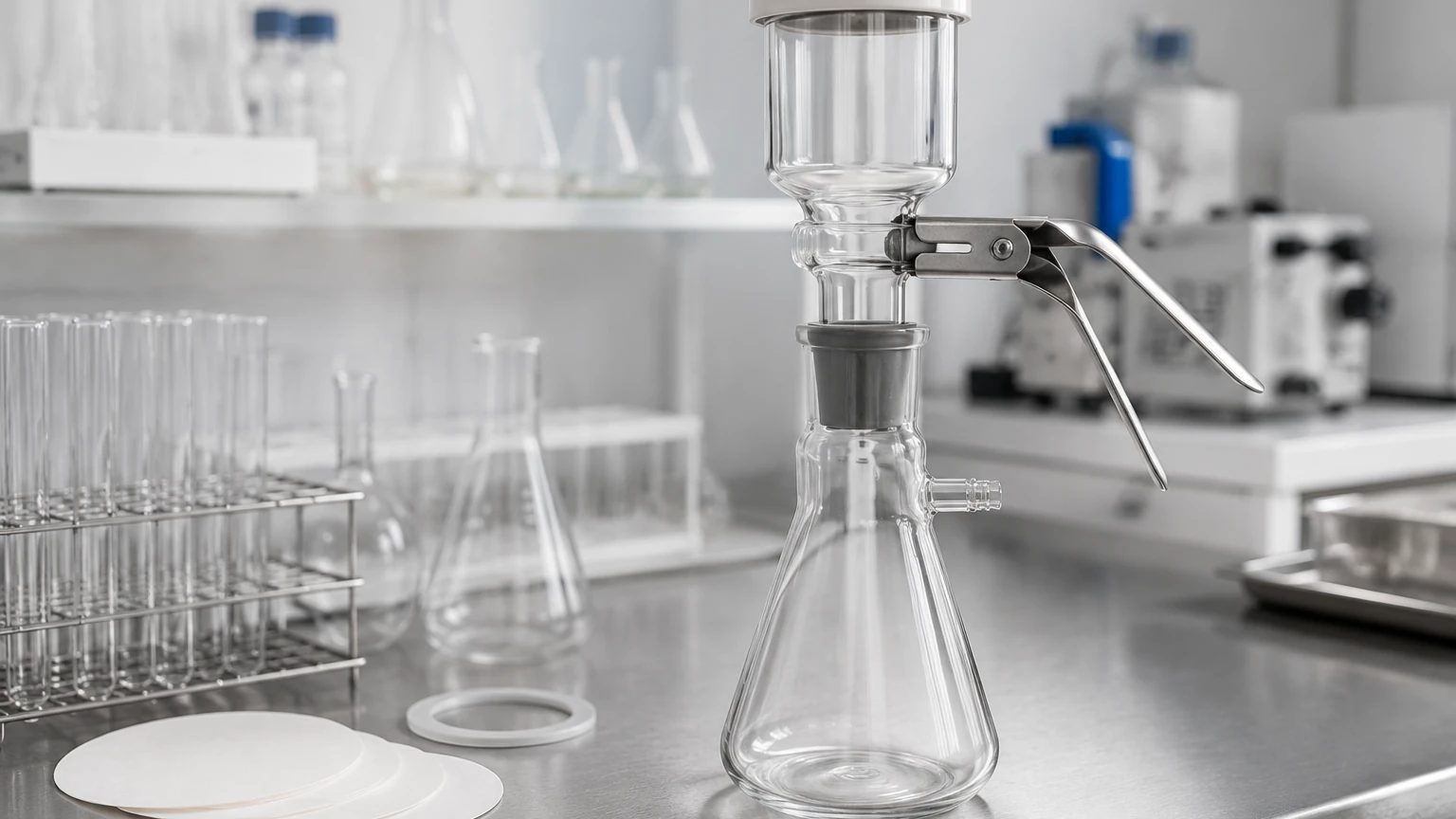
At its core, a vacuum filter flask is designed to withstand a pressure differential. Unlike standard Erlenmeyer flasks, these vessels feature significantly thicker walls and a specialized side arm for vacuum connection. This allows for the use of vacuum-assisted filtration, which significantly accelerates the process compared to gravity-based methods. For industrial applications requiring high-purity results, the choice of the flask and its accompanying filter media, such as the precision components found at Main Page, determines the efficiency of the entire separation workflow.
Engineering Principles of Vacuum Filtration
The primary function of a vacuum filter flask is to facilitate a pressure differential across a filter medium. In a standard gravity filtration setup, the flow rate is limited by the hydrostatic head of the liquid and the resistance of the filter cake. Vacuum filtration overcomes these limitations by creating a partial vacuum within the flask, effectively "pulling" the filtrate through the medium.
The Role of Differential Pressure
According to Darcy’s Law, the flow rate through a porous medium is directly proportional to the pressure drop across that medium. By connecting a vacuum pump or a water aspirator to the side arm of the flask, the internal pressure is reduced below atmospheric levels. This creates a driving force that overcomes the resistance of fine-pored filter media and viscous liquids. In industrial contexts, this principle is scaled up using stainless steel filter housings and vacuum receivers, but the underlying physics remains the same.
Fluid Dynamics and Particulate Retention
When selecting a vacuum filter flask system, engineers must consider the viscosity of the fluid and the particle size distribution of the solids. A vacuum that is too high can cause "blinding" or clogging of the filter media if the particles are forced into the pores too aggressively. Conversely, insufficient vacuum leads to uneconomical processing times. The goal is to achieve a steady state where the filtrate flow is maximized without compromising the structural integrity of the filter cake or the vessel itself.
Material Selection and Chemical Compatibility
Vacuum filter flasks are typically manufactured from heavy-walled borosilicate glass, specifically chosen for its low coefficient of thermal expansion and high resistance to chemical attack. However, the choice of material must be strictly aligned with the specific industrial application to prevent equipment failure or product contamination.
Borosilicate Glass vs. Industrial Alternatives
Standard lab-grade flasks are made from 3.3 borosilicate glass, which is resistant to most acids, saline solutions, and organic solvents. However, in certain industrial environments where hydrofluoric acid, strong alkalis, or high-temperature phosphoric acid are present, glass may degrade. In these instances, technical teams may look toward specialized polymer-coated glass or even stainless steel vacuum receivers for enhanced durability.
Gasket and Stopper Compatibility
The interface between the vacuum filter flask and the filtration funnel (such as a Büchner or Hirsch funnel) requires a vacuum-tight seal. This is usually achieved using rubber stoppers or G3 neoprene gaskets. It is critical to ensure that these sealing materials are compatible with the solvents being used. For example, standard nitrile or natural rubber may swell or degrade when exposed to certain hydrocarbons, leading to vacuum leaks and potential batch contamination.
Critical Design Features of a Vacuum Filter Flask
The design of a vacuum filter flask is dictated by safety and functionality. Every feature, from the wall thickness to the geometry of the side arm, is engineered to mitigate the risks associated with vacuum-induced stress.
Wall Thickness and Structural Integrity
The most defining characteristic of a vacuum flask is its wall thickness. Standard glassware is not rated for vacuum use; attempting to pull a vacuum on a standard Erlenmeyer flask can result in a violent implosion. Vacuum-rated flasks are engineered to distribute atmospheric pressure evenly across the surface area of the vessel. Engineers must inspect flasks regularly for scratches, chips, or "stars," as these minor defects act as stress concentrators that can lead to catastrophic failure under vacuum.
Side Arm Configurations
The side arm (or tubulation) is the point of connection for the vacuum hose. In high-demand industrial settings, the side arm is often reinforced to prevent breakage when thick-walled vacuum tubing is attached or removed. Some modern designs incorporate a threaded plastic side arm that can be replaced if damaged, reducing the total cost of ownership by eliminating the need to replace the entire flask due to a minor break at the port.
Neck Dimensions and Funnel Integration
The neck of the flask must be sized to accommodate the required funnel capacity. A common bottleneck in pilot-scale filtration is choosing a flask with a neck too narrow for the necessary flow rate. The internal diameter of the neck must allow for a secure fit of the stopper while maintaining enough clearance for the funnel stem to bypass the side arm opening, preventing filtrate from being sucked directly into the vacuum line.
Safety and Performance Considerations
Operating a vacuum filter flask involves inherent risks, primarily centered around vessel implosion and chemical exposure. Adhering to strict engineering protocols is necessary to maintain a safe working environment.
Implosion Protection
Even a small vacuum flask holds a significant amount of potential energy when evacuated. If a flask fails, the surrounding atmospheric pressure forces the glass inward, followed by a secondary outward spray of shards. To mitigate this, many industrial facilities utilize plastic-coated flasks or safety shields. Wrapping the flask in a mesh or specialized tape can also contain fragments in the event of a failure.
Vacuum Regulation
It is a common misconception that "more vacuum is always better." Excessive vacuum can lead to the evaporation of volatile solvents (flashing), which can damage vacuum pumps and lead to the loss of filtrate volume. Using a vacuum regulator or a bleed valve allows the operator to maintain the optimal pressure for the specific filtration task, ensuring consistent results across different batches.
Maintenance and Replacement Cycles
Unlike standard laboratory glassware, vacuum filter flasks have a finite lifespan dictated by their physical condition. In a B2B environment, a rigorous maintenance schedule should include visual inspections under polarized light to detect internal stresses in the glass. Flasks that have been subjected to thermal shock or mechanical impact should be decommissioned from vacuum service immediately, even if no visible cracks are present.
Transitioning from Lab to Industrial Scale
While the vacuum filter flask is an excellent tool for small-scale batches and R&D, industrial production often requires a transition to more robust systems. This is where the expertise in stainless steel filtration components becomes vital.
From Glass to Stainless Steel
As processes scale up, the fragility of glass becomes a liability. Industrial vacuum filtration systems often replace glass flasks with stainless steel vacuum receivers. These metal vessels offer superior mechanical strength, better heat transfer properties for temperature-controlled filtration, and complete immunity to the risk of shattering. For companies looking to move from benchtop setups to full-scale production, integrating custom stainless steel filter cartridges and wire mesh filters into their vacuum systems is a logical progression.
Customization Options for Industrial Filtration
In demanding industrial environments, off-the-shelf solutions rarely suffice. Customization of the filtration media is often required to meet specific micron ratings and flow requirements. Whether it is a specialized wire mesh for a chemical reactor or a reinforced filter cartridge for a hydraulic system, the performance of the vacuum system is only as good as the filter element it houses. Engineers should work closely with manufacturers to specify the exact material grade (such as 304 or 316L stainless steel) and the structural design required for their specific pressure and temperature parameters.
Selecting the Right Filtration Components
Choosing the correct vacuum filter flask and its associated components requires a thorough understanding of the process requirements. Engineers should confirm several factors before finalizing their equipment selection:
1. Total Volume: The flask should be large enough to hold the entire volume of the filtrate, or a manifold system should be used for continuous processing.
2. Micron Rating: The filter media used within the flask assembly must be rated for the specific particle size that needs to be retained. Over-specifying (choosing a filter that is too fine) will lead to unnecessarily slow filtration times.
3. Chemical Compatibility: Ensure that the flask, stoppers, and filter media are all resistant to the process fluids.
4. Vacuum Source: The vacuum pump must be capable of reaching the required ultimate pressure while handling any vapors that may be pulled through the flask.
For those involved in the procurement and engineering of filtration systems, the vacuum filter flask represents the intersection of laboratory precision and industrial utility. By understanding the technical nuances of these vessels and knowing when to transition to more durable stainless steel solutions, organizations can ensure efficient, safe, and cost-effective filtration outcomes. For more information on high-performance filtration components that complement vacuum systems, professionals can Review product options and application support to find tailored solutions for their specific industrial needs.
