


Vacuum Filtering Erlenmeyer Flask
In the landscape of industrial research, chemical processing, and pharmaceutical development, the vacuum filtering Erlenmeyer flask—commonly referred to as a Büchner flask or side-arm flask—serves as a fundamental component for solid-liquid separation. While often associated with laboratory-scale operations, the engineering principles behind these flasks are critical for professionals who are scaling processes from benchtop prototypes to full-scale industrial filtration systems. Understanding the structural requirements, material limitations, and integration possibilities of these flasks is essential for maintaining process integrity and safety.
Industrial filtration often requires a transition from batch-scale glass apparatus to robust, high-capacity stainless steel systems. However, the vacuum filtering Erlenmeyer flask remains the primary tool for initial filtration testing, catalyst recovery, and small-batch purification. This guide explores the technical specifications of these flasks and how they interface with larger industrial filtration components.
Understanding the Role of the Vacuum Filtering Erlenmeyer Flask in Industrial Processes
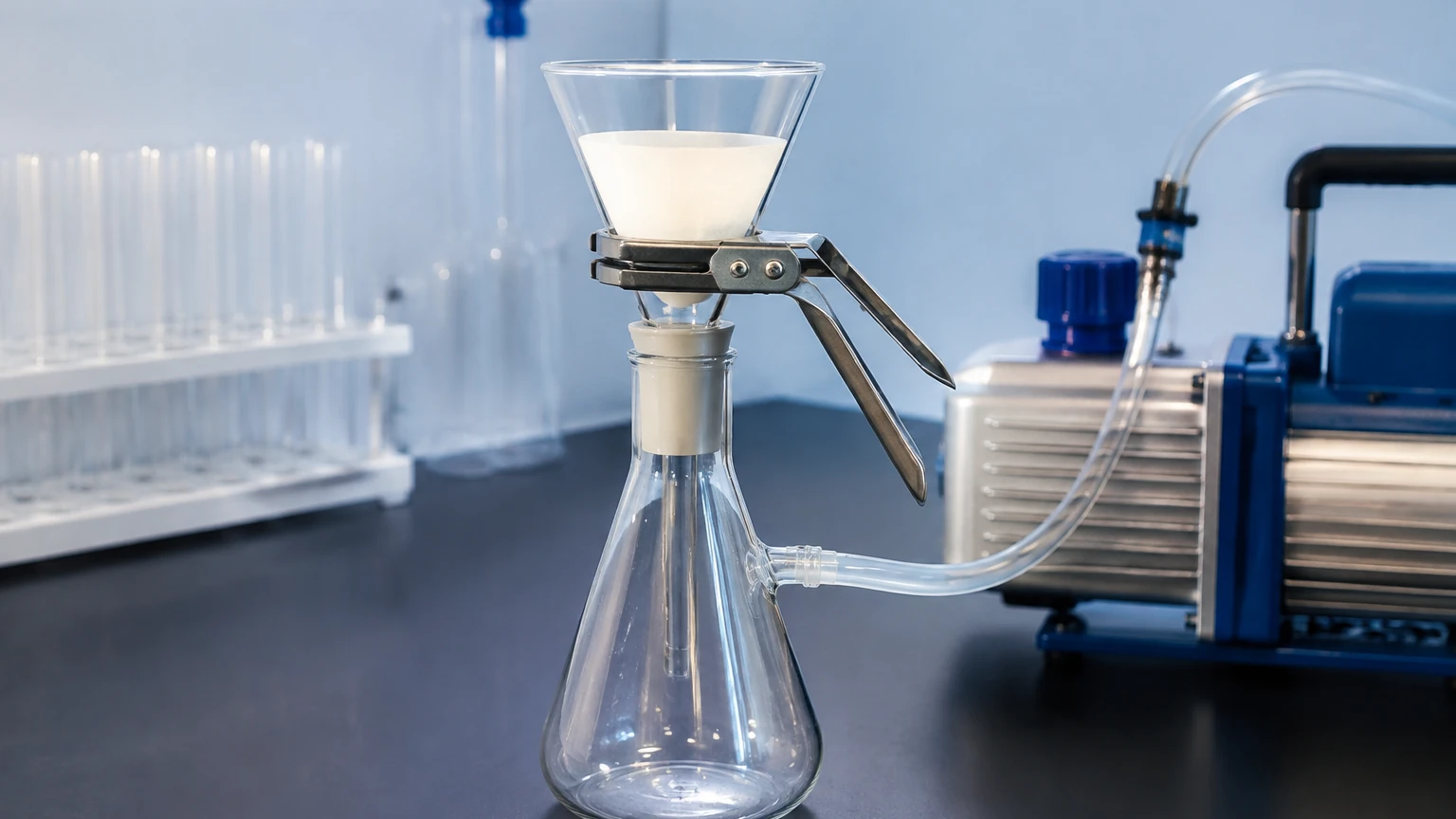
The vacuum filtering Erlenmeyer flask is designed specifically to withstand the pressure differentials created during vacuum-assisted filtration. Unlike a standard Erlenmeyer flask, which is intended for mixing and storage at atmospheric pressure, the vacuum variant features significantly thicker walls and a specialized side-arm (tubulature) for connection to a vacuum source.
In industrial R&D, this setup is used to accelerate the filtration process. By creating a pressure drop across the filter media, the liquid (filtrate) is forced through the media into the flask, leaving the solids (filter cake) behind on the filter support. This method is significantly faster than gravity filtration and is particularly effective when dealing with viscous liquids or fine particulate matter that would otherwise clog the filter media prematurely.
For engineers, the flask represents the first stage in defining the filtration parameters—such as micron rating and flow rate—that will eventually dictate the design of industrial-scale Main Page solutions, including stainless steel filter cartridges and wire mesh assemblies.
Engineering Specifications: Material and Structural Integrity
The primary material used for vacuum filtering Erlenmeyer flasks is borosilicate glass 3.3. This material is selected for its low coefficient of thermal expansion and high resistance to chemical attack. In a B2B procurement context, verifying the glass quality is paramount to ensure the flask can handle both thermal shock and the mechanical stress of a vacuum.
Wall Thickness and Pressure Resistance
Structural failure in a vacuum flask usually results in an implosion, which can be hazardous due to flying glass shards and the potential release of chemicals. Industrial-grade flasks are manufactured with extra-heavy walls. The thickness is not uniform; it is strategically increased at the neck and the base to support the weight of the funnel and the downward force of the vacuum.
The Side-Arm Design
The side-arm, or tubulature, is typically integrated into the neck of the flask. In professional applications, this arm is often barbed to provide a secure grip for vacuum tubing, preventing accidental disconnection during high-pressure operations. Some advanced models include replaceable plastic side-arms to reduce the risk of breakage at this vulnerable point.
Key Components of a Vacuum Filtration Setup
A vacuum filtering Erlenmeyer flask does not operate in isolation. It is part of a system that must be carefully matched to ensure efficiency and compatibility with the processed materials.
1. The Filter Support: This is usually a Büchner funnel (ceramic or plastic) or a fritted glass funnel. The choice depends on the chemical compatibility of the solvent being filtered.
2. Filter Media: While filter paper is common in basic labs, industrial applications often utilize precision stainless steel wire mesh discs. These provide superior durability and can be manufactured to specific micron ratings to match industrial production standards.
3. Vacuum Source: This can range from a simple water aspirator to a dedicated dry vacuum pump. The level of vacuum achieved must stay within the rated limits of the flask to avoid structural failure.
4. Sealing Elements: Rubber stoppers or specialized adapters are used to create an airtight seal between the funnel and the flask neck. Any leak in this interface significantly reduces filtration efficiency.
Selection Criteria for Technical Procurement
When selecting a vacuum filtering Erlenmeyer flask for industrial or pilot-plant use, purchasing teams and engineers must evaluate several technical factors beyond simple volume capacity.
Volume and Headspace
Flasks are available in sizes ranging from 25ml to 20,000ml (20 liters). However, for safety and efficiency, the flask should never be filled beyond its rated capacity. In fact, leaving sufficient headspace is critical to prevent the filtrate from being drawn into the vacuum line, which can damage pumps and contaminate the system.
Neck Diameter and Taper
Standardization is key in B2B environments. Most professional flasks utilize standard taper joints or specific neck diameters that must match the stoppers and funnels already in the facility’s inventory. Ensuring compatibility with existing hardware reduces the need for custom adapters.
Vacuum Rating
Not all flasks are rated for full vacuum. Engineers must confirm the maximum negative pressure the flask can safely sustain. For high-demand applications, stainless steel vacuum receivers may be substituted for glass flasks to eliminate the risk of implosion entirely.
Safety Protocols and Risk Mitigation in Vacuum Operations
Operating a vacuum filtering Erlenmeyer flask involves inherent risks that must be managed through strict safety protocols. Unlike positive pressure systems, which leak outward, vacuum systems fail inward.
* Visual Inspection: Before every use, the flask must be inspected for "stars," scratches, or chips. Even a minor surface defect can act as a stress concentrator, leading to a catastrophic implosion under vacuum.
* Thermal Stress: While borosilicate glass is heat-resistant, rapid temperature changes can weaken the structure. Flasks should be allowed to cool or warm gradually.
* Shielding: In many industrial labs, vacuum flasks are placed behind safety shields or wrapped in plastic mesh. This mesh is designed to contain glass fragments in the event of an implosion, protecting the operator and surrounding equipment.
From Laboratory Bench to Industrial Production: Scaling Filtration
The vacuum filtering Erlenmeyer flask is an excellent tool for feasibility studies, but it has clear limitations in a production environment. As volumes increase, the manual nature of flask filtration becomes a bottleneck. This is where the transition to industrial-grade filtration components becomes necessary.
When scaling up, the data gathered during flask filtration—such as the time required to filter a specific volume and the clarity of the filtrate—is used to specify larger systems. These systems often replace the glass flask with stainless steel filter housings and the simple funnel with high-surface-area filter cartridges.
Kaifil specializes in this transition, providing the precision metal components required to move from benchtop testing to continuous or large-batch industrial processing. By utilizing custom wire mesh and stainless steel cartridges, manufacturers can achieve the same precision found in lab-scale vacuum filtration but with the durability and flow rates required for commercial output.
Optimizing Filtration Performance with Precision Media
The efficiency of a vacuum filtering Erlenmeyer flask setup is largely determined by the media used within the funnel. For industrial professionals, moving away from disposable paper to reusable, high-precision media is a common step toward process optimization.
Stainless Steel Wire Mesh
Using stainless steel wire mesh as the filter medium within a vacuum setup offers several advantages. It provides a fixed pore size that does not swell or degrade in the presence of harsh solvents. This ensures consistent results across multiple batches. Furthermore, stainless steel mesh can be cleaned and sterilized, making it ideal for pharmaceutical and food-grade applications where contamination is a primary concern.
Customization for Specific Applications
In many cases, standard off-the-shelf filtration components do not meet the specific requirements of a unique chemical process. Customization of the filter support and media allows for optimized flow rates and particle retention. Whether it is adjusting the alloy for better corrosion resistance or engineering a multi-layer mesh for fine filtration, these technical adjustments are what differentiate a standard lab setup from a professional industrial process.
For those looking to enhance their filtration capabilities or transition from laboratory-scale vacuum filtering erlenmeyer flask setups to robust industrial systems, exploring professional-grade components is the next logical step. You can review product options and application support by visiting the Main Page to see how custom stainless steel solutions can be integrated into your specific workflow.
Conclusion: The Foundation of Reliable Filtration
The vacuum filtering Erlenmeyer flask remains a cornerstone of the filtration process, providing a reliable and transparent way to perform solid-liquid separation at a small scale. By understanding the engineering requirements of these flasks—from material composition to safety limits—technical professionals can ensure that their initial process development is both safe and accurate.
As processes grow in complexity and volume, the lessons learned from the vacuum flask guide the selection of industrial-strength filtration solutions. Transitioning to high-performance stainless steel cartridges and precision wire mesh ensures that the efficiency discovered on the lab bench is maintained at the production line, ultimately leading to higher product quality and more cost-effective operations.
