


Vented Disc Filters
In industrial filtration and fluid management, the ability to balance pressure while preventing contamination is a critical engineering requirement. Vented disc filters serve as specialized components designed to allow the passage of gases while retaining solids or, in specific configurations, separating liquid phases. These components are ubiquitous in sectors ranging from automotive sensor protection and medical device manufacturing to large-scale chemical processing and hydraulic systems.
For engineers and procurement professionals, selecting the appropriate vented disc filter involves a deep understanding of material science, fluid dynamics, and the specific environmental stressors of the application. As a manufacturer specializing in stainless steel filtration solutions, Kaifil provides precision-engineered components that meet these rigorous industrial demands. This guide explores the technical foundations, selection criteria, and operational considerations for vented disc filters in B2B environments.
Understanding the Functionality of Vented Disc Filters
The primary role of a vented disc filter is to act as a breathable barrier. In many closed systems, temperature fluctuations or fluid displacement can lead to pressure imbalances. If a system cannot "breathe," it risks mechanical failure, seal leakage, or inaccurate sensor readings. Vented disc filters provide a controlled path for air or gas to enter or exit a system while ensuring that the internal environment remains free from particulate matter.
Unlike standard liquid filters, which are designed for continuous flow, vented filters often operate in a bidirectional or intermittent capacity. They must maintain high gas permeability while offering a specific micron rating to block contaminants. In stainless steel variants, this is achieved through the use of multi-layered wire mesh or sintered metal powder structures. The porosity is carefully calibrated to ensure that the "bubble point"—the pressure at which gas overcomes the surface tension of a liquid within the pores—is appropriate for the system's safety parameters.
Material Selection and Engineering Specifications
Material integrity is the most significant factor in the longevity and reliability of vented disc filters. Because these filters are often exposed to harsh outdoor environments, corrosive chemicals, or high-temperature sterilization cycles, stainless steel is the industry standard.
Stainless Steel Grades
Most industrial vented discs are manufactured from Grade 304 or Grade 316L stainless steel.
- Grade 304: Suitable for general industrial applications where basic corrosion resistance is required.
- Grade 316L: Preferred for pharmaceutical, food and beverage, and marine environments due to its superior resistance to pitting and chloride-induced corrosion. The "L" designation (low carbon) is essential for components that require welding, as it prevents carbide precipitation.
Mesh Structure and Sintering
The performance of the filter is determined by the weave type and the manufacturing process.
- Woven Wire Mesh: Available in plain, twilled, or Dutch weaves. Dutch weaves offer higher strength and finer filtration ratings, making them ideal for high-pressure venting.
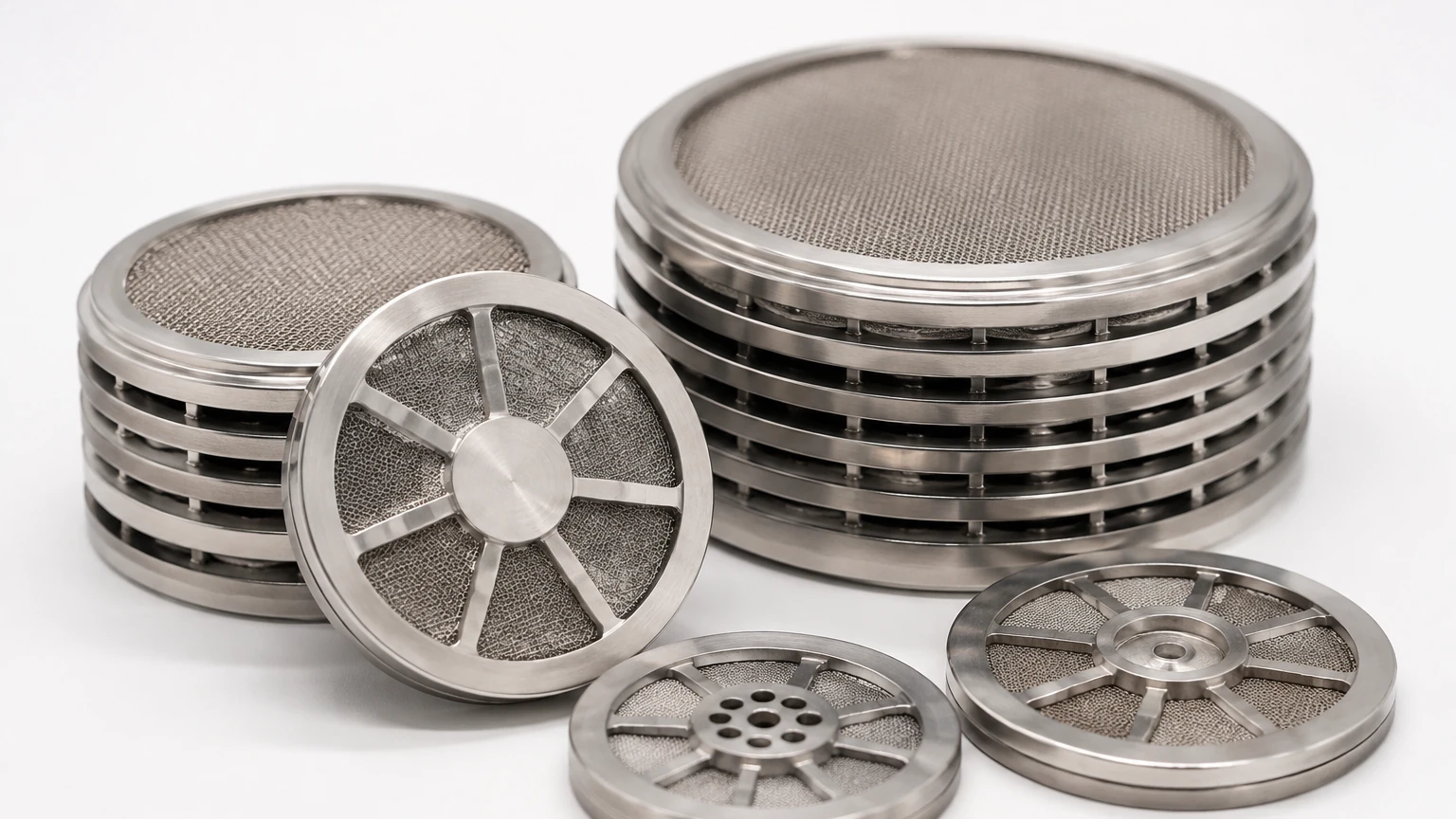
- Sintered Metal Mesh: This process involves bonding multiple layers of wire mesh together using heat and pressure without the use of binders. Sintering creates a robust, monolithic structure that eliminates the risk of wire migration—a common failure point in high-vibration environments like automotive exhaust sensors or hydraulic reservoirs.
Key Performance Evaluation Criteria
When specifying vented disc filters for a project, engineers must look beyond simple dimensions. The following technical parameters define the filter's efficacy in a real-world application:
1. Air Flow Rate and Permeability
Air flow is typically measured in liters per minute per square centimeter (L/min/cm²) at a specific differential pressure. For venting applications, the filter must allow enough gas to pass to equalize pressure rapidly. If the permeability is too low, the pressure lag could damage sensitive diaphragms or housings.
2. Micron Rating (Absolute vs. Nominal)
In B2B procurement, it is vital to distinguish between nominal and absolute micron ratings. An absolute rating indicates that 99.9% of particles above a certain size will be captured. For vented discs protecting sensitive electronics or sterile environments, an absolute rating is usually required to ensure no bypass of hazardous particulates.
3. Water Entry Pressure (WEP)
In applications where the filter must allow air to pass but block liquid water (such as in outdoor electrical enclosures), the Water Entry Pressure is a key metric. This measures the amount of pressure required to force water through the hydrophobic or fine-mesh structure of the filter. For stainless steel filters, this is often managed through extremely fine pore sizes or specialized surface treatments.
4. Mechanical Strength and Differential Pressure
Vented discs must withstand the maximum differential pressure (ΔP) the system might encounter during a surge. Sintered stainless steel discs are particularly valued here because they can resist collapse or bursting far better than polymer-based membranes.
Common Risks and Failure Modes in Industrial Venting
Failure to properly specify a vented disc filter can lead to systemic issues. Understanding these risks helps in developing a robust maintenance and selection strategy.
Clogging and Surface Loading
In environments with high dust concentrations, vented filters can suffer from surface loading. As particles accumulate on the outer layer, the air flow rate drops. Engineers should consider the "dirt holding capacity" of the filter. Using a pleated disc or a multi-layered depth-filter structure can extend the service life by providing more surface area for particle entrapment.
Chemical Incompatibility
While stainless steel is highly resistant, certain chemicals (such as strong acids or high-concentration chlorides) can degrade the mesh over time. This degradation often manifests as "pinhole" leaks, where the filtration accuracy is compromised long before the filter physically breaks apart.
Improper Installation and Sealing
A vented disc is only as effective as its seal. If the disc is not perfectly seated within its housing, gas and contaminants will take the path of least resistance—bypassing the filter entirely. Common sealing methods include ultrasonic welding, mechanical clamping, or over-molding with elastomers. Ensuring that the filter disc dimensions have tight tolerances is critical for these assembly processes.
Customization and OEM Integration
Standard off-the-shelf filters rarely meet the precise needs of specialized industrial equipment. Customization is often necessary to balance the competing demands of space, flow rate, and durability.
Kaifil specializes in providing OEM solutions where the vented disc is tailored to the specific housing of the client’s machinery. Customization options include:
- Geometric Variations: Producing discs in non-standard diameters, thicknesses, or even non-circular shapes to fit compact manifolds.
- Layered Composites: Combining different mesh counts to create a gradient filtration effect, which improves flow and longevity.
- Integrated Frames: Supplying the filter disc pre-mounted in a stainless steel or plastic ring to simplify the client's final assembly line.
By working closely with a manufacturer during the design phase, engineering teams can optimize the total cost of ownership. A slightly more expensive, high-durability sintered disc may eliminate the need for frequent maintenance shutdowns, providing better long-term value than a cheaper, disposable alternative.
Pre-Purchase Checklist for Engineering Teams
Before finalizing a specification for vented disc filters, the following information should be confirmed to ensure the component is fit for purpose:
1. Operating Environment: What is the maximum and minimum temperature? Is there exposure to salt spray, UV radiation, or aggressive cleaning agents?
2. Flow Requirements: What is the required air flow at the maximum allowable pressure differential?
3. Contaminant Profile: What is the size and nature of the particles being filtered? Are they dry dust, oily mists, or biological agents?
4. Regulatory Compliance: Does the application require FDA-compliant materials for food contact, or specific ISO certifications for medical or automotive use?
5. Assembly Method: How will the disc be secured? (e.g., press-fit, welding, or adhesive bonding).
By addressing these factors, purchasing teams can avoid the common pitfalls of under-specification, which often leads to premature component failure and increased operational risk.
Conclusion
Vented disc filters are small but vital components that ensure the safety and efficiency of complex industrial systems. Whether protecting a sensitive pressure transducer or venting a large chemical storage tank, the choice of filter material and structure has a direct impact on system performance. Stainless steel filters, particularly those manufactured with precision sintering techniques, offer the durability and reliability required for demanding B2B applications.
For organizations looking to optimize their filtration processes or develop custom OEM components, partnering with an experienced manufacturer is essential. To explore technical specifications, Review product options and application support on our Main Page to see how Kaifil’s engineering expertise can support your next project. From material selection to final production, ensuring the right filtration solution starts with a clear understanding of your application's unique technical boundaries.
