


Wastewater Filter
In industrial operations, the management of process water and effluent is a critical engineering challenge. A wastewater filter serves as the primary mechanical barrier against contaminants, ensuring that discharge meets environmental regulations or that water is sufficiently pre-treated for recycling within a closed-loop system. Unlike standard commercial filtration, industrial wastewater treatment requires components capable of withstanding aggressive chemical environments, high pressure, and heavy solids loading.
For engineers and procurement specialists, selecting the right filtration media is not merely about removing particles; it is about balancing filtration efficiency with operational uptime and total cost of ownership. Stainless steel filtration solutions, such as those found on the Kaifil Main Page, provide the structural integrity and chemical resistance necessary for these demanding applications.
The Role of Stainless Steel in Industrial Wastewater Treatment
While polymer-based filters are common in light-duty applications, industrial wastewater often contains solvents, oils, and abrasive minerals that can degrade plastic components. Stainless steel is the preferred material for a wastewater filter in heavy industry due to several inherent properties:
Corrosion and Chemical Resistance
Industrial wastewater can vary significantly in pH levels. Stainless steel 304 is suitable for general applications, but for environments containing high chloride concentrations or acidic effluents, Stainless Steel 316L is the industry standard. The molybdenum content in 316L provides superior resistance to pitting and crevice corrosion, which is essential for the longevity of the filter element.
Thermal Stability
Many industrial processes discharge wastewater at elevated temperatures. Synthetic filter media often have a low glass transition temperature, leading to deformation or failure under heat. Metal filters maintain their pore geometry and structural strength at temperatures exceeding 300°C, making them ideal for steam-cleaned systems or high-temperature process streams.
Mechanical Strength and Pressure Tolerance
High solids loading in wastewater can lead to rapid pressure build-up. A stainless steel wastewater filter can withstand significantly higher differential pressures than disposable cartridges. This strength allows for more aggressive cleaning cycles, including back-pulsing and high-pressure washing, without risking media migration or structural collapse.
Technical Parameters for Selecting a Wastewater Filter
When specifying a filter for wastewater applications, engineers must look beyond simple micron ratings. The performance of the filter is dictated by the interaction between the media and the specific characteristics of the fluid stream.
Filtration Accuracy (Micron Rating)
Filtration accuracy is defined as the ability of the filter to intercept particles of a specific size. In wastewater treatment, this is often divided into absolute and nominal ratings. For critical downstream equipment protection, an absolute-rated filter is required. For general suspended solids reduction, a nominal rating may suffice, offering higher flow rates and longer intervals between cleanings.
Effective Filtration Area (EFA)
The EFA determines the flow velocity through the media. A higher EFA reduces the flux rate (volume per unit area per unit time), which in turn lowers the pressure drop and extends the life of the filter. Custom-designed pleated filter cartridges are often used to maximize EFA within a compact housing footprint.
Flow Rate and Pressure Drop
The initial pressure drop (clean ΔP) should be minimized to allow for a greater operating range before the terminal pressure drop is reached. Factors affecting ΔP include the viscosity of the wastewater, the pore size of the mesh, and the total open area of the filter element.
Types of Stainless Steel Filter Media for Wastewater
Different wastewater profiles require different media structures. Choosing the correct type is essential for preventing premature clogging and ensuring effective cleaning.
Woven Wire Mesh
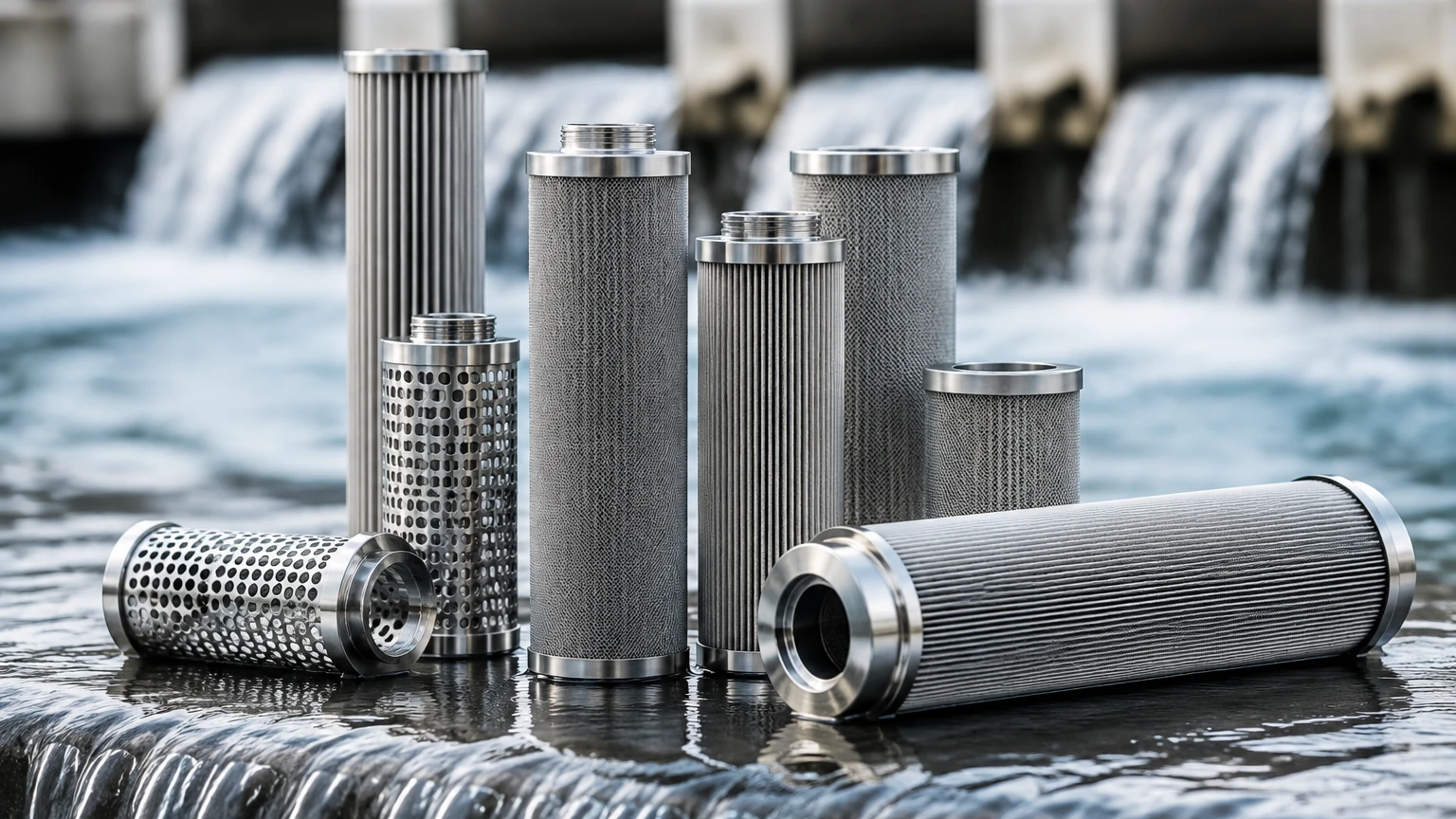
Stainless steel woven wire mesh is a versatile media used for surface filtration. It features precise pore sizes and is available in various weave patterns, such as plain, twill, or dutch weave. It is particularly effective for removing rigid, non-deformable particles. Because it is a single-layer or multi-layer laminate, it is relatively easy to clean via backwashing.
Sintered Metal Mesh
For high-pressure applications, multiple layers of wire mesh are sintered together—bonded through heat and pressure without the use of adhesives. This creates a robust, porous plate that combines the fine filtration of thin mesh with the mechanical support of heavy-duty mesh. Sintered wastewater filter elements are virtually immune to media migration, ensuring consistent performance over thousands of cycles.
Wedge Wire (V-Wire)
Wedge wire screens are constructed from V-shaped profiles resistance-welded onto support rods. This design creates a continuous slot that widens inwardly, which significantly reduces the risk of "pegging" or clogging by near-size particles. Wedge wire is the gold standard for high-solids wastewater where heavy-duty mechanical scraping or backwashing is employed.
Engineering Considerations for Wastewater Filter Integration
Integrating a wastewater filter into an existing industrial system requires a thorough analysis of the upstream and downstream conditions. Engineers should confirm several variables before finalizing a design.
Particle Characterization
Is the contaminant organic or inorganic? Is it fibrous, granular, or gelatinous? Fibrous materials can wrap around wire mesh, while gelatinous solids can "blind" the filter surface quickly. Understanding the particle morphology helps in selecting between surface filtration (mesh) and depth filtration (sintered felt or multi-layer mesh).
Continuous vs. Batch Processing
In continuous flow systems, duplex filter housings or self-cleaning automatic filters are necessary to prevent process downtime. In batch processing, a single-stage wastewater filter may be sufficient, provided the filter capacity matches the batch volume.
Compatibility with Cleaning Agents
If the wastewater contains oils or biological matter, periodic chemical cleaning (CIP – Clean In Place) may be required. The filter material must be compatible with the caustic or acidic cleaning agents used to dissolve organic fouling without degrading the metal substrate.
Maintenance and Total Cost of Ownership (TCO)
While the initial capital expenditure for a stainless steel wastewater filter is higher than for disposable alternatives, the TCO is often significantly lower in industrial settings.
Longevity and Reusability
A high-quality metal filter can last for years if maintained correctly. The ability to clean and reuse the filter eliminates the recurring cost of purchasing, stocking, and disposing of spent cartridges. In many jurisdictions, the disposal of contaminated filter cartridges is classified as hazardous waste, adding a substantial hidden cost to disposable systems.
Reduction in Downtime
Stainless steel filters are designed for durability. They are less prone to catastrophic failure caused by pressure spikes or temperature fluctuations. This reliability translates to fewer unscheduled shutdowns and more consistent output quality.
Energy Efficiency
By optimizing the filter design for a lower pressure drop, the energy consumption of the system pumps is reduced. Over the lifespan of the equipment, these energy savings can offset a portion of the initial investment.
Customization and OEM Solutions for Wastewater Filtration
No two industrial wastewater streams are identical. Standard off-the-shelf filters often fail to meet the specific nuances of a particular chemical process or flow requirement. This is where customized manufacturing becomes vital.
Customization options for a wastewater filter include:
* Variable Geometry: Designing filter elements to fit existing non-standard housings.
* Reinforced Structures: Adding internal or external support cores to handle extreme differential pressures.
* Specialized End Fittings: Customizing flanges, threads, or O-ring seats (such as 222, 226, or DOE) to ensure a leak-proof seal within the housing.
* Surface Treatments: Applying coatings or electropolishing to the stainless steel to further enhance corrosion resistance or reduce particle adhesion.
By working with a specialized manufacturer, engineering teams can develop filtration components that are precisely tuned to their specific wastewater characteristics, ensuring optimal performance and minimal maintenance.
Conclusion
Selecting a wastewater filter is a technical decision that impacts the efficiency, compliance, and profitability of an industrial facility. Stainless steel filtration components offer the durability and precision required to handle the complexities of modern industrial effluent. By focusing on material grade, filtration mechanics, and ease of maintenance, engineers can implement solutions that provide long-term reliability. For those seeking to optimize their filtration systems, exploring the technical capabilities of a dedicated manufacturer is the first step toward achieving superior water management outcomes.
