


Wastewater Screening Design Services
In the context of industrial and municipal water treatment, the initial stage of solids removal is critical to the longevity and efficiency of the entire system. Wastewater screening design services provide the engineering framework necessary to protect downstream equipment, such as pumps, membranes, and biological reactors, from damage or clogging caused by debris. Selecting the correct screening technology requires a deep understanding of hydraulic flow, solids loading, and material science.
For engineers and procurement professionals, the transition from a conceptual treatment flow to a physical screening installation involves complex calculations and material specifications. This guide examines the technical considerations, material requirements, and engineering benchmarks essential for successful wastewater screening implementation.
The Strategic Importance of Wastewater Screening Design Services
Wastewater screening is often categorized into coarse and fine screening. Coarse screens typically handle larger debris (6 mm or larger), while fine screens target smaller particulates that could interfere with secondary treatment processes. Wastewater screening design services focus on optimizing the interface between the influent flow and the physical barrier.
A well-designed screening system must balance two competing factors: capture efficiency and hydraulic head loss. If the screen is too fine for the application without sufficient surface area, the head loss increases, leading to potential overflows or excessive energy consumption in pumping. Conversely, if the screen is too coarse, the downstream equipment is exposed to abrasive materials and fibrous solids that can lead to "ragging" in pumps. Professional design services ensure that the screen geometry, aperture size, and mechanical strength are tailored to the specific characteristics of the wastewater stream.
Technical Parameters in Screen Selection and Design
When engaging in wastewater screening design services, several technical parameters serve as the foundation for the engineering process. These factors dictate the type of filtration media required, whether it be woven wire mesh, wedge wire, or perforated plates.
1. Hydraulic Capacity and Velocity
Throughput is the primary driver of screen sizing. Design services must calculate the approach velocity (the speed of the water as it nears the screen) and the through-screen velocity. If the through-screen velocity is too high, flexible solids may be forced through the openings, or the screen itself may suffer from premature wear due to impingement. Generally, a through-screen velocity of 0.6 to 0.9 meters per second is maintained to ensure effective capture while minimizing head loss.
2. Open Area Ratio
The open area ratio refers to the percentage of the total screen surface that allows water to pass. High-performance filtration components, such as those found on our Main Page, are designed to maximize this ratio without compromising structural integrity. A higher open area reduces the pressure drop across the screen, which is vital in gravity-fed systems where available head is limited.
3. Solids Loading and Characterization
Not all wastewater is equal. Industrial effluent from a food processing plant contains different solids than municipal sewage or chemical processing runoff. Design services must account for the peak solids loading rate, which occurs during storm events or high-production shifts. Understanding the nature of the solids—whether they are abrasive, greasy, or fibrous—determines the necessary surface treatment and mechanical cleaning mechanism of the screen.
Material Science in Industrial Filtration Components
In wastewater environments, material selection is not merely a matter of cost but a requirement for survival. The presence of hydrogen sulfide (H2S), chlorides, and varying pH levels creates a highly corrosive atmosphere. Stainless steel is the industry standard for these applications due to its inherent resistance to oxidation and chemical attack.
Stainless Steel Grades: 304 vs. 316
* Grade 304: Suitable for standard municipal wastewater where chloride levels are low. It provides excellent structural strength and moderate corrosion resistance.
* Grade 316/316L: Recommended for industrial wastewater, coastal installations, or environments with high chemical concentrations. The addition of molybdenum in Grade 316 enhances its resistance to pitting and crevice corrosion, which is essential for components like wire mesh filters and precision cartridges that have high surface area-to-volume ratios.
Durability and Precision
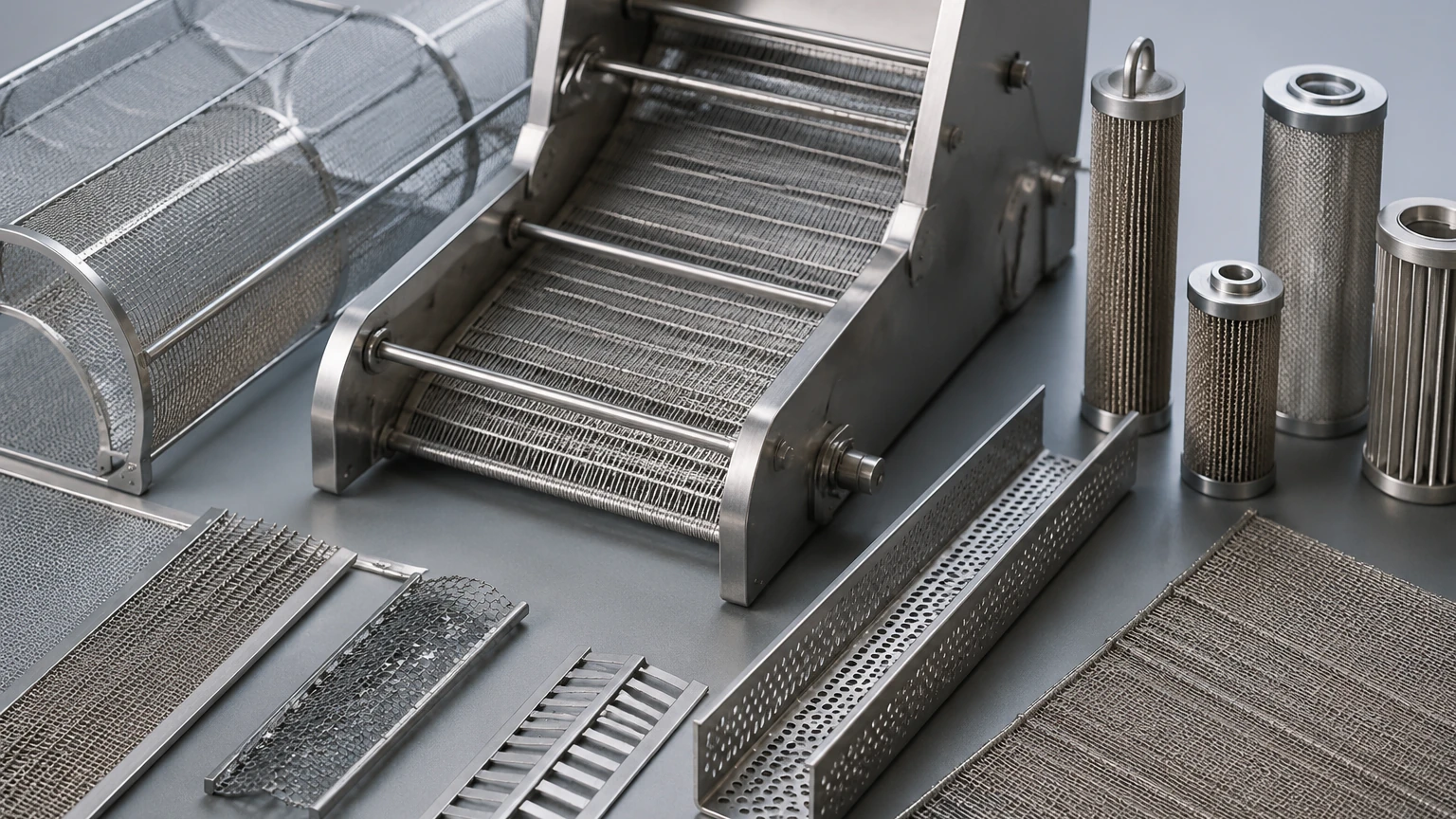
For fine screening applications, the precision of the filtration media is paramount. Custom stainless steel filtration solutions must maintain consistent aperture sizes under hydraulic pressure. If the wire mesh or perforated plate deforms, the filtration accuracy is lost. This is why manufacturing expertise is a critical component of wastewater screening design services—ensuring that the physical product matches the engineering specifications exactly.
Mitigating Operational Risks: Blinding and Mechanical Fatigue
One of the most significant risks in wastewater screening is "blinding," where solids become trapped within the screen openings, effectively sealing it off. This leads to a rapid rise in upstream water levels and can cause system bypasses.
Design Strategies to Prevent Blinding
Professional design services mitigate blinding through several methods:
* Surface Finish: Utilizing electropolished or passivated stainless steel surfaces reduces the adhesion of organic matter and greases.
* Screen Geometry: For certain applications, wedge wire (V-shaped wire) is preferred because it only has two contact points with the solid, making it easier to clean via backwashing or mechanical raking.
* Automated Cleaning Cycles: Integrating sensors that trigger cleaning based on differential pressure rather than a fixed timer ensures the screen remains clear during high-loading periods.
Addressing Mechanical Fatigue
Screens are subject to constant vibration and fluctuating hydraulic loads. Over time, this can lead to fatigue failure at weld points or within the mesh itself. High-quality manufacturing processes, including advanced welding techniques and stress-relieving treatments, are necessary to ensure the filtration components can withstand years of continuous operation in a submerged environment.
Customization and OEM Capabilities in Filtration Manufacturing
Off-the-shelf screening solutions rarely meet the specific needs of complex industrial processes. This is where the synergy between design services and OEM (Original Equipment Manufacturer) capabilities becomes vital. Customization allows for the integration of filtration components into existing infrastructure where space may be a constraint.
Customization options often include:
* Tailored Micron Ratings: Adjusting the mesh density to target specific particle sizes based on downstream requirements.
* Custom Housing and End Fittings: Ensuring that filter cartridges or mesh panels fit perfectly into the proprietary frames of various treatment systems.
* Reinforced Structures: Adding internal supports or outer cages to filter elements that must operate under high-pressure differentials.
By working with a manufacturer that understands both the engineering and the production of stainless steel filters, procurement teams can ensure that the final product is not only functional but also optimized for the total cost of ownership. Durable components require fewer replacements and less frequent maintenance, providing better long-term value.
Essential Data for Engineering Specification
Before proceeding with wastewater screening design services, engineers and purchasing teams should confirm several key data points to ensure the accuracy of the final design. Providing this information early in the process reduces the risk of specification errors.
1. Flow Rate Data: Include average, peak, and minimum flow rates.
2. Solids Concentration: Measured in mg/L or ppm, along with a description of the solids type (e.g., organic, inorganic, fibrous).
3. Chemical Profile: A list of chemicals present in the wastewater and the typical pH range to guide material selection.
4. Permissible Head Loss: The maximum allowable pressure drop across the screen at peak flow.
5. Downstream Requirements: The sensitivity of the equipment following the screen (e.g., if protecting a 50-micron membrane, the screen must be sized accordingly).
Conclusion
Effective wastewater screening is the foundation of a reliable treatment process. Through professional wastewater screening design services, facilities can ensure they are using the most efficient, durable, and cost-effective filtration components available. By focusing on precise material selection, hydraulic optimization, and custom engineering, these services prevent downstream failures and reduce operational costs.
For organizations looking to implement or upgrade their filtration systems, partnering with a manufacturer that offers deep technical expertise in stainless steel filtration is essential. To explore our range of custom filtration solutions, including wire mesh filters and precision cartridges, please visit our Main Page. Our team is dedicated to providing the engineering support and high-quality manufacturing required to meet the most demanding industrial filtration challenges.
