


Water Filter Industrial Use
In the landscape of modern manufacturing and processing, the requirements for water quality are as diverse as the industries themselves. From cooling towers and boiler feeds to high-purity pharmaceutical rinsing and food-grade ingredient water, the demand for reliable filtration is constant. Understanding the nuances of water filter industrial use is essential for engineers and procurement professionals who must balance filtration efficiency, equipment longevity, and operational costs. Unlike residential applications, industrial water filtration must withstand high pressures, corrosive environments, and continuous flow rates while maintaining precise particulate removal.
Industrial filtration is not a one-size-fits-all solution. It requires a deep understanding of fluid dynamics, material science, and the specific contaminants present in the source water. Whether the goal is to protect downstream membranes or to ensure the purity of a final chemical product, selecting the right filtration component is a critical engineering decision. This guide explores the technical considerations, material choices, and performance metrics that define effective industrial water filtration.
The Critical Role of Precision in Water Filter Industrial Use
Water filter industrial use spans a broad spectrum of applications, each with unique challenges. In the chemical processing industry, water often serves as a solvent or a cooling medium. Here, filters must be compatible with various pH levels and temperatures. In the food and beverage sector, the focus shifts to hygiene and the removal of organic matter, requiring materials that meet stringent safety standards. In hydraulic systems, water-glycol fluids require filtration to prevent component wear and system failure.
Precision is the hallmark of industrial-grade filters. A filter that is too coarse allows contaminants to pass through, potentially damaging sensitive equipment like high-pressure pumps or spray nozzles. Conversely, a filter that is too fine for the application will clog prematurely, leading to excessive pressure drops and frequent downtime for maintenance. Engineers must evaluate the particle size distribution of the contaminants and select a filter with the appropriate micron rating to achieve the desired balance between protection and throughput.
Furthermore, the structural integrity of the filter element is paramount. Industrial systems often experience pressure surges or "water hammer" effects. A filter must be engineered to resist collapse or bursting under these conditions. This is why many industrial facilities move away from disposable plastic or fabric filters toward robust, cleanable metal solutions that offer predictable performance over a long service life.
Material Engineering: Why Stainless Steel is the Industrial Standard
When considering water filter industrial use, material selection is perhaps the most significant factor in determining the filter's success. While polymer-based filters are common in low-demand scenarios, stainless steel remains the gold standard for industrial environments. Specifically, grades 304, 316, and 316L are favored for their exceptional mechanical and chemical properties.
Corrosion Resistance
Stainless steel 316L, containing molybdenum, offers superior resistance to chlorides and pitting, making it ideal for brackish water or chemical-heavy industrial processes. In environments where the water chemistry is aggressive, the use of high-grade stainless steel ensures that the filter itself does not become a source of contamination through corrosion or material degradation.
Thermal Stability
Industrial processes often involve high-temperature water or steam cleaning (SIP/CIP). Stainless steel filters can operate at temperatures far exceeding the melting points of standard polymer filters. This thermal stability allows for consistent filtration performance even in extreme conditions, such as those found in power generation or heavy manufacturing.
Mechanical Strength
Metal filters, particularly those using woven wire mesh or sintered metal fibers, provide a rigid structure that maintains its pore size even under high differential pressure. This structural stability is crucial for maintaining filtration accuracy. In many industrial designs, the filter media is pleated to increase the surface area, which is then supported by internal cores and external shrouds to handle the stresses of high-flow water systems.
Technical Specifications: Filtration Accuracy and Flow Dynamics
To optimize water filter industrial use, engineers must look beyond the basic dimensions of the filter and focus on technical performance metrics. The relationship between filtration accuracy, flow rate, and pressure drop is the foundation of filter selection.
Micron Ratings: Absolute vs. Nominal
It is vital to distinguish between nominal and absolute micron ratings. A nominal rating indicates the ability of the filter to retain a majority of particles of a certain size, but it does not guarantee 100% efficiency. In contrast, an absolute rating signifies that the filter will stop essentially all particles of that size. For critical industrial applications, such as protecting delicate machinery, absolute-rated stainless steel wire mesh is often the preferred choice.
Pressure Drop (Delta P)
Every filter introduces a resistance to flow, known as pressure drop. As the filter accumulates debris, the pressure drop increases. Industrial systems are designed with a maximum allowable pressure drop before the filter must be cleaned or replaced. High-quality stainless steel filters are designed to offer a low initial pressure drop, which maximizes the "dirt-holding capacity" and extends the time between maintenance cycles.
Flow Velocity and Surface Area
High flow rates in industrial water systems can lead to high face velocities at the filter media. If the velocity is too high, it can force deformable particles through the mesh or cause rapid blinding of the surface. To counteract this, industrial filters often utilize pleated designs. By pleating the stainless steel mesh, the effective surface area is increased significantly within the same footprint, allowing for higher flow rates at lower velocities.
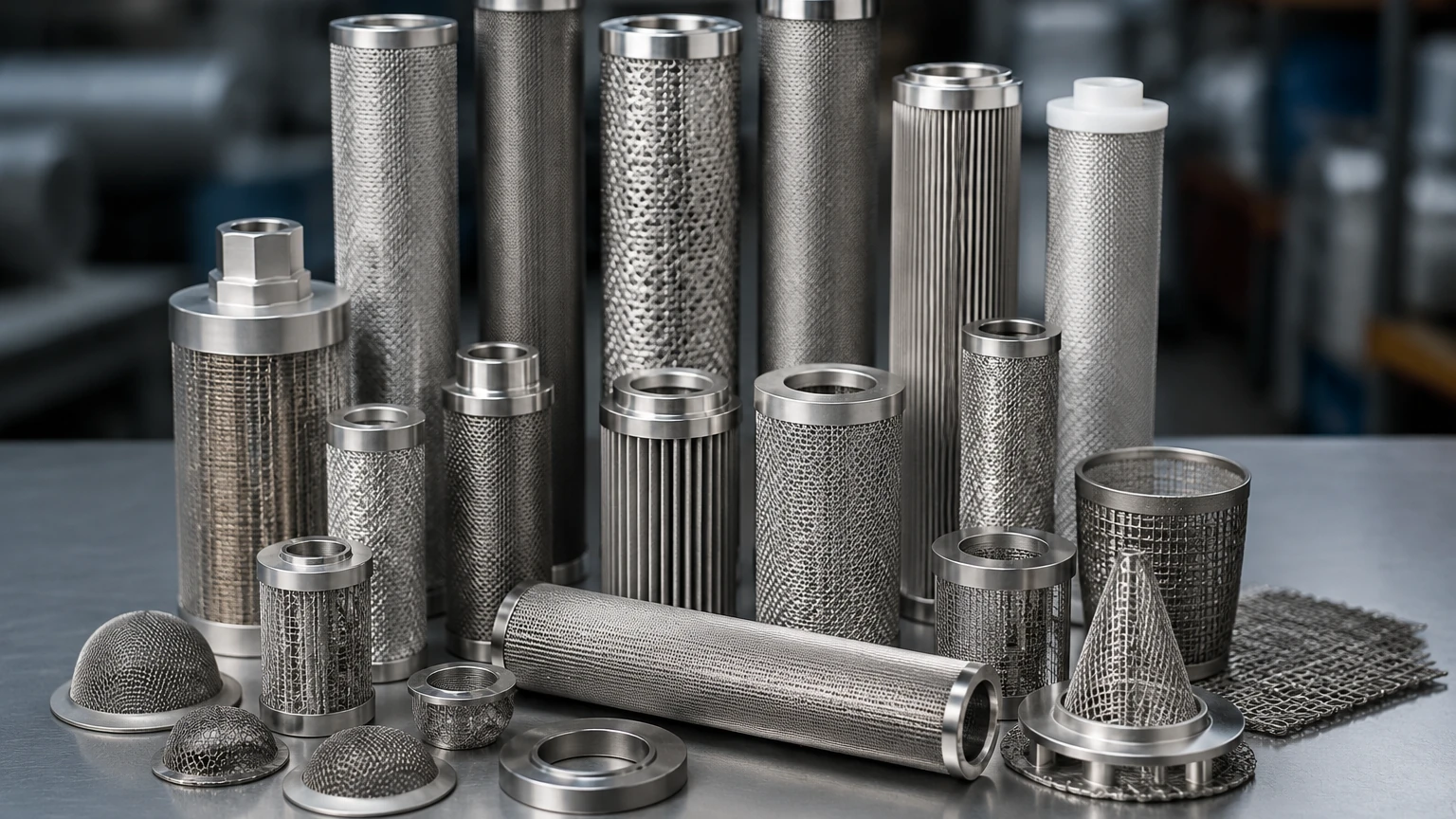
Customization and OEM Integration for Industrial Systems
Standard off-the-shelf filters rarely meet the specific needs of complex industrial machinery. This is where customization becomes essential. Manufacturers like Kaifil specialize in developing bespoke filtration solutions that integrate seamlessly into existing OEM equipment. Customization can involve several engineering variables:
* End Cap Configurations: Whether the system requires DOE (Double Open End), SOE (Single Open End) with various O-ring styles (like 222 or 226), or threaded connections, the interface must be leak-proof and secure.
* Multi-Layer Construction: For heavy-duty water filter industrial use, a single layer of mesh may not be sufficient. Sintered multi-layer mesh provides a combination of a fine filtration layer protected and supported by coarser drainage and support layers, all bonded into a single robust plate or tube.
* Custom Dimensions: From miniature precision filters for laboratory equipment to large-scale cartridges for municipal water treatment pre-filtration, the ability to manufacture to exact specifications ensures a perfect fit.
Engineers looking for specific technical data or customized design support can visit the Main Page to review product options and application support. Working directly with a manufacturer allows for the optimization of the filter’s geometry to match the housing and flow characteristics of the specific industrial system.
Operational Longevity and Maintenance Strategies
One of the primary advantages of utilizing stainless steel for water filter industrial use is the ability to clean and reuse the filter elements. This significantly reduces the total cost of ownership compared to disposable filters, which incur ongoing replacement and disposal costs.
Cleaning Methodologies
Depending on the nature of the contaminants, industrial metal filters can be cleaned using several methods:
1. Backwashing: Reversing the flow of water through the filter to dislodge surface-bound particles.
2. Ultrasonic Cleaning: Using high-frequency sound waves in a cleaning solution to remove fine particles trapped deep within the mesh or sintered structure.
3. Chemical Cleaning: Using acids, alkalis, or solvents to dissolve organic or mineral scaling, provided the filter material is chemically compatible.
Monitoring and Replacement
While stainless steel filters are durable, they are not infinite. Over many cleaning cycles, the mesh may experience fatigue or the pores may become permanently fouled (blinded). Industrial operators should monitor the pressure drop across the filter using differential pressure gauges. A consistent baseline after cleaning indicates a healthy filter, while a rising baseline suggests that the filter is reaching the end of its functional life and should be replaced to maintain system efficiency.
Selection Guide: Matching Filter Designs to Application Needs
Choosing the right filter for industrial water use requires a systematic approach. Engineers should confirm the following information before finalizing a selection:
1. Fluid Characteristics: What is the temperature, pH, and viscosity of the water? Are there any chemicals present that could affect the filter material?
2. Contaminant Profile: What are the sizes and types of particles being removed? Are they hard, abrasive grains or soft, organic fibers?
3. Flow Requirements: What is the maximum and average flow rate? What is the maximum allowable pressure drop for the system?
4. Regulatory Compliance: Does the application require FDA-compliant materials or specific industry certifications?
5. Environmental Conditions: Will the filter be exposed to outdoor elements, high vibration, or mechanical shock?
By addressing these factors, procurement teams can ensure they are investing in a filtration solution that provides the necessary protection without becoming a bottleneck in the production process. The move toward high-performance, customized stainless steel filters is a strategic choice for any facility aiming to improve its operational reliability.
In conclusion, the effective implementation of water filter industrial use relies on a combination of robust materials, precise engineering, and a clear understanding of the application’s demands. Stainless steel filtration components offer the durability and accuracy required to handle the rigors of industrial water processing, providing a sustainable and cost-effective solution for modern industry. For those seeking to optimize their filtration systems, focusing on material quality and customized design is the most reliable path to achieving long-term performance goals.
