


Water Well Screen Installation
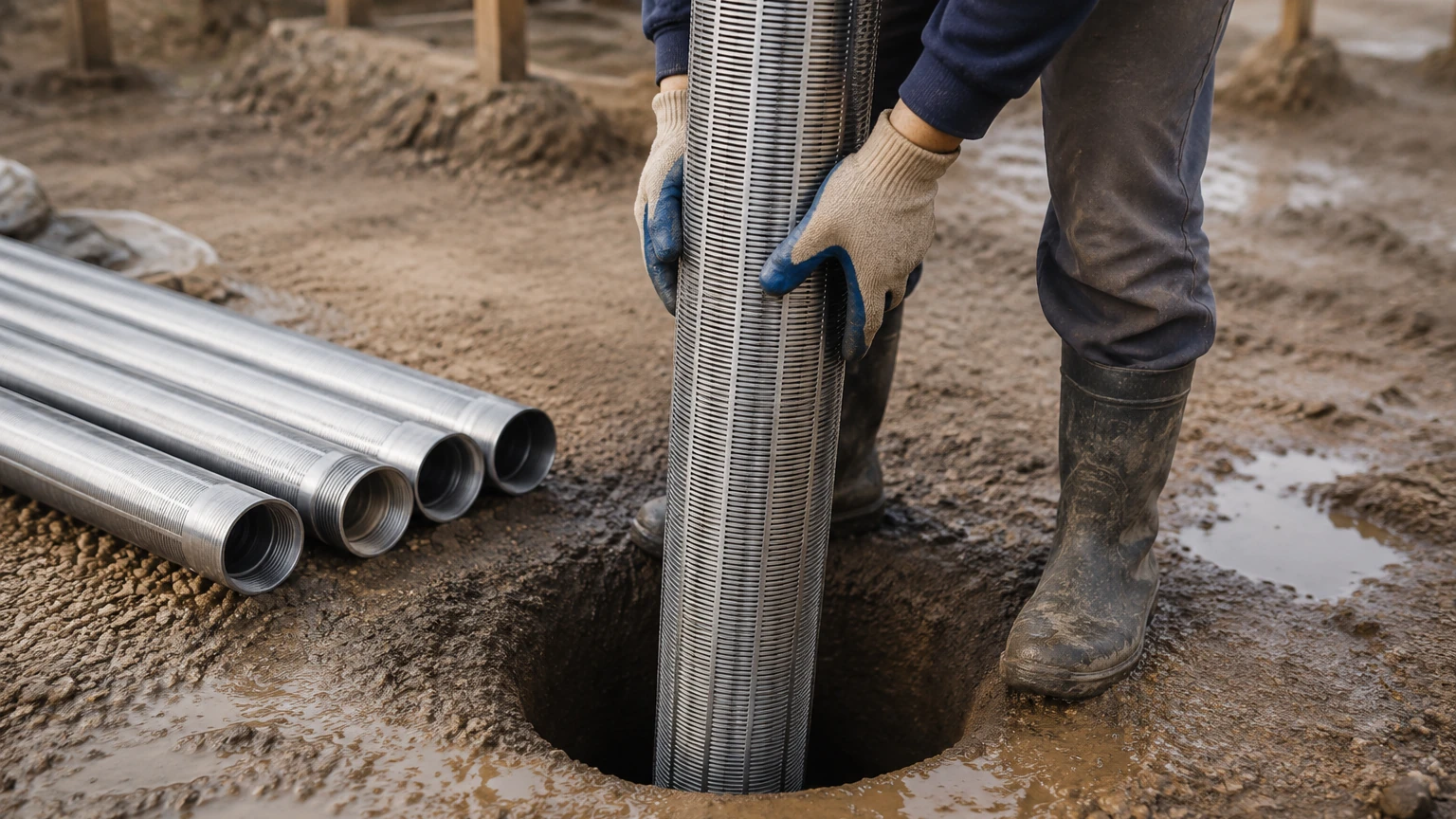
In industrial and municipal water supply projects, the water well screen serves as the critical interface between the aquifer and the wellbore. Proper water well screen installation is not merely a mechanical task but a precise engineering process that determines the efficiency, longevity, and sand-free operation of the well. A failure in the installation phase or an incorrect selection of screen parameters can lead to premature pump wear, reduced specific capacity, and eventual well failure.
For engineers and project managers, understanding the technical nuances of screen deployment—from material selection to the mechanics of placement—is essential for optimizing the total cost of ownership. This guide explores the technical requirements and best practices for installing stainless steel well screens in demanding industrial environments.
Understanding the Role of the Well Screen in Aquifer Management
The primary function of a well screen is to allow water to enter the well with minimal resistance while simultaneously preventing the formation material (sand and silt) from entering the casing. This is achieved through a controlled "open area" that manages slot velocity. If the open area is too small, the velocity of the water entering the screen increases, which can lead to accelerated corrosion, encrustation, and higher energy costs due to increased drawdown.
In high-capacity industrial wells, stainless steel wedge wire screens are often the preferred choice. Their V-shaped profile is designed to be non-clogging, as the narrowest part of the opening is at the outer face. Particles that pass through the outer slot are easily carried through the widening internal gap, reducing the risk of blinding. When planning for water well screen installation, engineers must balance the structural integrity required to withstand formation pressure with the hydraulic efficiency needed for the application.
Engineering Specifications and Material Selection
Before the installation process begins, the physical specifications of the screen must be verified against the borehole conditions. Material selection is the first line of defense against chemical and physical degradation.
Material Compatibility
Stainless steel grades 304 and 316 are the industry standards for most industrial water wells. Grade 304 offers excellent strength and corrosion resistance for standard applications, while Grade 316 is specified for environments with higher chloride content or more aggressive water chemistry. In highly corrosive or deep-well applications where high collapse strength is required, specialized alloys or heavier gauge wire profiles may be necessary. As a manufacturer of custom filtration solutions, Kaifil provides precision-engineered components that meet these rigorous material standards.
Slot Size and Sieve Analysis
The slot size of the screen is determined by a sieve analysis of the aquifer material. For a naturally developed well, the slot size is typically chosen to retain 30% to 50% of the formation material. For a filter-packed well, the slot size is selected to retain 90% or more of the filter pack material. Precise slot manufacturing is critical; even minor deviations can lead to sand pumping, which damages downstream equipment like valves and pumps.
Pre-Installation Preparation and Borehole Conditioning
The success of water well screen installation is heavily dependent on the state of the borehole. After drilling is completed, the hole must be stabilized and cleaned of excess drill cuttings and heavy mud cake.
1. Borehole Logging: Geophysical logging should be performed to confirm the exact depth of the water-bearing zones. This ensures the screen is placed precisely against the most productive intervals of the aquifer.
2. Mud Thinning: If rotary drilling with mud was used, the drilling fluid must be thinned and conditioned. High-viscosity mud can become trapped behind the screen or within the filter pack, significantly reducing the well's yield.
3. Equipment Inspection: Every section of the screen and casing should be inspected for transport damage. Threads or weld rings must be clean and intact to ensure structural integrity during the descent.
Technical Methods for Water Well Screen Installation
There are several established methods for placing a well screen, depending on the depth of the well, the drilling method used, and the geological conditions.
The Pull-Back Method
In this method, the casing is first driven or set to the full depth of the well. The screen is then lowered inside the casing. Once the screen is in position, the casing is pulled back (elevated) to expose the screen to the formation. A lead packer or a K-packer is typically used at the top of the screen to create a seal between the screen and the permanent casing. This method is common in cable tool drilling and provides excellent protection for the screen during installation.
The Wash-Down Method
The wash-down method is often used in unconsolidated formations. The screen is equipped with a wash-down bottom (a self-closing valve). Water or drilling fluid is pumped down through the inner string, exiting at the bottom of the screen to wash away sand and debris as the screen is lowered. This allows the screen to sink to the desired depth under its own weight or with minimal downward pressure. Once the pump is stopped, the valve closes, preventing sand from entering the bottom of the screen.
Setting with a Filter Pack
In many industrial applications, a filter pack (artificial gravel pack) is required. The screen is centered in the borehole using centralizers, and a specifically graded silica sand is tremied into the annular space between the screen and the borehole wall. The filter pack acts as a secondary filter and stabilizes the formation. Proper placement is vital; any bridging of the sand can leave sections of the screen exposed to raw formation material, leading to sand ingress.
Critical Engineering Considerations During Deployment
During the physical act of water well screen installation, several mechanical forces act upon the screen assembly. Engineers must account for these to prevent structural failure.
Collapse Strength
As the well is pumped, the pressure outside the screen (formation and hydrostatic pressure) becomes greater than the pressure inside. The screen must have sufficient collapse strength to withstand this differential. This is especially critical in deep wells or in formations prone to shifting. High-quality stainless steel screens from professional manufacturers are tested to ensure they meet the required PSI ratings for specific depths.
Tensile Strength
When lowering a long string of screen and casing, the top joints must support the entire weight of the assembly. In some cases, the screen may need to be pushed or pulled to overcome borehole friction. The joints (whether threaded or welded) must be engineered to handle these axial loads without deforming or separating.
Use of Centralizers
To ensure an even distribution of the filter pack and to prevent the screen from resting against the borehole wall, centralizers should be installed at regular intervals (typically every 20 to 40 feet). A screen that is not centered is prone to uneven flow distribution, which can cause localized high-velocity zones and premature failure.
Well Development and Performance Verification
Installation is not complete until the well has been "developed." Development is the process of removing the finer particles from the formation and the filter pack, as well as removing any remaining drilling fluids.
Common development techniques include:
* Surging: Using a plunger-like tool to move water back and forth through the screen slots.
* High-Velocity Jetting: Using horizontal water jets to break up mud cake on the borehole wall.
* Over-pumping and Backwashing: Cycling the pump to create a surging effect.
Effective development increases the porosity and permeability of the formation surrounding the screen. After development, a pumping test is conducted to determine the specific capacity of the well. This data serves as the baseline for future performance monitoring. If the specific capacity drops over time, it may indicate encrustation or biofouling of the screen, necessitating chemical or mechanical cleaning.
Maintenance and Long-Term Operational Efficiency
The total cost of a water well is not defined by the initial purchase of the screen, but by the efficiency of the well over its 20-to-50-year lifespan. Choosing high-quality stainless steel components from a reliable Main Page of industrial filtration solutions ensures that the screen can withstand periodic rehabilitation.
Mechanical cleaning (brushing) and chemical treatments (acidizing) are common maintenance tasks used to remove mineral scale. Low-quality materials or poorly installed screens may be damaged during these processes, leading to the total loss of the well. By adhering to strict installation protocols and utilizing precision-manufactured screens, industrial operators can ensure a consistent, high-volume water supply with minimal downtime.
In summary, successful water well screen installation requires a combination of accurate geological data, precise component manufacturing, and careful mechanical execution. By focusing on slot velocity, material integrity, and proper development, engineers can secure a reliable water source that meets the demanding needs of industrial processing, chemical manufacturing, and municipal supply. For those seeking specialized filtration components to support these projects, sourcing from experienced manufacturers like Kaifil provides the technical assurance required for critical infrastructure.
