


Water Well Screen Pipe
In industrial groundwater extraction and water treatment, the selection of a water well screen pipe is a critical engineering decision that directly impacts the efficiency, longevity, and maintenance costs of the entire well system. As the intake component of a well, the screen pipe must perform two contradictory functions: it must allow the maximum amount of water to enter the well with minimal resistance while simultaneously preventing the migration of formation sand and gravel into the pump assembly.
For engineers and procurement professionals, understanding the technical nuances of screen design—ranging from slot geometry to metallurgical properties—is essential for optimizing well performance. This guide examines the engineering principles, material considerations, and selection criteria for high-performance water well screen pipes within industrial and municipal contexts.
The Engineering Fundamentals of Well Screen Design
A water well screen pipe is not merely a perforated tube; it is a precision-engineered filtration component. Its primary goal is to facilitate a low-velocity flow of water into the wellbore. High entrance velocities are the leading cause of premature well failure, as they accelerate corrosion, promote mineral encrustation, and pull fine sediments through the filter pack.
Hydraulic Efficiency and Open Area
The "open area" of a screen refers to the percentage of the pipe's surface area that consists of openings (slots). A higher open area is generally preferred because it distributes the incoming water over a larger surface, thereby reducing the entrance velocity. Engineering standards typically recommend keeping entrance velocities below 0.1 feet per second (0.03 meters per second). By maintaining this low velocity, the laminar flow is preserved, which minimizes friction loss and protects the integrity of the aquifer formation.
Slot Size Precision
The slot size of a water well screen pipe must be matched to the grain size distribution of the surrounding aquifer or the artificial gravel pack. This is determined through a sieve analysis of formation samples. If the slots are too large, the well will "pump sand," leading to abrasive wear on pumps and downstream valves. If the slots are too small, the well will suffer from excessive drawdown and reduced yield. Precision manufacturing ensures that slot tolerances are held within strict limits, providing predictable filtration performance.
Types of Water Well Screen Pipes
Different geological conditions and depth requirements dictate the structural design of the screen. While several varieties exist, three types dominate industrial applications due to their reliability and performance characteristics.
Continuous Slot (Wedge Wire) Screens
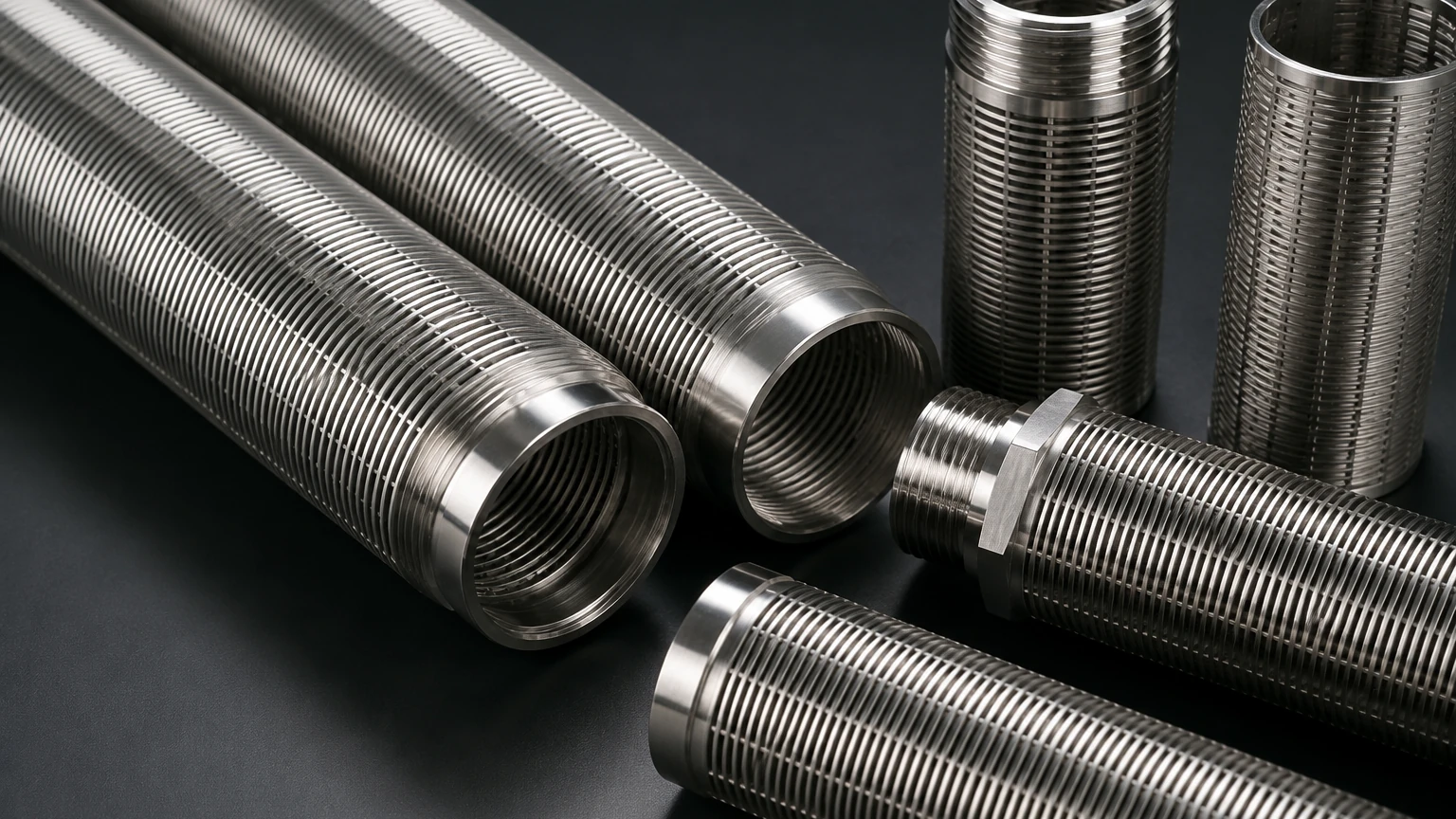
Wedge wire screens are widely considered the gold standard for industrial water wells. They are manufactured by wrapping a V-shaped wire around a circular array of internal longitudinal support rods. Each intersection is fusion-welded, creating a robust, one-piece structure.
The V-shaped profile offers a significant technical advantage: the slot narrows at the exterior and widens toward the interior. This geometry ensures that any particle small enough to pass through the outer opening will continue through the screen without becoming wedged, effectively making the screen self-cleaning during backwashing or development. For those seeking advanced filtration components, you can Review product options and application support to see how these designs are implemented in high-precision environments.
Bridge Slot Screens
Bridge slot screens are produced by punching openings into a flat sheet that is then rolled into a cylinder and welded. The "bridge" created by the punch provides a degree of mechanical protection for the openings. While they are often more cost-effective than wedge wire screens, they typically offer a lower open area and are more susceptible to clogging in fine-sand formations. They are most commonly used in shallow wells or in applications where the geological formation is stable and consists of coarser materials.
Perforated and Pipe-Based Screens
In extremely deep wells where high collapse resistance is required, pipe-based screens are utilized. These consist of a standard heavy-wall casing that is perforated and then wrapped with a secondary filtration layer, such as a wedge wire jacket or a stainless steel mesh. This design combines the structural strength of the base pipe with the filtration efficiency of the outer screen, allowing for extraction at depths where standard screens might fail under tectonic or hydrostatic pressure.
Material Selection: The Case for Stainless Steel
The chemical environment of a well is often aggressive. Factors such as pH levels, dissolved oxygen, and the presence of carbon dioxide or hydrogen sulfide can lead to rapid corrosion in carbon steel components. For industrial B2B applications, stainless steel is the preferred material for water well screen pipes due to its superior mechanical strength and chemical resistance.
Grade 304 vs. Grade 316L
* Type 304 Stainless Steel: This is the most common material for well screens. It provides excellent resistance to corrosion in most freshwater environments and offers the structural integrity needed for moderate to deep wells.
* Type 316L Stainless Steel: For applications involving brackish water, high chloride concentrations, or acidic conditions (low pH), Grade 316L is recommended. The addition of molybdenum enhances its resistance to pitting and crevice corrosion, significantly extending the service life of the well in harsh chemical environments.
Choosing the right alloy is a balance between initial capital expenditure and the total cost of ownership. While stainless steel screens have a higher upfront cost than galvanized or plastic alternatives, their resistance to encrustation and corrosion ensures that the well remains productive for decades rather than years.
Structural Integrity and Collapse Strength
As wells are drilled deeper to reach stable aquifers, the screen pipe must withstand immense external pressures. The collapse strength of a water well screen pipe is influenced by the diameter of the pipe, the wall thickness of the support rods, and the wire profile used in construction.
Engineers must calculate the maximum expected hydrostatic pressure and the potential for formation movement. In deep-well engineering, the screen must be designed with a safety factor that accounts for the "drawdown" effect, where the internal pressure of the pipe decreases as water is pumped out, increasing the net external pressure exerted by the surrounding water column and soil.
Installation and Well Development Considerations
The performance of a water well screen pipe is heavily dependent on the quality of the installation and the subsequent well development process.
Centralization
To ensure a uniform filter pack around the screen, centralizers should be used. If the screen rests against the side of the borehole, the filter pack will be thin or non-existent in that area, leading to localized high-velocity zones and potential sand infiltration.
Development Techniques
Well development is the process of removing fine silt and clay from the area immediately surrounding the screen. Techniques such as high-velocity jetting, surging, or over-pumping are used to agitate the formation. A high-quality wedge wire screen is particularly resilient during this phase, as its robust welded construction can withstand the mechanical stresses of surging without deforming the slot widths.
Addressing Common Operational Risks
Even a perfectly selected water well screen pipe can face challenges over its operational life. Understanding these risks allows for better proactive management.
1. Encrustation: This occurs when dissolved minerals (like calcium carbonate or iron) precipitate out of the water and clog the screen slots. This is often triggered by a drop in pressure at the screen face. Maintaining a high open area and low entrance velocity is the best defense against encrustation.
2. Biofouling: In some aquifers, iron-reducing bacteria or other microbial colonies can grow on the screen surface, creating a slimy biofilm that restricts flow. Stainless steel screens are compatible with various chemical rehabilitation treatments, such as acidizing or chlorination, which can be used to dissolve these biological blockages without damaging the pipe.
3. Sand Pumping: If the slot size was incorrectly specified or if the screen has suffered mechanical damage, sand may enter the well. This not only ruins the pump but can also lead to the collapse of the ground surface around the wellhead.
Customization in Industrial Filtration
Industrial applications often require bespoke solutions that go beyond standard municipal well specifications. Customization options for water well screen pipes include:
* Variable Slot Sizes: Different sections of the screen can have different slot widths to match varying strata within a single borehole.
* Specialized End Fittings: Threaded couplings, weld rings, or flange connections can be customized to match existing casing strings or specific installation tools.
* Reinforced Support: For high-load environments, additional internal support rods or heavier wire profiles can be engineered to meet specific collapse pressure requirements.
At Kaifil, the focus is on providing these tailored solutions. By combining manufacturing expertise with a deep understanding of filtration principles, we support engineers in developing components that meet the rigorous demands of chemical processing, mining, and large-scale water treatment. For more information on our engineering capabilities and product range, visit our Main Page.
Conclusion: Evaluating Total Cost of Ownership
When specifying a water well screen pipe, the cheapest option is rarely the most cost-effective. The true cost of a well includes the drilling expenses, pump electricity, maintenance cycles, and the potential loss of production during downtime.
A high-quality stainless steel wedge wire screen provides the highest hydraulic efficiency and the longest service life. By reducing friction losses, these screens lower the energy required to pump water, leading to significant savings in operational expenditures (OPEX) over the life of the well. Furthermore, the durability of stainless steel ensures that the well remains a reliable asset for 30 to 50 years, providing a much higher return on investment than lower-grade materials that may require replacement or expensive rehabilitation within a decade.
For technical professionals, the priority remains clear: prioritize precision, material integrity, and hydraulic design to ensure long-term aquifer stability and consistent water delivery.
