


Water Well Screen
In the field of industrial and municipal groundwater extraction, the water well screen serves as the critical interface between the geological formation and the pumping system. It is a precision-engineered filtration component designed to allow water to enter the well while simultaneously preventing the ingress of sand, silt, and gravel from the surrounding aquifer. For engineers and procurement professionals, selecting the appropriate water well screen is not merely a matter of sizing; it is a complex decision involving hydraulic efficiency, structural integrity, and long-term corrosion resistance.
At Kaifil, we specialize in high-performance stainless steel filtration solutions. Understanding the technical nuances of screen design is essential for optimizing well yield and extending the service life of the entire water supply infrastructure. This guide examines the engineering considerations, material requirements, and selection criteria necessary for professional well design.
The Role of the Water Well Screen in Aquifer Management
The primary function of a water well screen is to act as a structural retainer for the borehole while providing a low-resistance path for fluid flow. In a properly designed well, the screen supports the borehole wall and allows for the development of a natural or artificial gravel pack. This filtration zone is vital because it stabilizes the formation and ensures that the water reaching the pump is free of abrasive particulates.
From a hydraulic perspective, the screen must maximize the "open area"—the total percentage of the screen surface that is perforated or slotted. A high open area reduces the entrance velocity of the water. When entrance velocity is kept low (typically below 0.1 feet per second or 0.03 meters per second), the likelihood of turbulent flow is minimized. Turbulence is a leading cause of energy loss (well loss), accelerated corrosion, and the precipitation of minerals such as calcium carbonate, which leads to encrustation.
Technical Classifications of Well Screens
Not all screens are created equal. The choice of construction method significantly impacts the performance and durability of the well. In industrial applications, three primary types are commonly utilized:
1. Continuous Slot (Wedge Wire) Screens
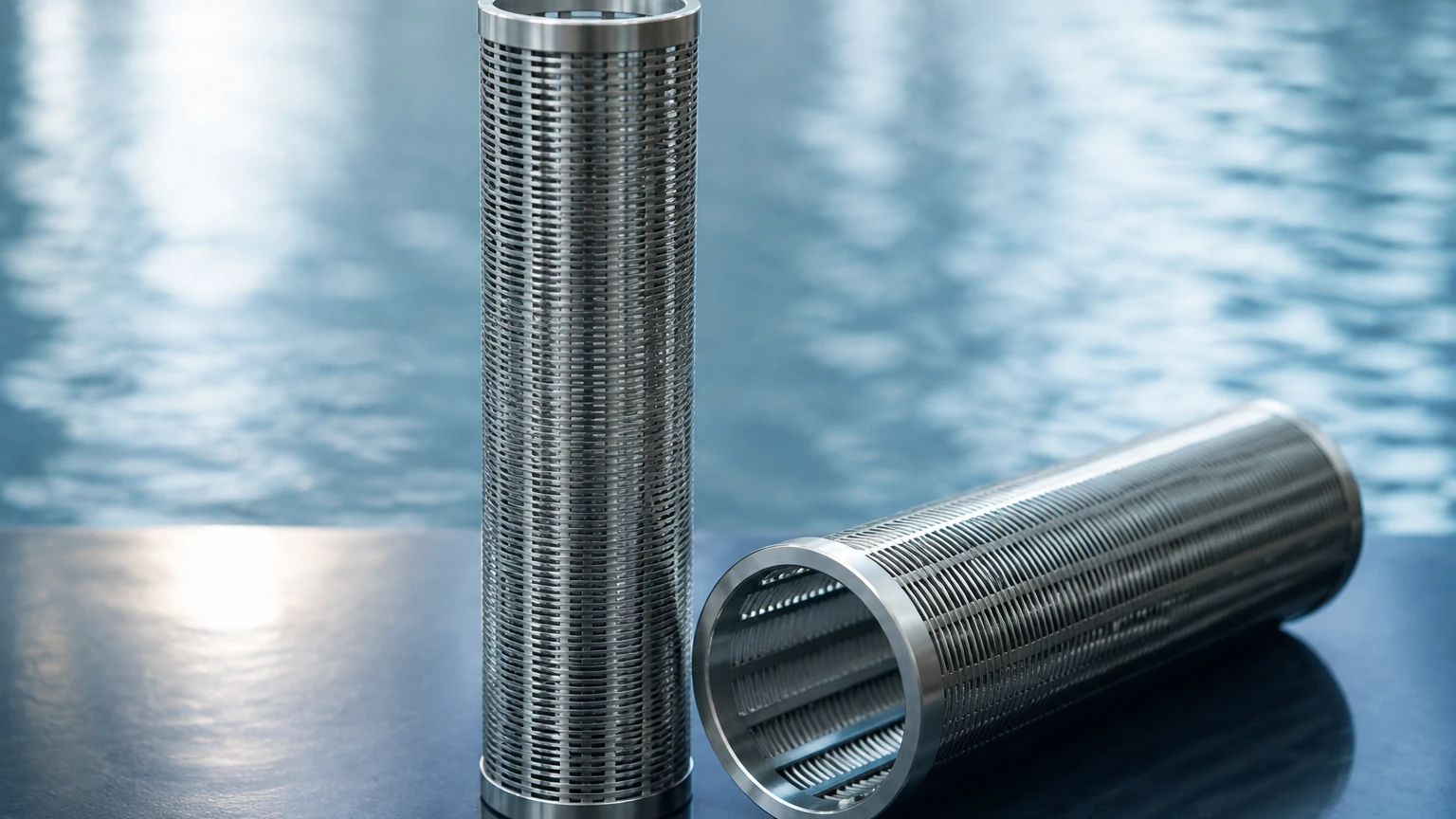
Continuous slot screens, often referred to as wedge wire screens, are widely considered the industry standard for high-capacity industrial and municipal wells. These are manufactured by wrapping a cold-rolled triangular (V-shaped) wire around a circular array of internal longitudinal support rods. Each intersection is fusion-welded for maximum strength.
The V-shaped profile offers a distinct engineering advantage: the slot narrows at the exterior and widens toward the interior. This geometry creates a self-cleaning effect; any particle that passes through the narrowest point of the slot will continue to flow into the screen without becoming wedged. This design provides the highest possible open area and superior hydraulic efficiency.
2. Pipe-Base Screens
For exceptionally deep wells or those subjected to high axial loads and hydrostatic pressure, pipe-base screens are often preferred. This design utilizes a standard perforated pipe as the internal structural core, which is then wrapped with a wedge wire screen or a stainless steel mesh. The internal pipe provides the necessary collapse strength, while the outer jacket handles the filtration. This hybrid approach is common in the oil and gas industry and deep-reach geothermal or water extraction projects.
3. Bridge Slot and Louvre Screens
Bridge slot screens are produced by punching staggered slots into flat sheets, which are then rolled into tubes and welded. Louvre (shutter) screens utilize a similar process but with downward-facing openings. While these are cost-effective for shallow, low-demand wells, they generally offer significantly less open area than wedge wire designs and are more prone to clogging in fine-sand formations.
Material Selection and Corrosion Resistance
The chemical environment of an aquifer is often aggressive. Factors such as pH levels, dissolved oxygen, carbon dioxide, and chloride concentrations dictate the material requirements for a water well screen. While carbon steel was historically common, its susceptibility to oxidation and pitting makes it unsuitable for modern industrial standards where a 25- to 50-year service life is expected.
Stainless steel is the preferred material for high-reliability filtration. At Kaifil, we focus on two primary grades:
* Grade 304 Stainless Steel: Suitable for most freshwater applications where chloride levels are low. It provides excellent structural strength and general corrosion resistance at a competitive cost.
* Grade 316L Stainless Steel: Contains molybdenum, which provides enhanced resistance to pitting and crevice corrosion, particularly in brackish water or environments with higher chloride concentrations. The "L" denotes low carbon content, which prevents sensitization during welding, ensuring the structural integrity of the screen joints.
For highly specialized environments, such as those involving chemical leaching or extreme salinity, exotic alloys like Duplex stainless steel or Monel may be required to prevent premature failure of the screen assembly.
Engineering the Slot Size: Sieve Analysis
The most critical technical step in specifying a water well screen is determining the slot size. This is not a guess; it must be based on a sieve analysis of the aquifer material. Engineers collect soil samples from the target depth and pass them through a series of calibrated sieves to determine the grain size distribution.
In a "naturally developed" well, the slot size is typically chosen to retain approximately 40% to 50% of the formation material. The remaining 50% of finer particles are removed during the well development process, leaving a highly permeable zone of coarse material around the screen. In an "artificial gravel pack" well, the slot size is determined by the size of the filter media (gravel) introduced into the borehole, usually designed to retain 90% or more of the gravel pack.
Incorrect slot sizing leads to two failure modes:
1. Slots too large: The well will "pump sand," leading to rapid wear of pump impellers and potential collapse of the surrounding ground.
2. Slots too small: The well will have high entrance resistance, leading to reduced yield and increased energy costs for pumping.
Structural Integrity and Collapse Strength
A water well screen must withstand significant physical stresses. These include the tensile load of the screen string during installation and the hydrostatic collapse pressure once the well is in operation. The collapse strength is a function of the material properties, the diameter of the screen, the thickness of the support rods, and the wire profile.
In deep wells, the difference between the internal pressure (inside the screen) and the external pressure (from the formation and water column) can be substantial, especially during drawdown. If the screen is under-engineered, it may buckle or collapse, leading to a total loss of the well. Professional filtration manufacturers provide detailed collapse ratings based on wall thickness and reinforcement configurations to ensure the screen can handle the specific depth requirements of the project.
Maintenance and Longevity: Managing Encrustation
Over time, even the best-designed water well screen may experience a reduction in performance due to encrustation or bio-fouling. Encrustation occurs when dissolved minerals—primarily calcium and magnesium carbonates—precipitate out of the water and deposit on the screen slots. This is often triggered by a drop in pressure or an increase in pH at the screen interface.
Bio-fouling is caused by iron-oxidizing bacteria or other microbial colonies that create a slime layer (biofilm) over the screen. Because Kaifil utilizes high-quality stainless steel, these screens can withstand aggressive chemical rehabilitation methods. Acid treatment (to dissolve mineral scale) and chlorination (to kill bacterial growth) are standard maintenance procedures that can restore well yield. The durability of stainless steel ensures that these treatments do not compromise the structural thickness of the screen, unlike carbon steel alternatives.
Why Customization Matters in Industrial Filtration
Standard off-the-shelf screens rarely meet the specific demands of complex industrial water systems. Every aquifer has a unique geological signature and chemical profile. Customization allows engineers to specify the exact wire profile, rod spacing, and end fittings (such as NPT threads, weld rings, or flanges) required for seamless integration into the well casing string.
As a manufacturer of custom stainless steel filtration solutions, Kaifil provides the technical expertise necessary to bridge the gap between geological data and mechanical hardware. Whether the application involves chemical processing, large-scale irrigation, or municipal water supply, the precision of the screen determines the efficiency of the entire operation. Detailed information regarding our manufacturing capabilities and custom design services can be found on our Main Page.
Conclusion: Making Informed Procurement Decisions
Selecting a water well screen is an investment in the long-term viability of a water source. By focusing on high-quality materials like 304 or 316L stainless steel and prioritizing wedge wire designs for their hydraulic advantages, engineers can significantly reduce the total cost of ownership. A well-designed screen reduces energy consumption, protects expensive pumping equipment from abrasive wear, and minimizes the need for frequent, costly interventions.
Before finalizing a specification, technical teams should confirm the following:
* Is the slot size based on a recent sieve analysis of the specific site?
* Does the material grade match the corrosive potential of the water chemistry?
* Has the collapse strength been verified against the maximum anticipated drawdown depth?
* Is the open area sufficient to keep entrance velocities below the threshold for turbulent flow?
By addressing these factors, industrial operators can ensure a reliable and efficient water supply for decades to come. For further technical support or to review specific product options for your next project, visit our Main Page to connect with our engineering team.
