


Wedgewire Screen
In the landscape of industrial filtration and separation, the wedgewire screen stands as a cornerstone technology for applications requiring high precision, mechanical strength, and long-term durability. Often referred to as V-wire screen or profile wire screen, these components are engineered to provide a unique combination of surface filtration and structural integrity that alternative media, such as woven mesh or perforated plates, often cannot match. For engineers and procurement specialists, understanding the technical nuances of wedgewire technology is essential for optimizing process efficiency and reducing the total cost of ownership in demanding industrial environments.
At Kaifil, the focus remains on delivering high-performance stainless steel filtration solutions that address the specific challenges of chemical processing, water treatment, and food production. By examining the engineering principles behind the wedgewire screen, technical professionals can better evaluate its suitability for their specific fluid-solid separation requirements.
Understanding the Fundamentals of Wedgewire Screen Technology
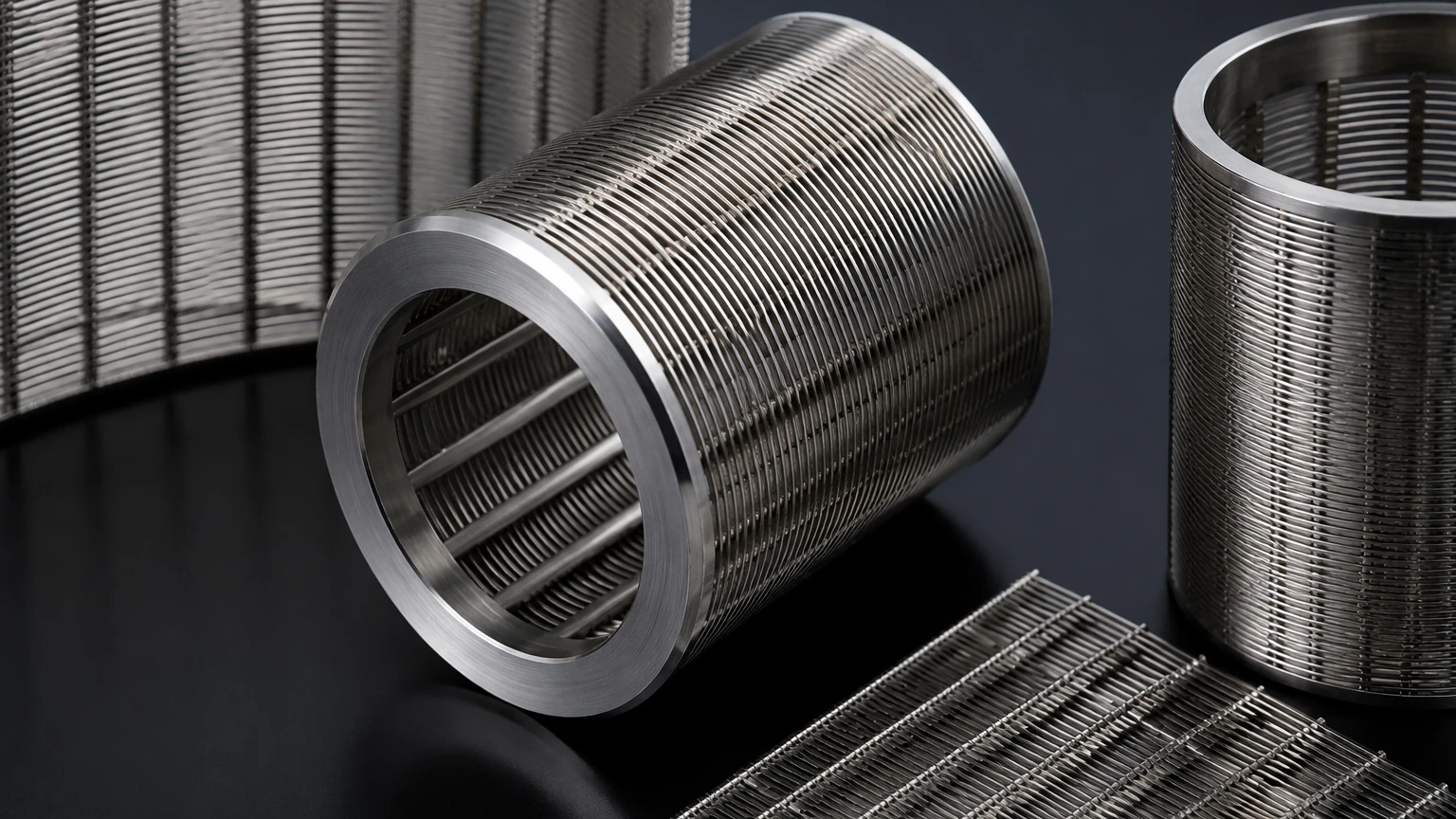
A wedgewire screen is a metallic filter medium constructed by resistance-welding V-shaped profile wires onto support rods. Unlike traditional filters that may rely on depth filtration or multiple layers of thin mesh, the wedgewire design is a surface filtration solution. The primary characteristic that defines this technology is the continuous slot opening formed between the adjacent V-profile wires.
The geometry of the wire is critical. The "V" shape is oriented so that the widest part of the wire faces the incoming flow, while the narrowest part creates the precise slot opening. As the fluid passes through the screen, the gap widens inwardly. This design ensures that any particle small enough to pass through the initial slot opening will continue through the screen without becoming wedged or trapped. This "self-cleaning" or non-clogging attribute is the primary reason engineers specify wedgewire for high-solids applications or automated systems.
Engineering Design: V-Profile Wires and Support Structures
The performance of a wedgewire screen is dictated by its mechanical construction. There are two primary components: the surface profiles (V-wires) and the support profiles (rods).
The V-Profile Wire
The surface wire defines the filtration accuracy. The width of the wire and the height of the profile are selected based on the required mechanical strength and the desired open area. Smaller wires allow for a higher density of slots, increasing the open area but potentially reducing the overall collapse strength of the screen. Conversely, heavier wires provide greater resistance to abrasion and pressure but may restrict flow.
Support Rods
Support rods are the structural backbone of the screen. They can be round, rectangular, or even V-shaped, depending on the application. The spacing between support rods determines the span of the surface wires and, consequently, the pressure rating of the screen. In high-pressure hydraulic or heavy-load mining applications, support rods are spaced closely to prevent the surface wires from deforming under hydrostatic stress.
Welding Integrity
The manufacturing process involves advanced resistance welding. Every intersection of the V-wire and the support rod is fused together. This creates a rigid, single-piece structure. Unlike woven mesh, which can shift or fray over time, the welded intersections of a wedgewire screen ensure that the slot width remains consistent throughout the service life of the component, maintaining precise filtration accuracy.
Key Performance Advantages in Industrial Filtration
When comparing filtration media for the Main Page of a technical specification, engineers often prioritize four key performance metrics: clogging resistance, mechanical strength, open area, and ease of cleaning.
1. Non-Clogging Geometry: As previously mentioned, the inward-widening slot prevents near-size particles from getting stuck. This is particularly important in applications involving fibrous materials or sticky solids that would quickly blind a standard woven wire cloth.
2. High Mechanical Strength: Because the screen is a welded assembly of relatively thick metal profiles, it can withstand significant pressure differentials (ΔP). This makes wedgewire ideal for high-viscosity fluids or systems where sudden pressure surges are common.
3. High Open Area: By optimizing the ratio between the wire width and the slot width, manufacturers can achieve a high percentage of open area. This results in lower initial pressure drops and higher flow rates, which translates to reduced energy consumption for pumps and processing equipment.
4. Surface Smoothness: The precision-engineered surface of a wedgewire screen is exceptionally smooth. This facilitates mechanical cleaning methods, such as scraping or backwashing, allowing for automated maintenance cycles without the need for frequent manual intervention.
Material Science and Chemical Compatibility
The choice of material is as important as the physical design of the screen. Most industrial wedgewire screens are manufactured from stainless steel due to its balance of strength and corrosion resistance.
* Grade 304/304L: The standard choice for general industrial applications, providing good corrosion resistance and excellent welding properties. It is widely used in water treatment and food processing.
* Grade 316/316L: Contains molybdenum, which provides superior resistance to chlorides and pitting. This grade is the industry standard for chemical processing, pharmaceutical manufacturing, and marine environments.
* Duplex Stainless Steels: For extreme environments involving high temperatures and highly corrosive media, Duplex alloys offer nearly double the yield strength of austenitic grades and exceptional resistance to stress corrosion cracking.
Selecting the correct alloy ensures that the wedgewire screen does not suffer from premature failure due to chemical attack or erosion-corrosion, which is a common risk in high-velocity fluid systems.
Critical Selection Criteria for Engineers and Purchasing Teams
Specifying a wedgewire screen requires a detailed analysis of the process conditions. Engineers should confirm the following parameters before finalizing a design:
Slot Width (Aperture)
The slot width is the distance between the surface wires. It must be sized based on the minimum particle size that needs to be retained. However, it is also important to consider the "bridging" effect, where particles slightly smaller than the slot may still be retained if the concentration of solids is high enough.
Flow Velocity and Pressure Drop
High flow velocities can lead to accelerated wear on the leading edges of the V-wires. Engineers must calculate the approach velocity to ensure it remains within acceptable limits for the chosen material. Additionally, the clean pressure drop must be factored into the system's pump head calculations to ensure efficient operation.
Loading Direction
Wedgewire screens can be designed for flow from the outside in (FOTI) or from the inside out (FITO). The orientation of the V-wire must be adjusted accordingly to ensure the widening part of the gap is always on the downstream side of the flow. Failure to orient the wires correctly will negate the non-clogging benefits of the technology.
Maintenance, Cleaning, and Operational Longevity
One of the most significant advantages of the wedgewire screen is its compatibility with various cleaning regimes. In many B2B industrial applications, downtime for filter replacement is a major cost driver. Wedgewire technology mitigates this through:
* Backwashing: The smooth surface and V-shaped slots allow for highly effective backwashing. The reverse flow of fluid easily dislodges the filter cake, restoring the screen to near-original flow conditions.
* Mechanical Cleaning: In systems where solids are particularly stubborn, mechanical scrapers or brushes can be used on the surface of the screen. Because the wires are welded and rigid, they can withstand the friction of a scraper without deforming.
* Chemical Cleaning (CIP): Stainless steel wedgewire is compatible with most Clean-In-Place (CIP) chemicals used in the food and beverage industry, allowing for sterilization without disassembly.
With proper material selection and sizing, a wedgewire screen can last for years, if not decades, in applications where traditional mesh filters would require monthly replacement.
Industry-Specific Applications and Custom Solutions
The versatility of the wedgewire screen allows it to be integrated into various equipment formats, including flat panels, cylindrical cartridges, baskets, and curved sieve bends.
Water and Wastewater Treatment
In municipal and industrial water treatment, wedgewire is used for intake screens to protect pumps from debris, as well as in resin traps to prevent the loss of expensive ion-exchange resins. Its durability makes it suitable for submerged applications where maintenance access is limited.
Food and Beverage Processing
In the brewing industry, wedgewire lauter tun screens are essential for efficient wort separation. The precise slots ensure clear wort while providing the structural strength to support the heavy grain bed. Similarly, in sugar and juice processing, these screens provide reliable separation of pulp and fiber.
Chemical and Petrochemical
Wedgewire is frequently used in reactor internals, such as center pipes and scale traps. The ability to withstand high temperatures and corrosive chemicals makes it a preferred choice for catalyst bed support and recovery, where the cost of media failure could lead to significant process disruptions.
Conclusion: Making Informed Procurement Decisions
For technical professionals, the selection of a wedgewire screen is a balance between initial capital expenditure and long-term operational efficiency. While the upfront cost of a custom-engineered stainless steel wedgewire component may be higher than that of a simple woven mesh, the reduction in maintenance labor, the elimination of frequent replacement parts, and the improved process consistency provide a clear return on investment.
As a specialist in custom stainless steel filtration, Kaifil provides the engineering expertise required to navigate these selection criteria. By focusing on precise manufacturing and high-quality materials, Kaifil ensures that every filtration component meets the rigorous demands of modern industrial processes. Whether the requirement is for a standard replacement or a completely customized filtration solution, understanding the technical advantages of wedgewire technology is the first step toward achieving optimized system performance.
