


What Is a Coalescing Filter
In industrial fluid dynamics and gas processing, the separation of liquid aerosols and fine droplets from a continuous gas or liquid stream is a critical requirement for protecting downstream equipment and ensuring product purity. A coalescing filter is a specialized engineering component designed to perform this phase separation. Unlike standard particulate filters that primarily capture solid contaminants, a coalescing filter focuses on the aggregation of sub-micron liquid particles into larger droplets that can be easily drained from the system.
Understanding what is a coalescing filter requires an analysis of its internal mechanics, material composition, and the specific industrial environments where it is deployed. For engineers and procurement teams, selecting the correct filtration technology is essential for maintaining system integrity and optimizing the total cost of ownership.
Core Principles of Coalescence
The fundamental function of a coalescing filter is the transition of a liquid from a suspended aerosol state to a bulk liquid state. This process occurs within a specialized filter media, often composed of borosilicate glass fibers, synthetic materials, or high-precision metal structures such as those found on the Main Page of specialized filtration manufacturers.
The process follows a three-stage mechanical progression:
1. Capture: Small droplets suspended in the gas or liquid stream are intercepted by the fibers of the filter media.
2. Coalescence: As these captured droplets travel through the depth of the media, they collide and merge with other droplets. Surface tension and the physical structure of the media encourage these particles to grow in size.
3. Separation: Once the droplets reach a sufficient mass, gravity overcomes the drag forces of the fluid stream. The enlarged droplets migrate to the outer surface of the filter element (in an inside-to-outside flow configuration) and fall into a collection sump at the bottom of the filter housing.
Mechanisms of Droplet Capture
To understand what is a coalescing filter in a technical context, one must examine the physics of how particles are captured by the filter fibers. There are three primary mechanisms involved, each targeting different particle sizes:
Direct Interception
Direct interception occurs when a particle follows a streamline in the fluid flow and comes within one particle radius of a fiber. The particle then touches the fiber and is captured. This mechanism is most effective for larger particles, typically those greater than 1 micron in diameter.
Inertial Impingement
Inertial impingement is effective for particles with higher mass. As the fluid stream navigates the tortuous path through the filter media, heavier liquid particles cannot change direction as quickly as the gas or liquid carrier. Their momentum carries them forward, causing them to strike the fibers directly. This is a dominant mechanism in high-velocity systems.
Brownian Diffusion
For extremely small sub-micron particles (typically less than 0.1 to 0.3 microns), the primary capture mechanism is Brownian diffusion. These particles move in a random, zig-zag pattern due to collisions with gas molecules. This erratic movement increases the probability that the particles will collide with and adhere to the filter fibers. Because of this, coalescing filters are exceptionally efficient at removing the finest oil mists and water aerosols.
Distinguishing Coalescing Filters from Particulate Filters
While both types of filters utilize a media to remove contaminants, their engineering objectives differ significantly. A particulate filter is designed to trap solid debris—such as rust, scale, and dust—within the pores of the media. These filters eventually clog as the "dirt-holding capacity" is reached, necessitating replacement or cleaning.
In contrast, a coalescing filter is designed to handle liquids. While it can capture solids, doing so often shortens its lifespan because solids do not drain away like liquids. Therefore, in most industrial configurations, a coalescing filter is preceded by a high-efficiency particulate pre-filter. This pre-filter removes solid contaminants, allowing the coalescing element to focus exclusively on liquid separation, which extends the service life of the more expensive coalescing media.
Material Engineering: The Role of Stainless Steel and Wire Mesh
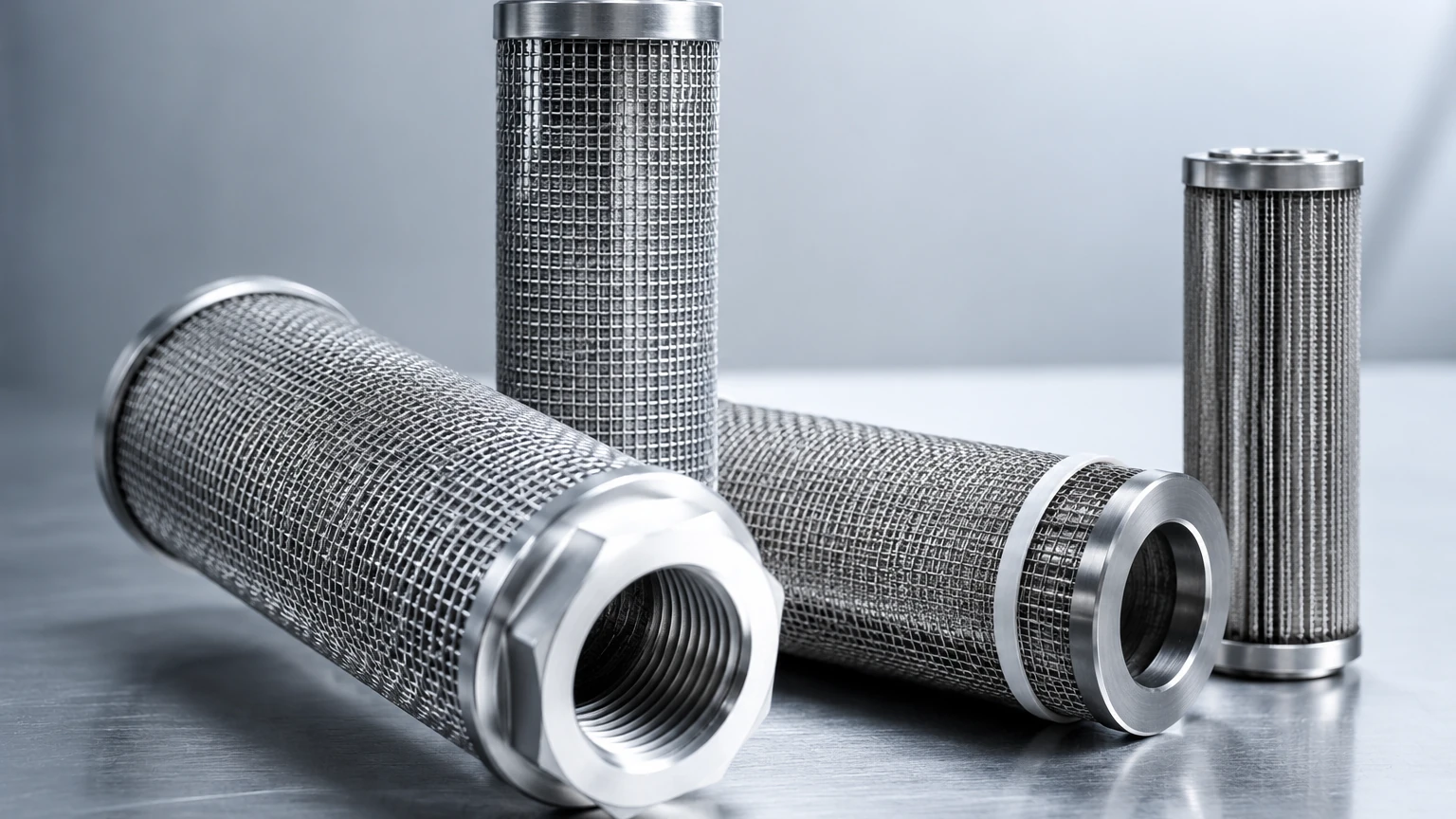
The choice of material for a coalescing filter depends on the chemical compatibility, temperature, and pressure of the application. In demanding industrial environments, such as chemical processing or high-pressure hydraulic systems, stainless steel filtration components are often preferred.
Stainless steel wire mesh and sintered metal fibers provide several advantages:
* Thermal Stability: They can operate in extreme temperatures where synthetic or glass-fiber media would degrade.
* Chemical Resistance: Stainless steel is resistant to a wide range of corrosive fluids and gases, making it ideal for natural gas processing and pharmaceutical applications.
* Structural Integrity: Under high differential pressure, metal media maintains its shape and pore structure, preventing bypass or media migration.
* Cleanability: Unlike disposable cartridges, many metal-based filtration components can be cleaned and reused, providing a more sustainable long-term solution.
Engineers often consult the Main Page of manufacturers to determine the specific alloy and mesh configuration required for their unique flow rates and viscosity requirements.
Key Industrial Applications
Coalescing filters are indispensable in several sectors where fluid purity is non-negotiable.
Compressed Air Systems
In compressed air systems, oil from the compressor's lubrication system often enters the air stream as an aerosol. If not removed, this oil can damage pneumatic tools, contaminate food products, or interfere with sensitive laboratory instruments. Coalescing filters are used to achieve ISO 8573.1 Class 1 or Class 2 air quality by removing oil down to 0.01 mg/m³.
Natural Gas Processing
In the oil and gas industry, coalescing filters remove liquid hydrocarbons and water from natural gas streams. This prevents "slugging" in pipelines and protects downstream equipment like turbines and compressors from liquid-induced damage.
Refrigeration and HVAC
Coalescing oil separators are used in large-scale refrigeration cycles to separate oil from the refrigerant gas. This ensures that the oil is returned to the compressor crankcase rather than coating the heat exchanger surfaces, which would significantly reduce heat transfer efficiency.
Hydraulic and Lube Oil Systems
Water is a common contaminant in hydraulic fluids, leading to oxidation, additive depletion, and component wear. Coalescing filters can remove free and emulsified water from oil, maintaining the lubricating properties of the fluid and extending the life of the machinery.
Engineering Selection Criteria for Coalescing Systems
When specifying a coalescing filter, engineers must evaluate several performance metrics beyond just the micron rating:
* Flow Rate and Velocity: Coalescing efficiency is highly sensitive to velocity. If the flow is too fast, the captured droplets may be re-entrained into the gas stream (a phenomenon known as "carryover").
* Differential Pressure (ΔP): This is the pressure drop across the filter. A high initial ΔP indicates a restricted flow, while a sudden increase in ΔP during operation usually signals that the filter is saturated or fouled with solids.
* Liquid Loading Capacity: This refers to the volume of liquid the filter can handle per unit of time while maintaining its efficiency.
* Flow Direction: Most coalescing filters for gas applications use an inside-to-outside flow pattern. This allows the coalesced liquid to form on the outer surface and drain away without being picked up by the high-velocity gas entering the center of the element.
Maintenance, Service Life, and Performance Monitoring
A coalescing filter does not have an infinite lifespan. While the coalesced liquid drains away, any solid particles that bypass the pre-filter will eventually plug the media. Performance monitoring is typically conducted via differential pressure gauges.
In many B2B industrial settings, a scheduled replacement cycle is established based on the operating hours or a specific pressure drop threshold (e.g., 8-10 psi). Failure to replace a saturated coalescing filter can lead to:
* Contaminant Breakthrough: Liquid aerosols passing through the filter and reaching downstream equipment.
* Energy Inefficiency: Increased pressure drop requires the compressor or pump to work harder, raising energy costs.
* Element Rupture: In extreme cases, the pressure differential can cause the filter media to collapse or tear.
Customization and OEM Solutions in Filtration
Standard off-the-shelf filters may not meet the requirements of specialized industrial processes. Factors such as non-standard pipe sizes, unique chemical exposures, or space constraints often necessitate custom-engineered solutions. Manufacturers like Kaifil specialize in providing OEM and customized stainless steel filtration components that are tailored to specific flow dynamics and environmental conditions.
By collaborating with filtration experts, companies can develop components that balance filtration accuracy with durability. Whether it is a specific wire mesh weave or a custom-designed filter housing, the goal is to achieve reliable, long-term separation performance. For those seeking technical specifications on customized metal filters, the Main Page provides a comprehensive overview of available manufacturing capabilities and material options.
In summary, understanding what is a coalescing filter involves recognizing it as a sophisticated phase-separation tool. By leveraging the principles of impingement, interception, and diffusion, these filters ensure that liquid contaminants are effectively removed from gas and liquid streams, protecting industrial infrastructure and maintaining process standards across the globe.
