


What Is a Protein Skimmer
In the realm of industrial water treatment and large-scale aquaculture, maintaining water quality requires more than just basic mechanical filtration. While traditional filters excel at removing suspended solids, they often struggle with dissolved organic compounds that can degrade water chemistry and harbor pathogens. This is where the protein skimmer, also known as a foam fractionator, becomes an essential component of a comprehensive filtration strategy. Understanding what is a protein skimmer and how it integrates into industrial systems is critical for engineers and facility managers aiming for optimal water clarity and biological stability.
The Fundamental Principles of Foam Fractionation
To answer the question of what is a protein skimmer, one must first understand the process of foam fractionation. Unlike mechanical filters that use a physical barrier to trap particles, a protein skimmer utilizes the physical properties of air bubbles and surface tension to remove organic waste.
Most organic waste molecules found in industrial process water or aquaculture systems are "amphipathic." This means they possess a hydrophilic (water-attracting) head and a hydrophobic (water-repelling) tail. When air is injected into a column of water, these molecules naturally migrate toward the air-water interface. The hydrophobic tails attach to the air bubbles, effectively hitching a ride as the bubbles rise to the surface.
As these bubbles accumulate at the top of the reaction chamber, they form a stable foam. This foam, concentrated with proteins, amino acids, and other organic debris, eventually overflows into a collection cup or discharge pipe. By removing these compounds before they break down into ammonia and nitrites, the protein skimmer reduces the biological load on subsequent filtration stages, such as bio-filters.
Key Components and Engineering Considerations
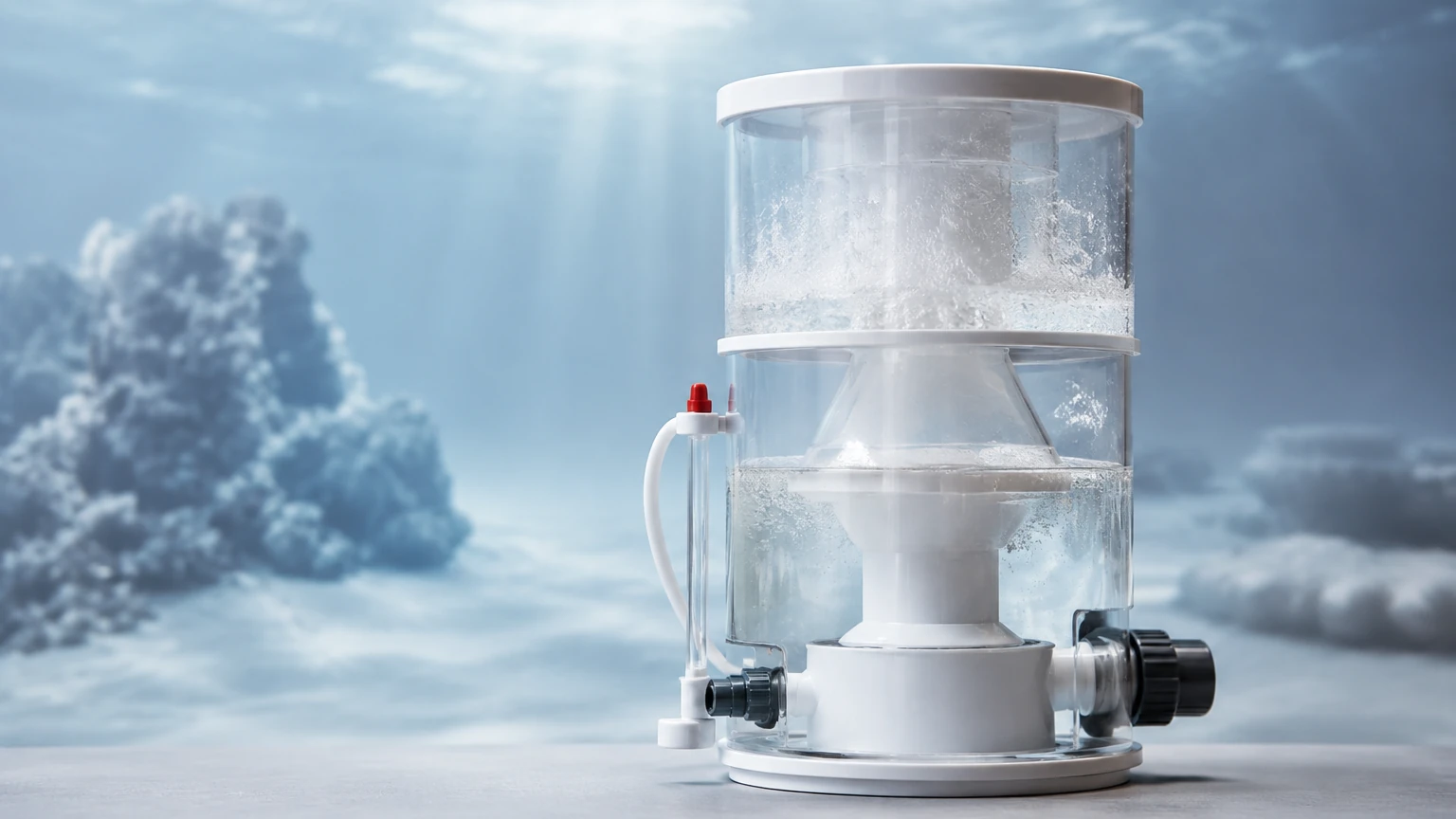
An industrial-grade protein skimmer is a precision-engineered vessel designed to maximize the contact time between air and water. Several critical components determine its efficiency:
1. The Reaction Chamber: This is the main body where the air and water mix. Its height and diameter are calculated to ensure sufficient dwell time, allowing organic molecules enough time to attach to the rising bubbles.
2. The Air Injection System: This is arguably the most important part. Industrial systems often use Venturi injectors or specialized needle-wheel pumps to create a dense cloud of microbubbles. The smaller the bubbles, the greater the total surface area available for organic attachment.
3. The Collection Neck: The area where the foam is compressed and pushed upward. The diameter of the neck must be precisely calibrated to the air-to-water ratio to ensure the foam is dry enough to remove waste but wet enough to move through the system.
4. Inlet and Outlet Filtration: To protect the sensitive injectors and pumps within a skimmer, pre-filtration is necessary. High-quality stainless steel wire mesh filters are often employed at the intake to prevent large debris from clogging the Venturi or damaging pump impellers.
For those evaluating filtration infrastructure, visiting the Main Page of a specialized manufacturer can provide insights into the custom components required to support these high-performance systems.
Industrial Applications: Beyond the Aquarium
While protein skimmers are well-known in the hobbyist aquarium trade, their industrial applications are far more demanding. In Recirculating Aquaculture Systems (RAS), skimmers are vital for maintaining the water quality necessary for high-density fish or shrimp farming. They are particularly effective in saltwater environments, where the high ionic strength of the water allows for the creation of much smaller, more stable bubbles than in freshwater.
In industrial wastewater treatment, foam fractionation is used to remove surfactants, fats, oils, and greases (FOG). It is also employed in the pharmaceutical industry for the separation of specific proteins and in the food and beverage sector for clarifying process liquids. In these environments, the durability of the equipment is paramount. Unlike plastic hobbyist models, industrial skimmers and their associated filtration components must withstand continuous operation, chemical cleaning cycles, and high flow rates.
The Role of Stainless Steel in Skimmer Systems
When discussing what is a protein skimmer in an industrial context, material selection is a primary engineering concern. While the main body of a skimmer may be constructed from UV-resistant plastics or fiberglass, the internal and peripheral components often require the resilience of stainless steel.
Stainless steel 316L is the industry standard for components that come into contact with saline or chemically treated water. Precision-engineered stainless steel filter cartridges and wire mesh screens are used to:
* Protect Air Injectors: Fine stainless steel mesh prevents micro-particles from entering the Venturi, ensuring consistent bubble production.
* Stabilize Flow: Stainless steel baffles can be used within the reaction chamber to reduce turbulence, which helps in the formation of a stable foam head.
* Effluent Management: Post-skimming, the water may pass through secondary stainless steel filtration to ensure no residual foam or large particles remain before the water returns to the main process.
Kaifil specializes in these types of custom stainless steel filtration solutions, providing the durability needed for the rigorous environments where industrial protein skimmers operate.
Selection Criteria for Industrial Protein Skimmers
Choosing the right skimmer involves more than just matching a flow rate. Engineers must consider the following technical factors:
Total Organic Carbon (TOC) Loading
The volume of organic waste in the water dictates the size of the reaction chamber and the required air-to-water ratio. Systems with high stocking densities or heavy industrial waste loads require larger contact volumes.
Salinity and Temperature
Water density and temperature significantly affect bubble size and stability. Skimmers designed for cold seawater will operate differently than those designed for warm process water in a chemical plant. Customization of the injection system is often necessary to account for these variables.
Integration with Mechanical Filtration
A protein skimmer is not a replacement for mechanical filtration. In fact, it works best when preceded by a high-efficiency screen or drum filter. Removing large solids (TSS) beforehand prevents the skimmer from becoming overwhelmed and allows it to focus on dissolved organics.
Maintenance and Accessibility
In a B2B environment, downtime is costly. Skimmers should be designed with easy-access ports for cleaning the collection neck and the air injectors. Using high-quality, corrosion-resistant components like stainless steel reduces the frequency of replacement and ensures long-term reliability.
Common Risks and Performance Limitations
While highly effective, protein skimmers have limitations that must be managed. One common risk is "over-skimming," where too much water is removed along with the foam, leading to water loss and potential chemistry imbalances. This is usually managed through precise control of the water level within the chamber.
Another challenge is biofouling. Over time, bacteria can grow on the internal surfaces of the skimmer and the air injectors, reducing efficiency. This highlights the importance of using materials like stainless steel that can be thoroughly cleaned and sanitized without degrading. Furthermore, certain water additives, such as specific oils or medications, can temporarily collapse the foam head, rendering the skimmer ineffective until the substances are processed out.
Conclusion: Optimizing Your Filtration Train
Understanding what is a protein skimmer is the first step in optimizing a complex water treatment system. By leveraging the power of foam fractionation, industrial operators can achieve a level of water purity that mechanical filtration alone cannot provide. However, the success of a skimmer depends heavily on the quality of its components and its integration into the broader filtration system.
For engineers and purchasing managers, selecting a partner who understands the nuances of industrial filtration is essential. Reliable performance starts with high-quality materials and precision manufacturing. To explore how custom stainless steel filtration components can enhance your industrial water treatment processes, you can review product options and application support on the Kaifil Main Page. By focusing on durability and technical precision, facilities can ensure their protein skimmers and associated filtration hardware deliver consistent results in even the most demanding applications.
