


What Is a Well Screen
In the context of industrial water extraction, environmental monitoring, and specialized fluid intake systems, a well screen is a critical structural component designed to facilitate the efficient flow of fluids while preventing the ingress of formation solids. For engineers and procurement specialists, understanding what is a well screen involves more than just recognizing it as a perforated pipe; it requires a deep dive into hydraulic efficiency, material science, and mechanical integrity.
A well screen serves as the intake section of a well, positioned within the aquifer or the fluid-bearing zone. Its primary objective is to act as a high-precision filter that allows water, oil, or gas to enter the wellbore while keeping sand, gravel, and silt out. By maintaining the stability of the surrounding geological formation, the well screen protects the pumping equipment from abrasion and prevents the well from filling with sediment, which would otherwise lead to premature failure and costly downtime.
Understanding the Role of Well Screens in Industrial Filtration
The fundamental purpose of a well screen is to provide a stable, non-clogging interface between the well and the surrounding environment. In industrial applications, where high flow rates and long-term reliability are paramount, the well screen must be engineered to withstand significant hydrostatic and mechanical stresses.
When asking what is a well screen, one must consider its three primary functions:
1. Sand Control: Preventing the migration of fine particles from the aquifer into the well. This is achieved through precise slot sizing based on a sieve analysis of the formation material.
2. Structural Support: Supporting the borehole against collapse, especially in unconsolidated formations where the pressure of the surrounding earth could crush a standard pipe.
3. Hydraulic Efficiency: Maximizing the "open area" to ensure that fluid enters the well with minimal resistance, thereby reducing drawdown and lowering energy costs for pumping operations.
For those seeking specialized filtration components for demanding environments, visiting the Main Page provides a comprehensive overview of how custom-engineered solutions can address these specific industrial needs.
Primary Types of Well Screen Construction
Well screens are manufactured in several configurations, each suited to different geological conditions and performance requirements. Selecting the right type is essential for optimizing the lifecycle of the well.
Continuous Slot (Wedge Wire) Screens
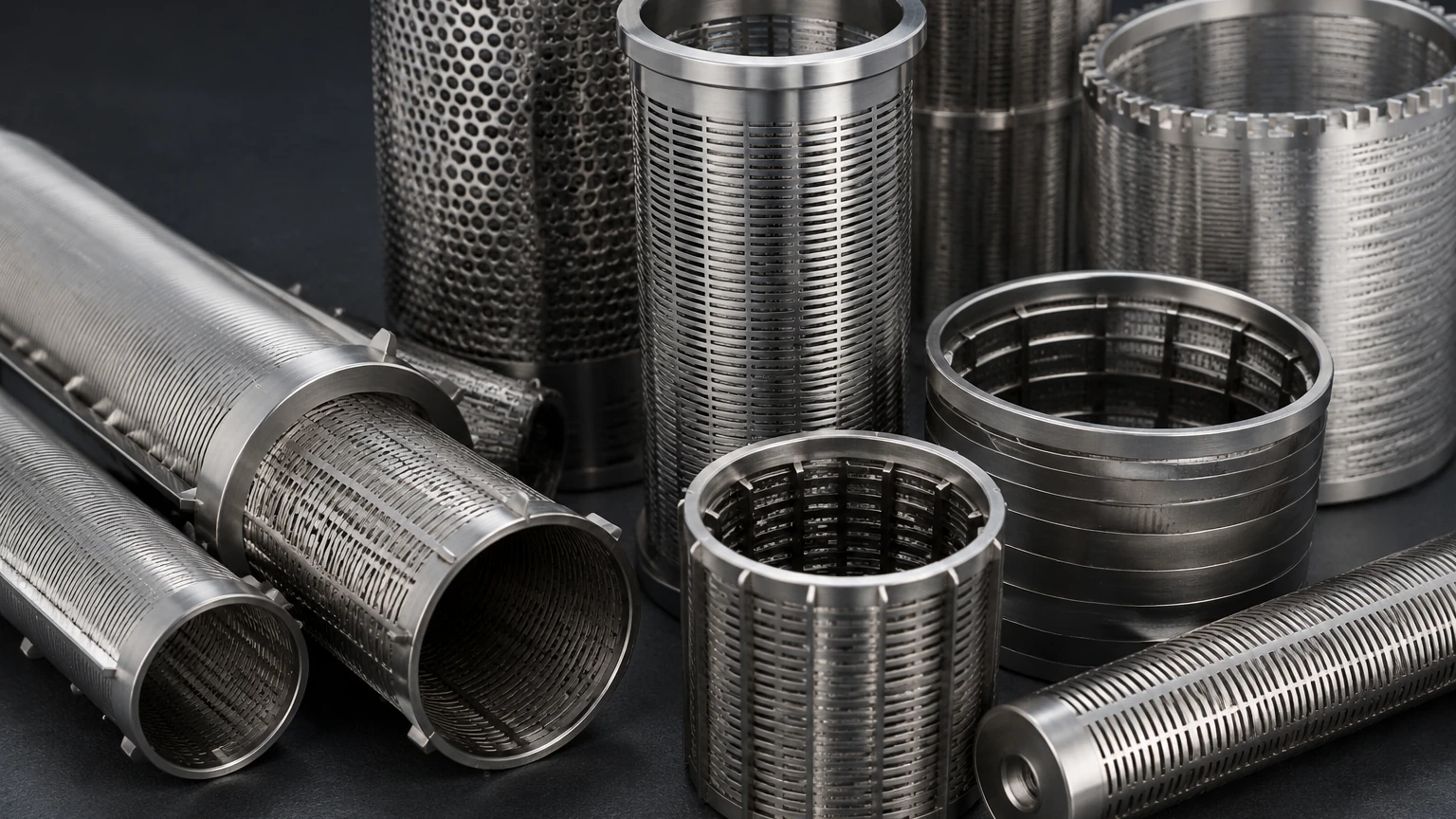
Continuous slot screens, often referred to as wedge wire screens, are widely considered the industry standard for high-performance industrial wells. They are constructed by wrapping a V-shaped wire around a circular array of internal support rods. Each intersection is resistance-welded, creating a robust, one-piece unit. The V-shaped profile creates a slot that widens inwardly, which means particles that pass the outer edge of the slot will not become lodged midway through, making the screen inherently non-clogging.
Pipe-Based Screens
In extremely deep wells or applications involving high axial loads, pipe-based screens are utilized. These consist of a perforated base pipe (which provides the structural strength) wrapped with a continuous slot screen or a stainless steel mesh jacket. This dual-layer construction combines the high open area of a screen with the collapse resistance of a heavy-wall pipe.
Shutter (Louver) Screens
Shutter screens feature staggered, bridge-like openings pressed into the pipe wall. These are typically used in large-diameter wells with coarse-grained formations. While they offer high structural strength, they generally have a lower percentage of open area compared to wedge wire designs, which can impact hydraulic efficiency in high-yield applications.
Engineering Considerations: Material Selection and Corrosion Resistance
The longevity of a well screen is largely determined by the material from which it is fabricated. In industrial filtration, where fluids may be chemically aggressive or contain high levels of dissolved minerals, material selection is a critical engineering decision.
* Stainless Steel (304 and 316L): These are the most common materials for industrial well screens. Grade 304 is suitable for most freshwater applications, while 316L offers superior resistance to chlorides and acids, making it ideal for brackish water, seawater intakes, or chemical processing environments.
* Carbon Steel: Occasionally used in temporary or low-budget wells, carbon steel is prone to corrosion and encrustation, which can significantly shorten the well's lifespan and contaminate the fluid stream with iron oxides.
* Specialty Alloys: For highly corrosive or high-temperature environments, alloys like Monel or Inconel may be specified to ensure the integrity of the filtration system over decades of service.
Engineers must evaluate the pH, redox potential, and microbial activity of the fluid to determine the most cost-effective material that will prevent premature failure due to pitting or stress-corrosion cracking.
Determining Slot Size and Open Area Requirements
A critical step in defining what is a well screen for a specific project is the determination of the slot size. This is not a generic measurement; it must be tailored to the grain size distribution of the aquifer material (the "filter pack" or the natural formation).
If the slots are too large, the well will "pump sand," leading to pump wear and potential surface subsidence. If the slots are too small, the screen will restrict flow, increasing the entrance velocity and causing excessive drawdown. This increased velocity can also accelerate mineral encrustation and mechanical erosion of the screen material.
Open Area refers to the percentage of the screen surface that consists of openings. A higher open area is generally preferred because it distributes the flow over a larger surface, lowering the entrance velocity. In high-capacity industrial wells, maintaining an entrance velocity below 0.1 feet per second (0.03 meters per second) is a common design standard to ensure laminar flow and minimize head loss.
Hydraulic Performance and Entrance Velocity
The hydraulic performance of a well screen directly impacts the total cost of ownership of the well. A well-designed screen reduces the energy required to lift fluid to the surface. When the open area is maximized, the friction losses (head loss) as fluid passes through the screen are minimized.
Lower entrance velocities also play a vital role in preventing chemical precipitation. When water undergoes a rapid pressure drop as it enters a well, dissolved gases can escape, shifting the chemical equilibrium and causing minerals like calcium carbonate or iron to precipitate out of the solution. These precipitates can clog the screen slots and the surrounding formation, a process known as encrustation. By selecting a screen with a high open area, engineers can mitigate these risks and extend the intervals between well rehabilitation sessions.
Installation, Development, and Maintenance Protocols
Even the highest quality well screen will underperform if not installed and developed correctly. During the drilling process, the borehole wall is often coated with a "filter cake" of drilling mud. Well development is the process of removing this mud and the fine-grained particles from the formation immediately surrounding the screen.
Common development methods include:
* Surging: Using a plunger-like tool to move water back and forth through the screen slots, breaking up bridges of fine particles.
* High-Velocity Jetting: Directing high-pressure water jets through the screen to agitate the formation.
* Over-pumping: Pumping the well at a higher rate than its intended operating capacity to draw out fines.
Proper development ensures that the well screen achieves its maximum designed flow rate and that the water produced is sand-free from the first day of operation.
Customization and Procurement for Industrial Projects
For technical professionals and purchasing teams, the procurement of a well screen involves verifying several technical specifications. It is rarely a "one-size-fits-all" purchase. Customization options often include specific end-fittings (such as NPT threads, weld rings, or flanges), specialized lengths to match aquifer thickness, and varying rod shapes to handle specific collapse pressures.
When evaluating suppliers, it is important to confirm their ability to provide documented material certifications and precision manufacturing tolerances. Inconsistent slot widths can lead to localized failures, where sand bypasses the screen in specific areas, eventually compromising the entire well structure.
Industrial filtration requires a partner who understands the nuances of fluid dynamics and mechanical engineering. By focusing on high-performance stainless steel solutions, manufacturers like Kaifil ensure that the filtration components can withstand the rigors of chemical processing, water treatment, and heavy industrial use. To explore the full range of custom wire mesh and metal filtration solutions, professionals are encouraged to review the technical data available on the Main Page.
Conclusion
In summary, a well screen is a sophisticated engineering tool designed to balance the conflicting requirements of structural support and fluid permeability. Whether used in a municipal water well, an industrial cooling system, or a complex chemical extraction process, the screen is the heart of the intake system. By carefully considering material selection, slot geometry, and hydraulic design, engineers can ensure that their wells operate efficiently and reliably for their intended service life, providing a consistent supply of filtered fluid while protecting downstream infrastructure.
