


Wynn 222 Filter
In the landscape of industrial filtration, precision and reliability are the primary benchmarks for operational success. The term wynn 222 filter often surfaces in discussions regarding high-efficiency filtration systems where secure sealing and specific mechanical interfaces are critical. Understanding the technical nuances of the 222 configuration, particularly when integrated into demanding industrial environments, is essential for engineers and procurement specialists looking to optimize their filtration processes. This guide examines the engineering principles, material considerations, and selection criteria associated with 222-style filtration components, with a focus on how custom stainless steel solutions provide superior durability and performance.
The Technical Anatomy of the 222 Connector
The "222" designation refers to a specific type of adapter used on filter cartridges to ensure a leak-proof connection within a filter housing. In industrial liquid and gas filtration, the 222 interface features a double O-ring seal. The O-rings are typically located on a plug-in style base that inserts into a matching receptacle in the housing's tube sheet.
Mechanical Sealing and Bypass Prevention
One of the most significant risks in industrial filtration is fluid bypass—where unfiltered media escapes around the edges of the filter element. The 222 adapter is engineered to mitigate this risk. Unlike Double Open End (DOE) filters that rely on flat gaskets and mechanical compression, the 222 interface uses radial compression. The two O-rings provide a redundant seal that maintains integrity even under thermal expansion or pressure surges. This makes the 222 configuration a standard choice for critical applications in the pharmaceutical, chemical, and food and beverage industries.
Variations: Code 3 vs. Code 7
While the 222 O-ring base is standard, it is often paired with different top-end configurations.
- Code 3: Features a 222 O-ring base with a flat closed top.
- Code 7: Features a 222 O-ring base with a locking "bayonet" or "fin" top. The bayonet tabs allow the filter to be twisted and locked into the housing, providing additional mechanical stability and ensuring the filter remains seated during backwashing or high-flow operations.
Material Science: Enhancing Performance with Stainless Steel
While many 222-style filters are available in polymer materials like polypropylene or PTFE, industrial applications involving high temperatures, aggressive chemicals, or high differential pressures require the robustness of stainless steel. At Kaifil, we specialize in transforming these standard interfaces into high-performance metal filtration components.
304 vs. 316L Stainless Steel
Selection of the correct alloy is the first step in engineering a durable filter.
- 304 Stainless Steel: Suitable for general industrial use, providing good corrosion resistance and mechanical strength at a cost-effective price point.
- 316L Stainless Steel: The "L" denotes low carbon, which improves weldability and resistance to intergranular corrosion. 316L is the preferred choice for pharmaceutical and food-grade applications due to its superior resistance to chlorides and acidic cleaning agents.
Filtration Media Options
When designing a custom stainless steel version of a wynn 222 filter equivalent, the choice of media determines the filtration efficiency and cleanability:
1. Sintered Wire Mesh: Multiple layers of stainless steel wire cloth are bonded together through heat and pressure (sintering) to create a rigid, stable pore structure. This media offers excellent permeability and is easily cleaned through backpulsing.
2. Sintered Metal Fiber (Felt): Non-woven stainless steel fibers are sintered to create a high-porosity depth media. This is ideal for high-viscosity fluids or applications requiring high dirt-holding capacity and fine micron ratings.
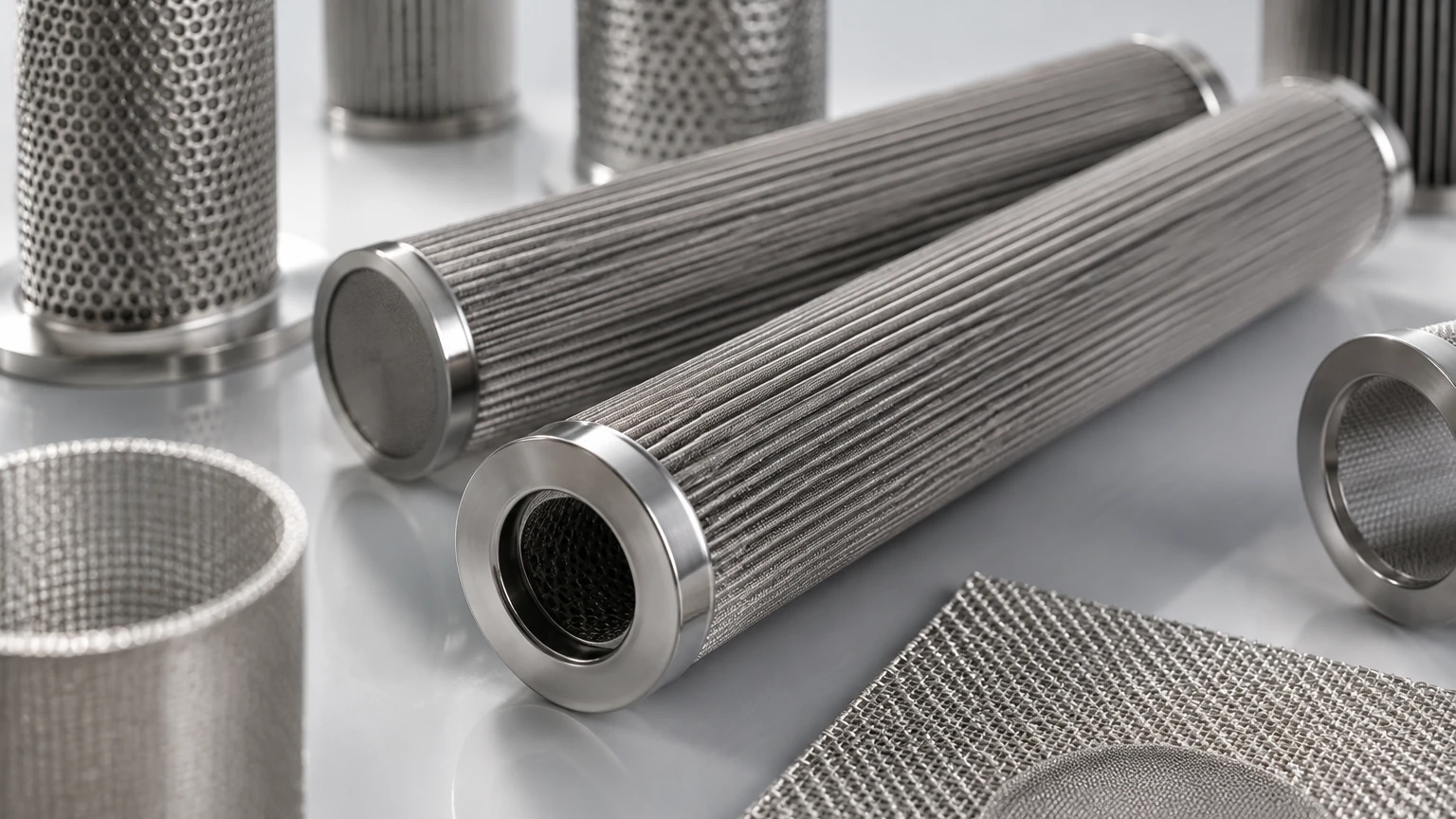
3. Pleated Wire Mesh: For applications requiring a large surface area in a compact footprint, pleating the wire mesh increases the effective filtration area, reducing the face velocity and extending the service life between cleanings.
Key Engineering Considerations for Filter Selection
When specifying a 222-style filter for an industrial system, engineers must evaluate several performance metrics to ensure the component meets the application's demands.
Micron Rating: Absolute vs. Nominal
It is vital to distinguish between nominal and absolute micron ratings. A nominal rating indicates the filter's ability to retain a majority of particles at a certain size, whereas an absolute rating (often defined as Beta 5000 or 99.9% efficiency) guarantees the retention of particles at that specific size. For critical processes, absolute-rated stainless steel mesh is often required to prevent downstream contamination.
Differential Pressure (ΔP) and Collapse Strength
The differential pressure is the difference between the inlet and outlet pressure. As the filter accumulates contaminants, ΔP increases. Stainless steel 222 filters are engineered with internal support cores to withstand significant collapse pressures, often exceeding 50-100 PSI, which is far beyond the capabilities of standard polymer filters. This allows for longer run times and protection against pump-induced pressure spikes.
Chemical and Thermal Compatibility
In chemical processing, the O-ring material is just as important as the filter media. While the stainless steel body is highly resistant, the O-rings (typically Viton, EPDM, Silicone, or PTFE-encapsulated) must be compatible with the process fluid and the sterilization temperatures. Stainless steel components can operate in environments exceeding 250°C, provided the seals are selected accordingly.
Application-Specific Performance Expectations
The versatility of the 222 interface allows it to be used across diverse sectors. Understanding the specific expectations of each sector helps in selecting the right configuration.
Food and Beverage Industry
In this sector, the primary goal is often the removal of yeast, bacteria, or sediment while maintaining the organoleptic properties of the product. Stainless steel 222 filters are favored here because they can be Cleaned-in-Place (CIP) and Steam-in-Place (SIP) repeatedly without losing structural integrity. The 222 double O-ring design ensures that no bypass occurs during the critical final filtration stages of beer, wine, or bottled water.
Pharmaceutical and Biotechnology
Filtration in pharma requires strict adherence to validation standards. Filters must be non-fiber releasing and capable of withstanding rigorous autoclave cycles. Sintered metal 222 cartridges provide a permanent solution that eliminates the risk of extractables and leachables associated with plastic filters.
Hydraulic and Industrial Fluids
For hydraulic systems, 222-style filters are used to protect sensitive valves and actuators from particulate wear. The high mechanical strength of pleated stainless steel mesh is essential for handling the high-viscosity fluids and rapid flow fluctuations common in hydraulic circuits.
Customization and OEM Solutions for Specialized Filtration
Every industrial process has unique challenges that off-the-shelf products may not fully address. Customization is where engineering expertise adds the most value. When a standard wynn 222 filter configuration does not meet specific flow rates or chemical resistance needs, custom-designed stainless steel elements become the logical alternative.
At Kaifil, we provide extensive OEM capabilities to tailor filtration components to exact specifications. This includes:
- Custom Lengths: While 10", 20", and 30" are standard, we can manufacture custom lengths to fit proprietary housings.
- Reinforced Cores: For high-pressure applications, we can increase the thickness of the perforated inner core to prevent deformation.
- Specialized End Caps: Beyond the 222 adapter, we can integrate custom flanges, threaded connections, or specialized handles for easier installation and removal.
For comprehensive technical specifications and to explore our full range of custom industrial filtration components, visit our Main Page.
Operational Maintenance and Total Cost of Ownership
While the initial purchase price of a stainless steel 222 filter is higher than that of a disposable polymer cartridge, the Total Cost of Ownership (TCO) is often significantly lower in the long term.
Cleanability and Reuse
One of the primary advantages of metal filtration is the ability to clean and reuse the elements. Depending on the contaminant, filters can be cleaned using ultrasonic baths, chemical solvents, or high-pressure backwashing. This reduces the waste disposal costs associated with single-use cartridges and minimizes inventory management requirements.
Monitoring Filter Health
Engineers should implement regular monitoring of the differential pressure. A sudden drop in ΔP may indicate a seal failure or media rupture, while a rapid increase suggests an upstream process change or heavy contaminant loading. Regularly inspecting the O-rings on the 222 base is also critical; any nicks, flattened spots, or chemical degradation can lead to bypass.
Replacement Cycles
Even permanent stainless steel filters have a finite lifespan. Over hundreds of cleaning cycles, the metal may experience work hardening or fatigue. Establishing a replacement cycle based on the number of cleanings or a periodic integrity test (such as a bubble point test) ensures that the filtration system always operates within its design parameters.
Conclusion: Making an Informed Selection
Selecting the right filtration component requires a balance of mechanical compatibility, material science, and economic analysis. The wynn 222 filter configuration remains a cornerstone of industrial filtration due to its superior sealing capabilities. By opting for high-quality stainless steel constructions, industrial operators can achieve higher levels of process purity, better thermal resistance, and improved long-term cost efficiency.
Whether you are upgrading an existing system or designing a new process, confirming the exact micron requirements, chemical compatibility, and pressure limits with a specialist manufacturer is the most effective way to ensure reliable performance. At Kaifil, we are committed to providing the engineering support and manufacturing precision necessary to solve the most complex filtration challenges in today's industrial environment.
