


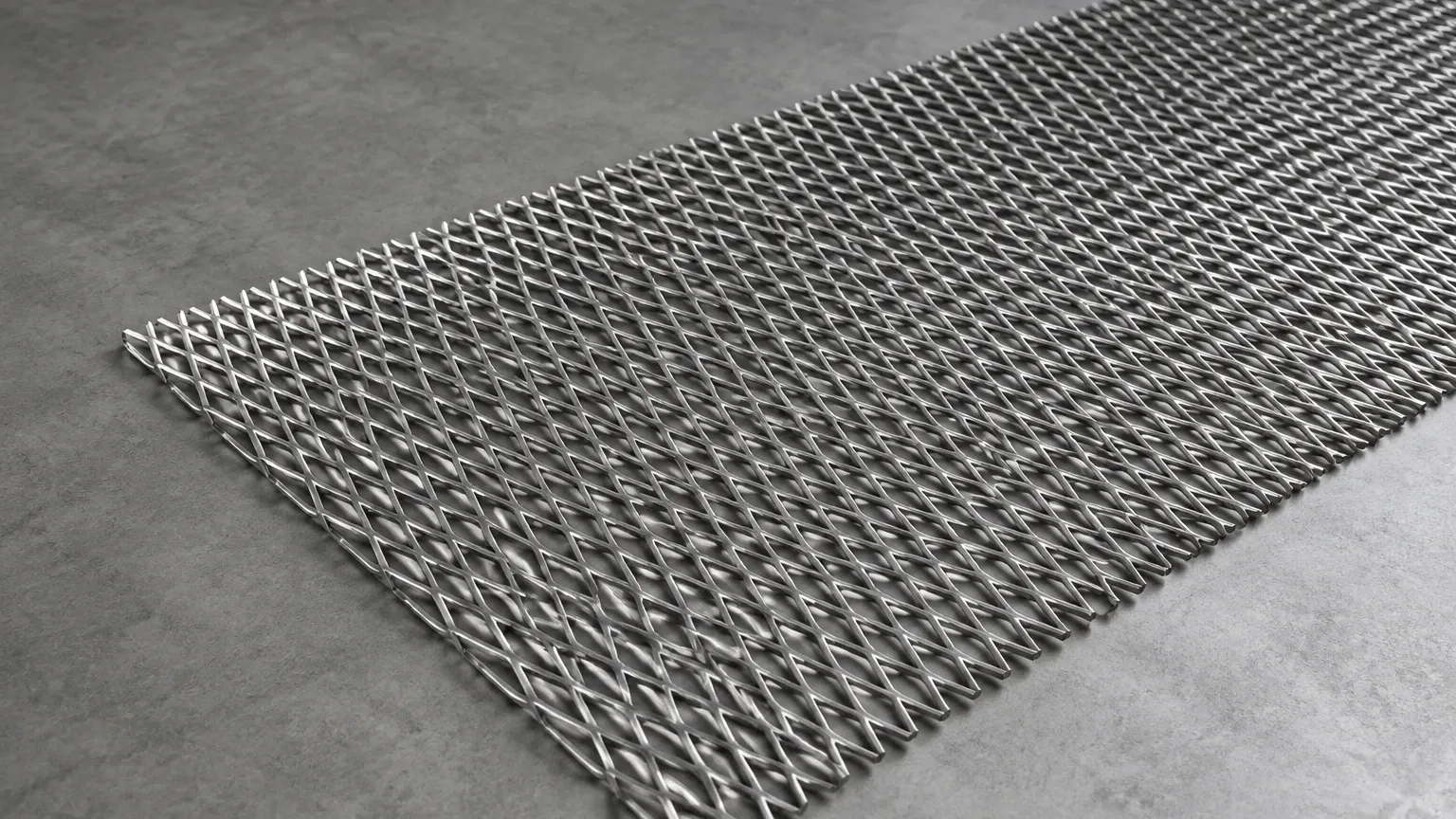
4×8 Sheet of Expanded Metal
In industrial manufacturing and structural engineering, the 4×8 sheet of expanded metal serves as a foundational component for a vast array of applications, ranging from heavy-duty industrial flooring to high-precision filtration systems. This specific dimension—48 inches by 96 inches—is the industry standard for raw material stock, mirroring the common sizing found in plywood and other sheet goods. However, unlike solid plate, expanded metal offers a unique combination of high strength-to-weight ratio, excellent open area for ventilation or drainage, and cost-effective production.
For engineers and procurement professionals, understanding the technical nuances of expanded metal is essential for ensuring the longevity and performance of the final assembly. This guide examines the manufacturing process, material considerations, and engineering specifications that define the utility of a 4×8 sheet of expanded metal in professional B2B environments.
Understanding Expanded Metal Manufacturing and Terminology
Expanded metal is produced through a simultaneous slitting and stretching process. A solid metal sheet is fed through a machine equipped with specialized knives that cut and expand the material in a single motion. Because no metal is removed during this process—unlike perforated metal where the "slugs" are punched out and discarded—expanded metal is an exceptionally resource-efficient material.
When specifying a 4×8 sheet of expanded metal, it is critical to understand the primary terminology used in the industry:
* SWD (Short Way of Design): The distance from the center of one bond to the center of the next bond measured across the short diamond diagonal.
* LWD (Long Way of Design): The distance from the center of one bond to the center of the next bond measured across the long diamond diagonal.
* Strand Width: The amount of metal fed into the machine between the knives for each stroke.
* Strand Thickness: The thickness of the original base metal.
* Bond: The intersection where two strands meet, creating the diamond pattern.
These dimensions dictate the mechanical properties of the sheet, including its rigidity and the percentage of open area, which is a primary concern in filtration and ventilation applications.
Why the 4×8 Sheet of Expanded Metal is an Industry Standard
The 4×8 foot dimension (approximately 1220mm x 2440mm) is ubiquitous in the metal distribution and fabrication industry for several practical reasons:
1. Logistical Compatibility: Standard shipping containers, flatbed trucks, and pallet dimensions are optimized for 4×8 footprints. This reduces shipping costs and minimizes the risk of damage during transit.
2. Machine Utilization: Most industrial CNC cutters, press brakes, and shearing machines are designed with a 4-foot or 8-foot bed width. Utilizing a standard sheet size reduces setup time and material handling overhead.
3. Waste Reduction: Many structural frames and architectural supports are designed on 12-inch, 16-inch, or 24-inch centers. A 4×8 sheet fits these modules perfectly, resulting in minimal off-cut waste during installation.
While custom sizes are available for specialized OEM requirements, starting with a standard 4×8 sheet is often the most cost-effective route for small to medium production runs.
Material Selection for Demanding Industrial Environments
The performance of an expanded metal sheet is heavily dependent on the alloy from which it is manufactured. In industrial filtration and chemical processing, material selection is the primary factor in determining the service life of the component.
* Stainless Steel (304, 316, 316L): As a specialist in stainless steel solutions, Kaifil emphasizes the use of these alloys for environments involving high temperatures, corrosive chemicals, or stringent hygiene requirements. Grade 316L is particularly favored in marine and pharmaceutical applications due to its superior resistance to pitting and crevice corrosion.
* Carbon Steel: Frequently used for structural applications, walkways, and security fencing where corrosion is less of a concern or where the material will be galvanized or powder-coated after fabrication.
* Aluminum: Chosen for its lightweight properties and natural resistance to atmospheric corrosion. It is common in architectural facades and aerospace components.
For filtration applications, stainless steel is the preferred choice because it maintains structural integrity under high pressure and can be cleaned and reused multiple times, lowering the total cost of ownership.
Technical Specifications: SWD, LWD, and Open Area
When an engineer evaluates a 4×8 sheet of expanded metal, the diamond size is the most critical variable. The diamond orientation relative to the sheet dimensions is also important. Typically, the LWD runs parallel to the 8-foot length of the sheet, while the SWD runs parallel to the 4-foot width. However, this can be reversed (known as "turned diamond") depending on the specific application needs.
The Role of Open Area
The "percentage of open area" determines how much light, air, or liquid can pass through the sheet. In filtration, this is a balancing act: a higher open area reduces pressure drop but may compromise the structural support of the filter media. Conversely, a lower open area provides a more robust support structure but may increase the energy required to move fluid through the system.
For those integrating these components into complex systems, reviewing Perforated & Expanded Metal specifications allows for precise alignment between the material's physical properties and the system's hydraulic requirements.
Comparing Perforated & Expanded Metal for Filtration and Support
In the context of industrial filtration, engineers often choose between perforated metal and expanded metal. While both provide excellent support for fine wire mesh or filter paper, they offer different advantages:
* Structural Rigidity: Expanded metal, particularly in its "raised" form, has a three-dimensional profile that provides inherent stiffness. This makes it an excellent choice for outer guards on filter cartridges that must withstand external impact.
* Flow Dynamics: Perforated metal offers more predictable flow patterns due to its uniform hole geometry. However, expanded metal can create beneficial turbulence in certain chemical mixing applications.
* Weight: Because expanded metal is stretched, a 4×8 sheet of expanded metal will typically weigh significantly less than a perforated sheet of the same thickness and open area, reducing the weight of the final assembly.
Engineering Considerations: Load Capacity and Deflection
When a 4×8 sheet of expanded metal is used for flooring, walkways, or heavy-duty shelving, load-bearing capacity is the paramount concern. The strength of the sheet depends on the strand thickness and the bond width.
Engineers must consider two types of loads:
1. Uniform Load: The weight distributed evenly across the entire surface of the sheet.
2. Concentrated Load: A weight applied to a small, specific area (e.g., a person standing on a walkway).
Because expanded metal is an anisotropic material—meaning its strength properties vary depending on the direction of the load—it is essential to orient the sheet so that the LWD spans the supports. This orientation maximizes the material's resistance to deflection. If the SWD spans the supports, the sheet will be significantly more prone to sagging under load.
Customization and Secondary Processing Options
While the 4×8 sheet is the starting point, industrial applications often require secondary processing to meet specific tolerances or performance standards.
Flattened vs. Raised Expanded Metal
Standard expanded metal comes off the machine in a "raised" state, where the strands are at an angle to the plane of the sheet. This provides maximum slip resistance and rigidity. For applications requiring a smooth surface—such as internal filter supports or aesthetic panels—the sheet is passed through a cold-rolling flattening mill. This reduces the thickness of the sheet and levels the strands and bonds into a single plane.
Degreasing and Surface Finishing
In the food, beverage, and pharmaceutical industries, any residual lubricants from the manufacturing process must be removed. Kaifil provides specialized degreasing and ultrasonic cleaning for stainless steel components to ensure they meet high-purity standards. Other finishing options include electropolishing, which enhances corrosion resistance and provides a mirror-like finish, and passivating, which restores the protective oxide layer on stainless steel.
Procurement Guide: Specifying Your Requirements
To ensure a smooth procurement process and receive a product that meets engineering requirements, purchasing teams should confirm the following details before placing an order for a 4×8 sheet of expanded metal:
1. Material Grade: Specify exactly which alloy is required (e.g., SS316 vs. SS304).
2. Style Designation: Use the industry-standard naming convention, which typically includes the gauge or thickness and the SWD (e.g., 1/2" #13).
3. Raised or Flattened: Clearly state if the material should be in its natural raised state or flattened.
4. Tolerances: Standard mill tolerances for 4×8 sheets can vary. If your application requires high precision (e.g., for automated welding), specify the allowable deviation in sheet length, width, and squareness.
5. Edge Requirements: Indicate if the sheet needs "random sheared" edges (where diamonds are cut through) or "bond sheared" edges (where the cut happens at the intersection of the strands).
Conclusion: Selecting the Right Filtration Partner
The 4×8 sheet of expanded metal is more than just a commodity; it is a versatile engineering material that, when specified correctly, provides essential structural and functional benefits to industrial systems. Whether it is used as a support core for a high-pressure hydraulic filter or as a protective screen in a chemical reactor, the quality of the expansion and the integrity of the material are non-negotiable.
By focusing on technical precision and material expertise, manufacturers like Kaifil help engineers navigate the complexities of metal selection and customization. When your application demands specific filtration accuracy and long-term durability, choosing a partner with deep experience in stainless steel fabrication ensures that your components will perform reliably in the most challenging environments.
