


50 Perforated Metal
In the landscape of industrial filtration and structural engineering, the specification of "50" in relation to perforated metal typically refers to one of two critical technical parameters: a 50% open area or a hole diameter of 0.050 inches. Both interpretations are vital for engineers and procurement specialists who must balance flow efficiency with structural integrity. As a specialized manufacturer of custom stainless steel filtration solutions, Kaifil provides precision-engineered Perforated & Expanded Metal components designed to meet the rigorous demands of chemical processing, pharmaceutical manufacturing, and high-pressure hydraulic systems.
Understanding the nuances of 50 perforated metal requires a technical deep dive into how hole patterns, material thickness, and open area percentages influence the performance of a filtration system. This guide examines the engineering considerations, material selection, and application-specific advantages of these configurations.
Understanding the Technical Significance of 50% Open Area
The open area of a perforated sheet is the ratio of the total area of the holes to the total area of the sheet, expressed as a percentage. A 50% open area is often considered a "sweet spot" in industrial design. It provides a significant reduction in weight and high permeability while retaining enough metal (the "ligaments") to maintain mechanical strength.
The Geometry of Flow
For filtration applications, the open area directly correlates to the pressure drop (Delta P) across the filter element. A 50% open area allows for high flow rates with minimal resistance, which is essential in gravity-fed systems or low-pressure liquid filtration. When designing a support core for a wire mesh filter, a 50% open area ensures that the perforated metal provides sufficient back-pressure resistance without obstructing the effective filtration surface of the finer mesh overlay.
Calculation and Patterns
To achieve exactly 50% open area, engineers typically utilize a staggered 60-degree pattern. This is the most popular arrangement because it offers the highest inherent strength and a uniform distribution of stress. The formula for calculating the open area in a staggered pattern is:
Open Area % = (D² × 90.69) / P²
Where *D* is the hole diameter and *P* is the pitch (the distance between the centers of two adjacent holes). For a 50% open area, the pitch must be carefully calibrated against the hole diameter to ensure the ligaments are wide enough to prevent the sheet from deforming under hydraulic load.
Engineering 0.050" Perforations for Precision Filtration
When "50" refers to a hole size of 0.050 inches (approximately 1.27 mm), the metal serves as a medium-coarse filter or a robust protective screen. This specific sizing is frequently used in the food and beverage industry and in pre-filtration stages for water treatment.
Particle Retention and Sizing
A 0.050" perforation is effective at capturing larger particulates, such as scale, seeds, or metal shavings, before they can reach more sensitive downstream components like high-precision stainless steel filter cartridges. In many industrial processes, using a 50 perforated metal screen as a primary stage extends the service life of secondary fine-mesh filters by reducing the total suspended solids (TSS) load.
Gauge and Durability
The thickness of the metal (the gauge) is just as important as the hole size. For 0.050" perforations, Kaifil often recommends a gauge that balances the "aspect ratio"—the ratio of the hole diameter to the sheet thickness. Ideally, the thickness should not exceed the hole diameter to ensure clean punching and to avoid "clogging" within the depth of the hole itself. In high-pressure hydraulic applications, a thicker gauge is utilized to prevent the "oil canning" effect, where the metal flexes and eventually fatigues under pulse cycles.
Material Selection: The Role of Stainless Steel
For B2B applications in demanding environments, material selection is non-negotiable. While perforated metal can be made from various alloys, stainless steel remains the industry standard for filtration due to its corrosion resistance and thermal stability.
Grade 304 vs. 316L
* Grade 304: Suitable for general industrial use, including food processing and architectural applications. It provides excellent strength and good corrosion resistance at a lower cost point.
* Grade 316L: The "L" stands for low carbon, which improves weldability and prevents intergranular corrosion. This grade is essential for chemical processing and marine environments where exposure to chlorides or acidic solutions is common. Kaifil specializes in 316L 50 perforated metal for pharmaceutical-grade filters where purity and resistance to aggressive CIP (Clean-in-Place) chemicals are required.
Surface Finishes and Passivation
In the pharmaceutical and food sectors, the surface finish of the perforated metal is critical. Beyond the physical holes, the metal must be free of burrs and microscopic pits where bacteria could proliferate. Electropolishing or chemical passivation is often applied to 50 perforated metal components to enhance the protective oxide layer and ensure a smooth, sanitary surface.
Perforated vs. Expanded Metal: Choosing the Right Structure
When evaluating Perforated & Expanded Metal for a project, it is important to distinguish between the two manufacturing processes, as they yield different performance characteristics.
Perforated Metal Characteristics
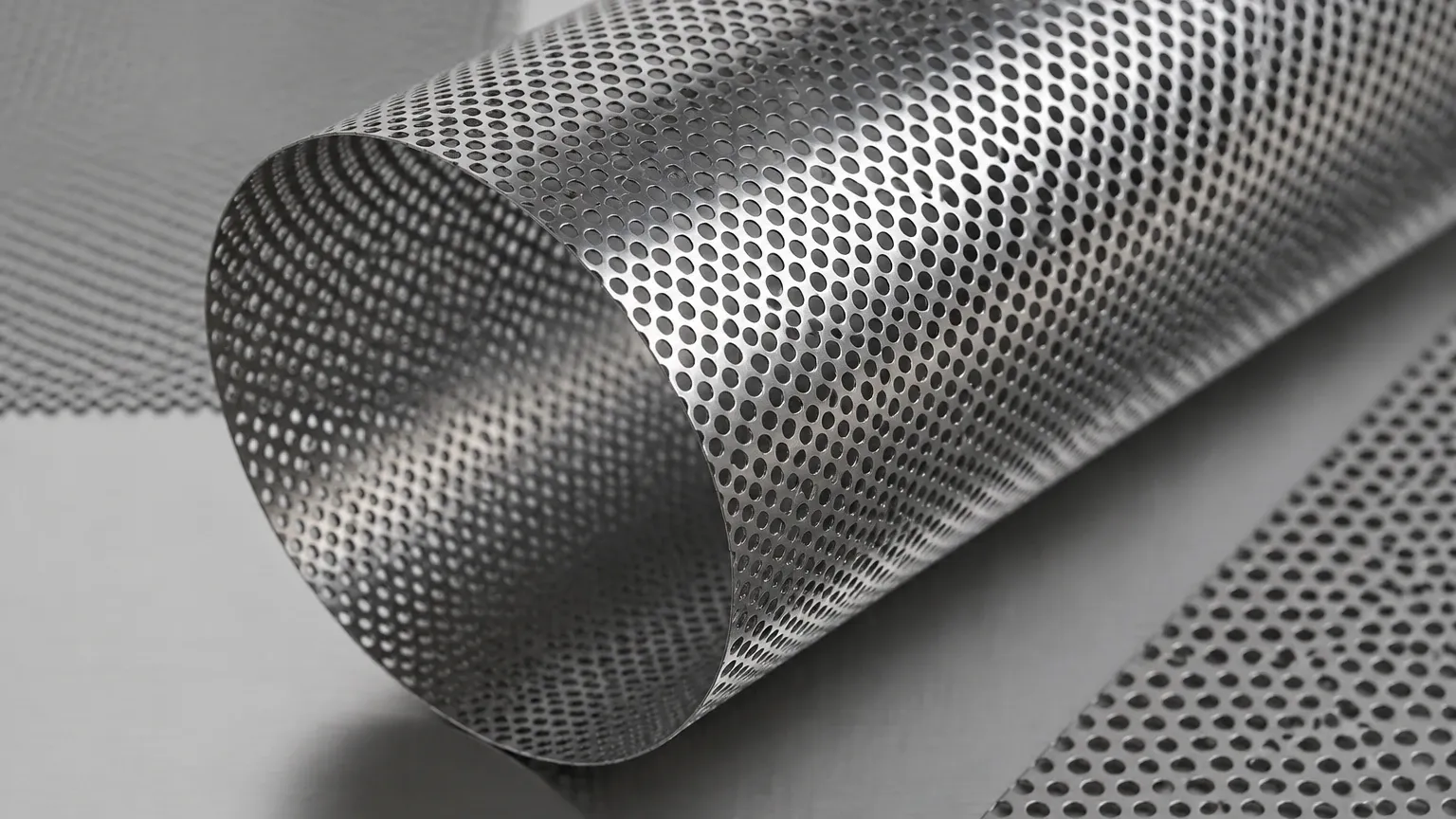
Perforated metal is created by punching holes into a solid sheet. This process allows for extreme precision in hole placement and size. It results in a flat, consistent surface that is easy to clean and weld into cylinders or cones. For 50% open area requirements, perforation offers the most predictable flow dynamics.
Expanded Metal Characteristics
Expanded metal is produced by slitting and stretching the sheet simultaneously. This creates diamond-shaped openings. While it is often more cost-effective (as there is no scrap metal lost in the process), it lacks the precise aperture control of perforated metal. However, expanded metal offers a unique "grip" and high strength-to-weight ratio, making it suitable for outer protective cages where exact flow coefficients are less critical than impact resistance.
Customization and OEM Capabilities
Industrial filtration rarely follows a one-size-fits-all approach. Customization is the core of effective filtration engineering. When sourcing 50 perforated metal, several variables must be confirmed during the design phase:
1. Margin Requirements: Standard perforated sheets often have "minimal margins" where the pattern runs to the edge. For custom filter cartridges, specified unperforated margins are necessary to allow for clean longitudinal welding and secure end-cap attachment.
2. Hole Shape: While round holes are standard for 50% open area, square or hexagonal holes can be utilized to achieve higher open areas (up to 80%) if the application requires even lower resistance.
3. Forming and Fabrication: Perforated sheets must often be rolled into cylinders or fabricated into pleated supports. The direction of the perforation (straight row vs. staggered) affects how the metal bends and resists kinking during the rolling process.
Kaifil works closely with engineering teams to provide OEM solutions that integrate these variables into the final product design, ensuring that the 50 perforated metal component fits perfectly within the larger assembly.
Maintenance, Replacement, and Total Cost of Ownership
The longevity of a perforated metal filter is determined by its environment and maintenance schedule. Unlike disposable polymer filters, stainless steel perforated components are designed for long-term reuse.
Cleaning Protocols
Because of the rigid structure of 50 perforated metal, it can withstand high-pressure backwashing and ultrasonic cleaning. This is a significant advantage in heavy-duty industrial sectors where downtime for filter replacement is costly. Regular cleaning prevents the buildup of "bridge" particulates—where solids span across the ligaments of the 50% open area—maintaining the intended flow rate.
When to Replace
Engineers should monitor for signs of mechanical fatigue, such as cracked ligaments or deformation of the hole shapes. Corrosion, even in stainless steel, can occur if the fluid chemistry changes or if the material was not properly passivated. A well-specified 50 perforated metal component should last for years, making the initial investment in high-quality materials like 316L stainless steel more cost-effective over the equipment's lifecycle.
Conclusion
Whether "50" signifies a 50% open area for optimized flow or a 0.050" hole size for specific particle retention, the success of the component depends on precision manufacturing and informed material selection. By understanding the trade-offs between structural strength and permeability, and by choosing the appropriate grade of stainless steel, engineers can ensure their filtration systems operate at peak efficiency.
For those seeking reliable, custom-engineered solutions, Kaifil offers extensive expertise in the production of Perforated & Expanded Metal products. From initial material selection to final fabrication, our focus remains on delivering filtration components that withstand the most demanding industrial environments.
