


Aluminum Perforated Metal
In the landscape of industrial design and filtration, aluminum perforated metal stands as a versatile and high-performance material choice. It is defined by a sheet or coil of aluminum that has been mechanically punched or stamped to create a specific pattern of holes, slots, or decorative shapes. For engineers and procurement specialists, selecting this material involves a balance of weight requirements, corrosion resistance, and structural integrity.
As part of the broader category of Perforated & Expanded Metal, aluminum variants offer unique advantages over heavier metals like carbon steel or even stainless steel in specific environments. This guide examines the technical specifications, material properties, and engineering considerations essential for integrating aluminum perforated metal into industrial systems.
Understanding Aluminum Perforated Metal in Industrial Contexts
Aluminum is prized in industrial manufacturing primarily for its high strength-to-weight ratio. When perforated, these sheets retain a significant portion of their structural strength while allowing for the controlled passage of air, light, sound, and fluids. This makes them indispensable in sectors ranging from aerospace and electronics to HVAC and chemical processing.
Unlike expanded metal, which is slit and stretched to create openings without material waste, perforated metal is created by punching material out of the sheet. This process allows for higher precision in hole size and placement, which is critical for filtration applications where specific micron ratings or flow rates must be maintained. The versatility of aluminum perforated metal lies in its ability to be customized to exact tolerances, ensuring compatibility with complex industrial assemblies.
Material Science: Selecting the Right Aluminum Alloy
Not all aluminum is created equal. The performance of aluminum perforated metal depends heavily on the specific alloy selected. Engineers must match the alloy's mechanical properties to the operational demands of the application.
3003-H14 Aluminum
This is the most common alloy used for general-purpose perforation. It is an alloyed aluminum with manganese, providing excellent workability and moderate strength. It is highly resistant to atmospheric corrosion and is frequently used in architectural components and basic filtration housings.
5052-H32 Aluminum
For environments where higher strength and superior corrosion resistance are required—particularly in marine or chemical applications—5052 is the preferred choice. It offers better fatigue strength than most alloys and maintains its integrity in salt-water environments, making it a staple for offshore filtration components.
6061-T6 Aluminum
When structural rigidity is the primary concern, 6061-T6 (a heat-treated structural alloy) is utilized. While it is more difficult to perforate than the 3000 or 5000 series, it provides the structural backbone needed for heavy-duty industrial platforms, machine guards, and high-pressure filtration supports.
Technical Parameters and Design Considerations
When specifying aluminum perforated metal, several geometric and mechanical parameters must be defined. These factors directly influence the material's performance in filtration, acoustic dampening, and structural support.
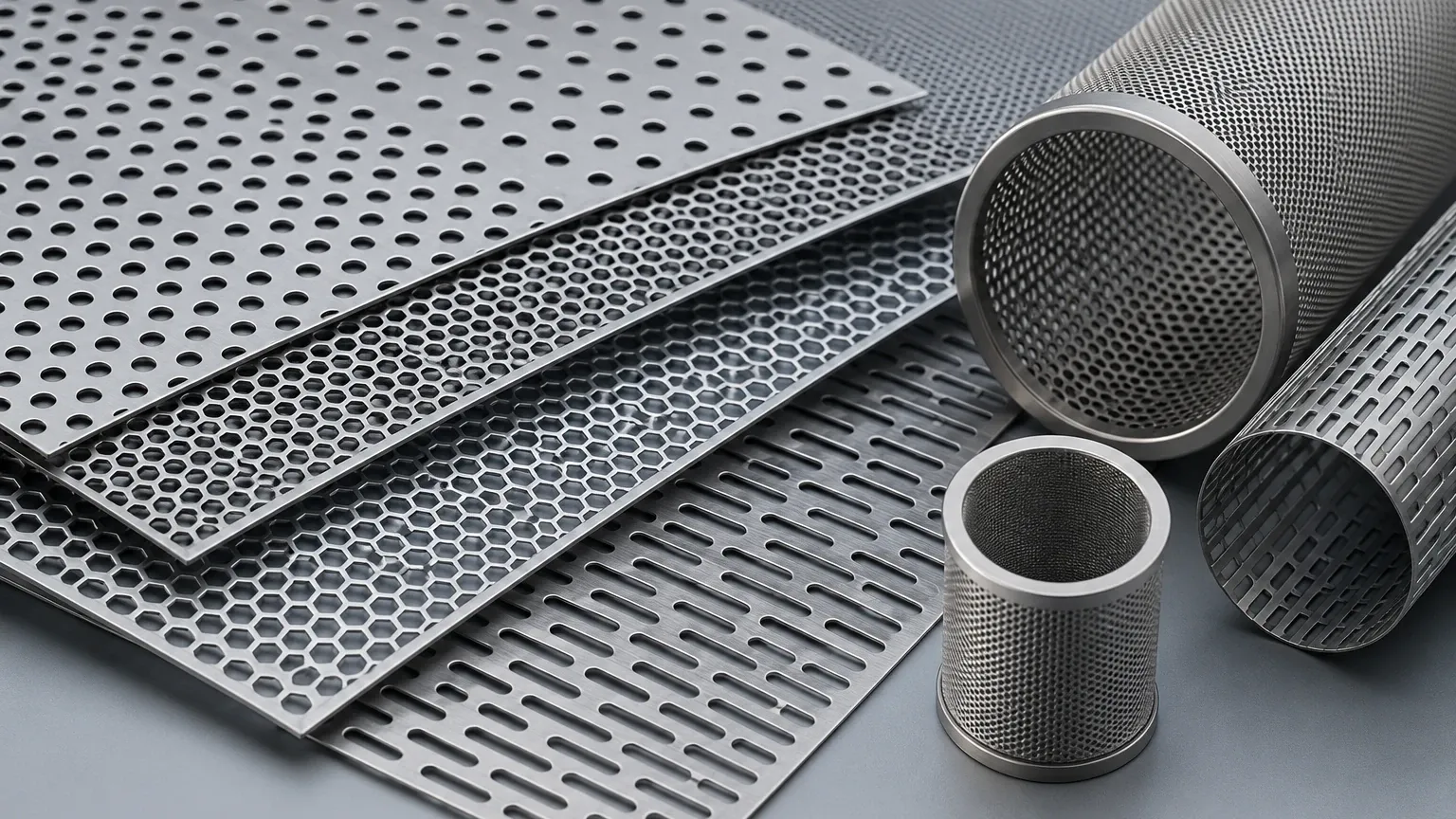
Hole Patterns and Orientation
* Staggered Pattern: The most common configuration, usually at a 60-degree angle. This orientation provides the highest open area and uniform strength across the sheet.
* Straight Row: Holes are aligned in both vertical and horizontal rows. This is often chosen for aesthetic reasons or specific tracking requirements in conveyor systems, though it offers less structural stability than staggered patterns.
* Slotted Holes: Used primarily for sorting and sifting applications where elongated particles must be managed.
Calculating Open Area
The "open area" is the percentage of the sheet that is occupied by holes. This is perhaps the most critical metric for engineers calculating flow rates or pressure drops in filtration systems. For a standard 60-degree staggered round hole pattern, the formula is:
Open Area % = (D² × 90.69) / P²
Where:
* D = Hole Diameter
* P = Pitch (the distance from the center of one hole to the center of the adjacent hole)
An accurate calculation ensures that the aluminum perforated metal does not become a bottleneck in hydraulic or pneumatic systems.
Margins and Blank Areas
Industrial applications often require "safe sides" or unperforated margins to facilitate welding, mounting, or bolting. Specifying the width of these margins is essential to prevent the deformation of the hole pattern during the installation process.
Comparing Perforated and Expanded Metal Structures
Within the Perforated & Expanded Metal product group, it is important to distinguish when aluminum perforated metal is superior to its expanded counterpart.
Expanded metal is often more cost-effective because the manufacturing process involves no scrap loss. However, perforated aluminum offers a flat, smooth surface that is easier to clean and less likely to trap contaminants—a vital feature in food and beverage or pharmaceutical processing. Furthermore, perforated metal allows for much smaller hole diameters (fine perforation), which is necessary for precision filtration that expanded metal cannot achieve. For high-accuracy liquid-solid separation, perforated sheets serve as the ideal support medium for finer wire mesh layers.
Industrial Applications and Performance Expectations
Aluminum perforated metal is utilized across diverse industries due to its non-magnetic properties, thermal conductivity, and lightweight nature.
Filtration and Separation
In the filtration industry, perforated aluminum often serves as the inner core or outer cage for filter cartridges. It provides the necessary mechanical support for delicate filter media, such as fiberglass or fine stainless steel mesh, ensuring the filter does not collapse under high differential pressure. Its corrosion resistance is particularly valued in water treatment and chemical filtration where carbon steel would fail.
Acoustic and Vibration Control
In power plants and manufacturing facilities, aluminum perforated metal is used in acoustic panels to dampen noise. The material’s ability to allow sound waves to pass through into sound-absorbing material, combined with its lightweight nature, makes it ideal for ceiling panels and machinery enclosures.
Heat Dissipation in Electronics
Aluminum’s high thermal conductivity makes perforated sheets excellent for electronic enclosures. They allow for maximum airflow and heat venting while providing EMI/RFI shielding to protect sensitive internal components.
Food and Beverage Processing
Because aluminum is non-toxic and can be easily sanitized, it is used in drying trays, grain screens, and sorting equipment. The smooth edges of high-quality perforated aluminum prevent food particles from snagging, reducing the risk of bacterial growth.
Customization, Finishing, and Quality Control
To meet the rigorous demands of industrial environments, aluminum perforated metal often undergoes secondary processing. These finishes enhance both the durability and the functional performance of the component.
Anodizing
Anodizing is an electrochemical process that thickens the natural oxide layer on the surface of the aluminum. This significantly increases corrosion and wear resistance. For components exposed to harsh outdoor environments or chemical vapors, anodized aluminum perforated metal offers a much longer service life.
Degreasing and Deburring
The perforation process involves high-speed punching, which can leave oil residues and sharp burrs. For filtration and pharmaceutical applications, thorough degreasing and professional deburring are mandatory to ensure the purity of the process and the safety of the handlers.
Precision Leveling
Internal stresses during the punching process can cause the metal sheet to curl or bow. Precision leveling ensures the final product is perfectly flat, which is critical for automated assembly lines and seamless integration into filter housings.
Procurement and Total Cost of Ownership
When evaluating aluminum perforated metal for a project, engineers should look beyond the initial purchase price and consider the total cost of ownership (TCO). Aluminum’s longevity and low maintenance requirements often make it more cost-effective than cheaper alternatives that require frequent replacement.
Key Information for Technical Quotes
To receive an accurate quote and ensure the material meets application requirements, procurement teams should confirm the following details with the manufacturer:
1. Alloy and Temper: (e.g., 5052-H32)
2. Thickness/Gauge: Expressed in inches or millimeters.
3. Hole Size and Shape: (e.g., 1/8" round holes)
4. Pattern and Pitch: (e.g., 3/16" staggered centers)
5. Open Area Percentage: To ensure flow requirements are met.
6. Sheet Dimensions and Margins: Specific length, width, and unperforated border requirements.
7. Secondary Operations: Requirements for leveling, shearing, or anodizing.
Quality Assurance
Reliable manufacturers provide material test reports (MTRs) that verify the chemical composition and mechanical properties of the aluminum. For critical industrial applications, ensuring the material adheres to ASTM standards is a necessary step in the quality control process.
Conclusion
Aluminum perforated metal is a sophisticated engineering material that offers a unique combination of lightness, strength, and corrosion resistance. Whether it is used as a structural support in a complex filtration system or as a heat-dissipating enclosure for electronics, its performance depends on precise specification and quality manufacturing. By understanding the nuances of alloy selection, open area calculations, and finishing options, engineers can optimize their systems for durability and efficiency.
As part of a comprehensive range of Perforated & Expanded Metal solutions, aluminum remains a top-tier choice for modern industrial challenges, providing a reliable and customizable platform for innovation in filtration and beyond.
