


Brass Perforated Metal Sheet
In industrial engineering and filtration, the selection of material is as critical as the mechanical design of the component. The brass perforated metal sheet represents a specialized solution that balances mechanical strength, corrosion resistance, and specific electrical properties. While stainless steel is often the default choice for harsh environments, brass offers unique advantages in applications involving acoustic damping, EMI shielding, and spark-sensitive environments. For engineers and procurement teams, understanding the technical nuances of brass alloys and perforation patterns is essential for optimizing system performance and longevity.
As a manufacturer specializing in Perforated & Expanded Metal, Kaifil provides precision-engineered components designed to meet the rigorous demands of industrial filtration and structural applications. This guide examines the technical specifications, application benefits, and selection criteria for brass perforated metal sheets in a B2B context.
Technical Composition and Alloy Selection
Brass is a non-ferrous alloy primarily composed of copper and zinc. The ratio of these two elements, along with trace amounts of other metals, determines the physical and chemical properties of the perforated sheet. In industrial settings, the most common grades used for perforation include:
* C260 (Cartridge Brass): Comprising approximately 70% copper and 30% zinc, this is the most popular grade for perforation. It offers excellent ductility and cold-working properties, allowing for clean, precise holes without compromising the structural integrity of the sheet.
* C270 (Yellow Brass): With a slightly higher zinc content, C270 provides a balance of strength and formability. It is frequently used in architectural and industrial applications where a combination of durability and aesthetic finish is required.
* C280 (Muntz Metal): This alpha-beta brass contains about 60% copper and 40% zinc. It is notably stronger and harder than C260, making it suitable for heavier-duty industrial components, though it is less ductile.
When selecting a brass perforated metal sheet, engineers must consider the alloy's resistance to dezincification—a form of corrosion where zinc is selectively leached from the alloy. In environments with high moisture or specific chemical exposures, selecting an inhibited brass or a grade with higher copper content may be necessary to ensure long-term stability.
Perforation Patterns and Open Area Calculations
The performance of a perforated sheet is defined by its hole pattern and the resulting "open area" percentage. This calculation is vital for determining flow rates in filtration, pressure drops in ventilation, and the effectiveness of acoustic barriers.
Round Hole Patterns
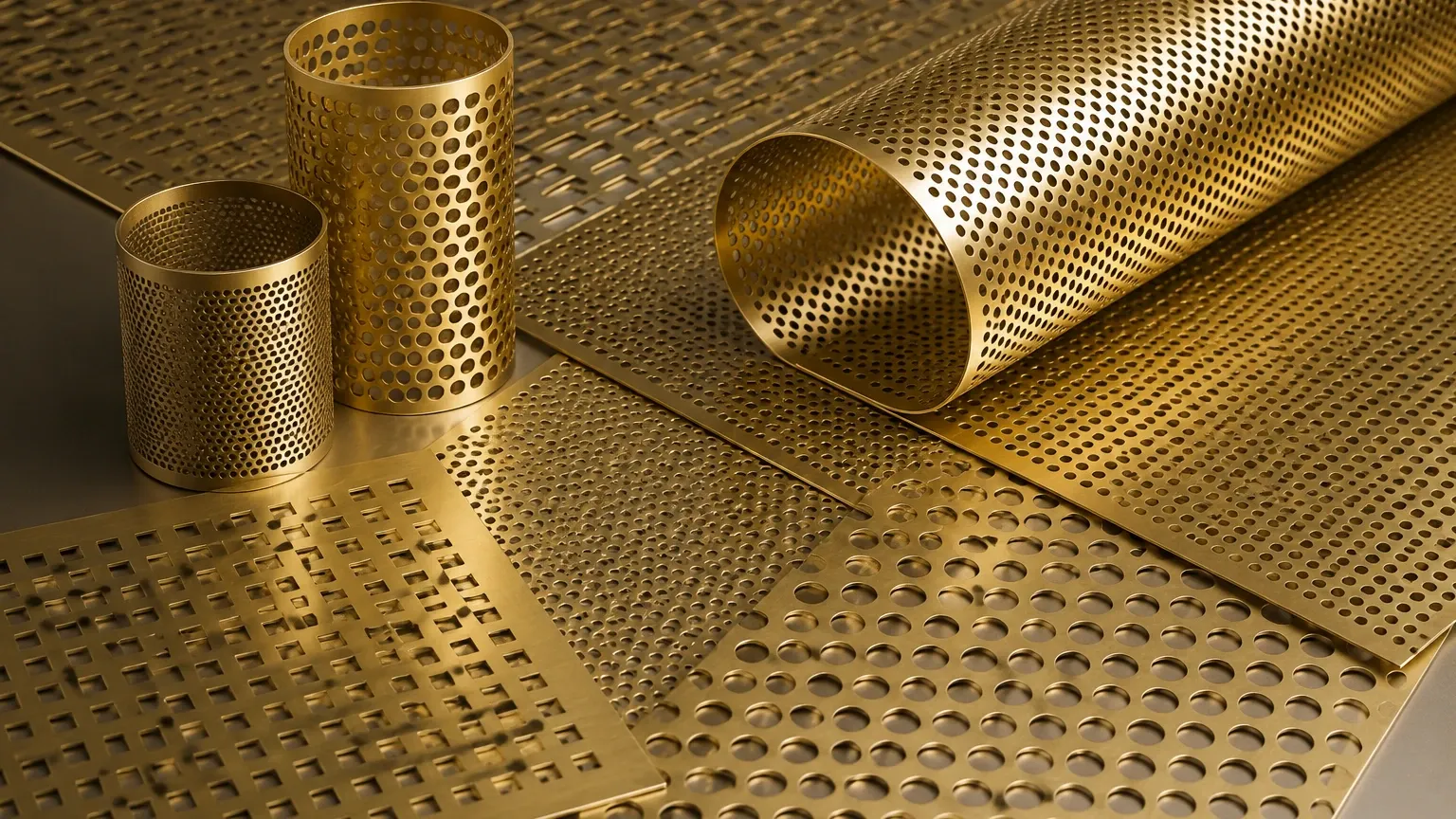
Round holes are the most common and cost-effective pattern. They are typically arranged in two configurations:
1. 60-Degree Staggered: This is the industry standard due to its inherent structural strength and high open area potential. It provides a uniform distribution of holes, which is critical for consistent filtration and fluid dynamics.
2. Straight Line: Holes are aligned in both horizontal and vertical rows. While simpler to manufacture, this pattern offers lower structural rigidity compared to staggered configurations.
Calculating Open Area
For a 60-degree staggered round hole pattern, the open area percentage (OA%) is calculated using the formula:
OA% = (D² × 90.69) / P²
*Where D is the hole diameter and P is the center-to-center pitch.*
In B2B procurement, specifying the exact open area is crucial. A higher open area reduces weight and increases flow but decreases the tensile strength of the sheet. For filtration support structures, a balance must be struck to ensure the brass perforated metal sheet can withstand the differential pressure of the system without deforming.
Key Performance Advantages in Industrial Applications
Why choose brass over stainless steel or aluminum? The decision often rests on four primary performance factors:
1. Corrosion Resistance and Biofouling
Brass naturally resists corrosion in many environments, particularly in freshwater and non-oxidizing acids. Furthermore, the copper content in brass provides inherent antimicrobial properties and resists biofouling. This makes brass perforated sheets an excellent choice for water treatment components and heat exchanger guards where organic growth can impede performance.
2. Electrical and Thermal Conductivity
Brass is significantly more conductive than stainless steel. In electronic enclosures or specialized filtration systems, a brass perforated metal sheet can serve as an effective EMI (Electromagnetic Interference) or RFI (Radio Frequency Interference) shield. It allows for airflow and cooling while maintaining electrical continuity across the assembly.
3. Non-Sparking Characteristics
In volatile environments, such as chemical processing plants or grain silos, the risk of mechanical sparks is a safety priority. Brass is a non-sparking material. Using brass perforated components in these zones mitigates the risk of ignition during maintenance or operational friction.
4. Acoustic Damping
Brass has unique acoustic properties that make it superior for sound attenuation. Perforated brass sheets are often used as the facing material for acoustic insulation in engine rooms, power plants, and industrial HVAC systems. The mass and density of the brass, combined with specific perforation patterns, help tune sound absorption across various frequency ranges.
Engineering Considerations for Filtration Systems
In the context of industrial filtration, the brass perforated metal sheet often serves as a primary filter for coarse particles or as a robust support cage for fine wire mesh or filter media. When integrating these components into a filtration system, several engineering factors must be evaluated:
* Pressure Drop (ΔP): The resistance to flow caused by the perforated sheet must be calculated to ensure the pump or blower system operates within its efficient range. The thickness of the sheet and the smoothness of the perforated edges (burr-free) play a role in minimizing turbulence.
* Mechanical Load: In hydraulic or high-pressure liquid filtration, the perforated sheet must support the filter media against significant force. Engineers must specify the required yield strength and ensure the sheet thickness is sufficient to prevent "oil-canning" or buckling.
* Edge Margins: Customization allows for "blank" or unperforated margins along the edges of the sheet. These margins are essential for welding, bolting, or clamping the sheet into a filter housing. Specifying precise margins prevents the compromise of the structural seal.
Manufacturing Tolerances and Customization
Precision manufacturing is the hallmark of high-quality industrial components. At Kaifil, the production of Perforated & Expanded Metal involves CNC punching and high-speed pressing to ensure consistency across large production runs. Standard tolerances for brass perforated metal sheets typically include:
* Thickness Tolerance: Adhering to ASTM or ISO standards for sheet metal gauge.
* Hole Diameter Tolerance: Usually within +/- 0.05mm to 0.1mm depending on the sheet thickness.
* Flatness: Industrial sheets may require leveling after the perforation process to remove internal stresses and ensure they sit flush in their intended frames.
Customization options extend beyond hole patterns. Sheets can be supplied in specific dimensions, formed into cylindrical cartridges, or treated with surface finishes like degreasing or lacquering to prevent oxidation during transit and storage.
Procurement and Total Cost of Ownership (TCO)
When evaluating the cost of a brass perforated metal sheet, B2B buyers should look beyond the initial price per square foot. The Total Cost of Ownership includes:
1. Longevity: Brass's resistance to certain types of corrosion can result in a longer service life compared to lower-grade steels, reducing the frequency of replacement.
2. Machinability: Brass is easier to cut, weld, and form than many stainless steel alloys. This can lead to lower fabrication costs when the perforated sheet is being integrated into a larger assembly.
3. Recyclability: As a copper-based alloy, brass has a high scrap value. At the end of the component's lifecycle, the material can be recycled, providing a small return on investment and supporting corporate sustainability goals.
Conclusion: Making an Informed Selection
The brass perforated metal sheet is a versatile, high-performance material that solves specific engineering challenges where conductivity, non-sparking properties, and corrosion resistance are paramount. Whether used as a decorative architectural element or a critical component in a high-pressure filtration system, the quality of the perforation and the suitability of the alloy grade are the primary drivers of success.
For engineers and technical professionals, the next step involves confirming the specific environmental conditions—such as pH levels, temperature, and mechanical stress—to which the sheet will be exposed. By partnering with a manufacturer like Kaifil that understands the complexities of Perforated & Expanded Metal, purchasing teams can ensure they receive components that meet exact tolerances and performance expectations.
When requesting a quote or technical consultation, be prepared to provide the alloy grade, hole diameter, pitch, sheet thickness, and required margins. These details allow for a precise manufacturing approach that optimizes both the material's utility and the system's overall efficiency.
