


Bronze Perforated Metal
In the landscape of industrial materials, bronze perforated metal stands as a specialized solution that bridges the gap between high-performance mechanical properties and specific chemical or electrical requirements. Unlike standard carbon steel or stainless steel alternatives, bronze alloys offer a unique combination of corrosion resistance, electrical conductivity, and anti-sparking characteristics that are essential in volatile or marine environments. For engineers and procurement specialists, selecting the correct grade and configuration of Perforated & Expanded Metal is critical to ensuring the longevity and efficiency of filtration systems, shielding components, and structural elements.
Understanding Bronze Alloys in Perforated Metal Production
Bronze is primarily an alloy of copper and tin, though modern industrial "bronze" often includes other elements like phosphorus, manganese, aluminum, or silicon to enhance specific mechanical properties. When specifying bronze perforated metal, it is vital to distinguish between the various alloys available, as each performs differently under industrial stress.
Phosphor Bronze (C51000 / C54400)
Phosphor bronze is perhaps the most common alloy used in perforated metal for industrial applications. By adding a small amount of phosphorus (typically 0.01% to 0.35%) during the smelting process, the alloy gains increased wear resistance, fatigue resistance, and chemical durability. In the context of perforated sheets, phosphor bronze maintains excellent spring-like qualities and is highly resistant to corrosion, making it a preferred choice for precision filtration and electrical contact components.
Aluminum Bronze
Aluminum bronze alloys are characterized by their high strength and exceptional resistance to corrosion in seawater. The formation of a thin, protective layer of aluminum oxide on the surface of the metal allows it to withstand harsh marine environments better than many stainless steels. Perforated sheets made from aluminum bronze are often utilized in offshore oil and gas applications and shipboard cooling systems.
Silicon Bronze
Silicon bronze is known for its easy weldability and high resistance to various chemicals, including many acids and alkalis. It is frequently used in chemical processing plants where perforated components must maintain structural integrity while exposed to corrosive vapors or fluids.
Technical Specifications and Perforation Patterns
The performance of bronze perforated metal is dictated not only by the material grade but also by the geometry of the perforations. Engineering teams must calculate the balance between "open area" for flow and the structural rigidity required for the application.
Round Hole Perforations
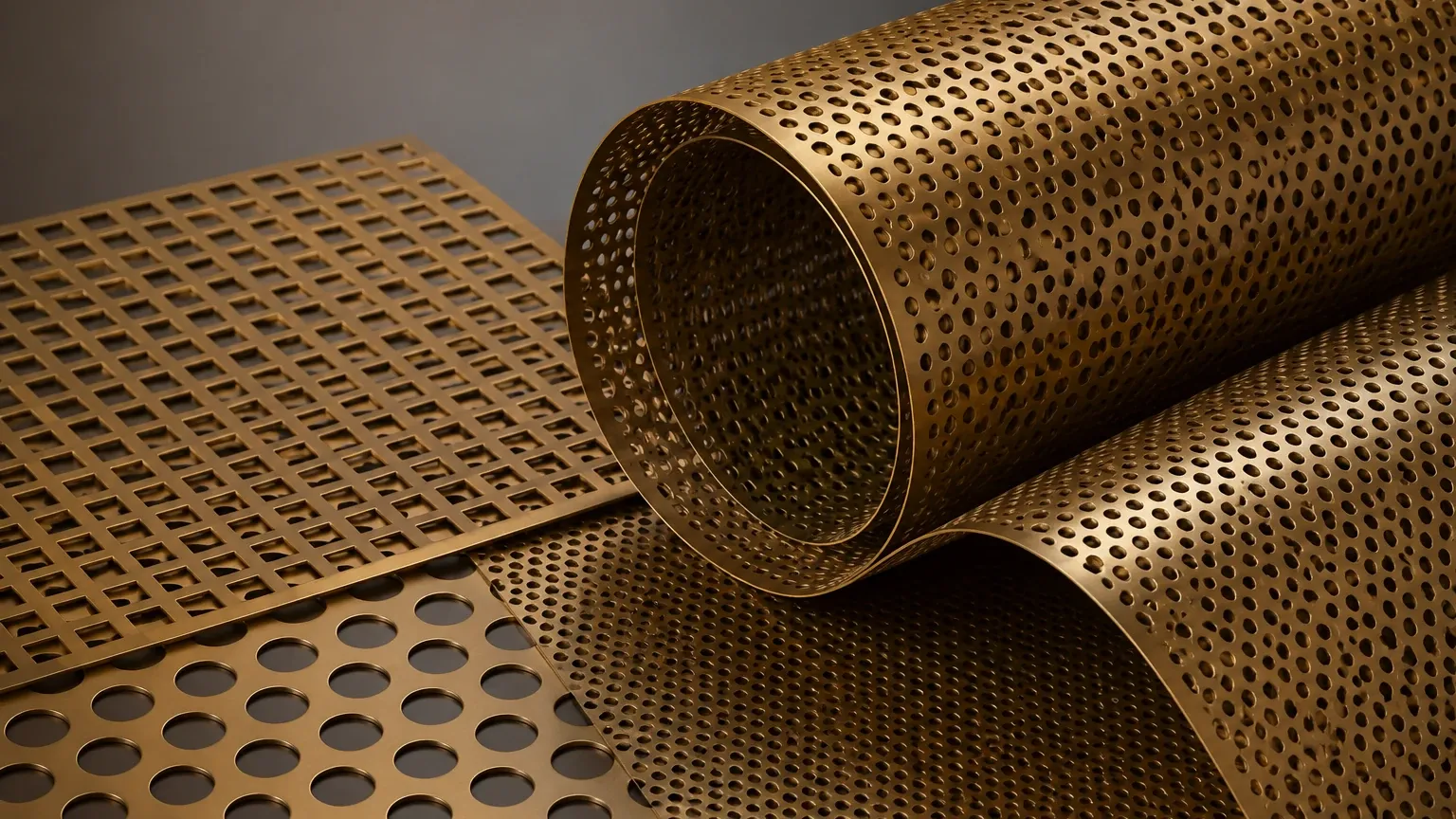
Round holes are the most common and cost-effective pattern. They offer the greatest structural strength and are available in various arrangements:
- 60-Degree Staggered: This is the industry standard, providing the highest open area and maximum strength-to-weight ratio. It ensures a uniform flow of liquids or gases across the entire surface.
- Straight Line: Holes are aligned in both horizontal and vertical rows. While easier to manufacture for certain custom designs, this pattern offers lower structural integrity than staggered configurations.
Square and Slotted Holes
Square holes provide a larger open area for applications requiring high flow rates, such as ventilation or coarse filtration. Slotted holes, often used in sieving or sorting equipment, are ideal for materials that might clog round or square apertures. Slotted bronze perforated metal is particularly useful in the food and beverage industry for processing viscous liquids where the non-reactive nature of bronze is a benefit.
Key Dimensional Variables
When ordering, engineers must specify:
- Hole Diameter (D): The size of the individual perforation.
- Pitch (P): The distance from the center of one hole to the center of the adjacent hole.
- Thickness (T): The gauge of the bronze sheet. A general engineering rule is that the hole diameter should not be smaller than the material thickness to prevent tool breakage and ensure clean edges.
Industrial Applications of Bronze Perforated Metal
Because of its distinct physical properties, bronze perforated metal is selected for specialized industrial roles where other metals fail or prove inefficient.
Filtration and Separation
In the chemical and pharmaceutical industries, bronze is often used for filter support structures or as the primary filtration media for specific chemical batches. Its resistance to biofouling—the growth of algae and barnacles—makes it an excellent choice for intake screens in water treatment and marine cooling systems. Unlike stainless steel, which can suffer from pitting in stagnant seawater, bronze maintains a more stable surface profile.
EMI and RFI Shielding
Copper-based alloys like bronze have high electrical conductivity. Perforated bronze sheets are highly effective at attenuating electromagnetic interference (EMI) and radio frequency interference (RFI). In sensitive electronic environments or aerospace applications, these sheets allow for airflow and cooling while maintaining a conductive cage that protects internal components from external signals.
Acoustic Dampening
In industrial machinery housing, perforated bronze is utilized in acoustic panels. When backed by sound-absorbing materials, the perforations allow sound waves to pass through and be trapped, significantly reducing noise pollution in engine rooms or manufacturing floors. Bronze is preferred here when the environment is damp or corrosive, as it will not rust like carbon steel.
Anti-Sparking Safety Components
In environments where explosive gases or flammable dust are present, such as grain elevators or refineries, bronze is valued for its non-sparking properties. Tools or guards made from perforated bronze reduce the risk of mechanical sparks that could trigger a fire or explosion.
Engineering Considerations: Open Area and Structural Integrity
Calculating the "Open Area" is a fundamental step in filter design. The open area percentage determines the pressure drop across the filter and the velocity of the fluid passing through the media. For a standard 60-degree staggered round hole pattern, the formula is:
Open Area % = (D² × 90.69) / P²
Where D is the hole diameter and P is the pitch.
However, increasing the open area reduces the mechanical strength of the sheet. For high-pressure hydraulic applications or heavy-duty sieving, engineers must ensure the "bar" (the metal remaining between the holes) is wide enough to withstand the operating load without deforming. In custom manufacturing, Kaifil provides expertise in balancing these conflicting requirements, ensuring that the Perforated & Expanded Metal meets the specific stress-strain profiles of the end-use environment.
Comparing Bronze with Stainless Steel and Brass
Choosing between bronze, brass, and stainless steel involves evaluating the total cost of ownership and the specific environmental stressors.
| Feature | Bronze (Phosphor) | Stainless Steel (316) | Brass |
| :— | :— | :— | :— |
| Corrosion Resistance | Excellent (especially seawater) | Excellent (general chemical) | Moderate |
| Conductivity | High | Low | High |
| Strength | Moderate to High | High | Moderate |
| Biofouling Resistance | High | Low | Moderate |
| Sparking Risk | Non-sparking | Low (but possible) | Non-sparking |
While stainless steel 316 is the "go-to" for many B2B filtration needs due to its high tensile strength and acid resistance, it lacks the electrical conductivity and natural antimicrobial/anti-biofouling properties of bronze. Brass, while similar in appearance to bronze, contains zinc, which can leach out in certain corrosive environments (a process known as dezincification), making bronze the more durable choice for long-term industrial reliability.
Customization and Manufacturing Precision
Industrial filtration often requires more than just a flat perforated sheet. Customization options provided by manufacturers like Kaifil allow for the integration of perforated bronze into complex systems.
Secondary Processing
- Forming and Rolling: Perforated bronze can be rolled into cylinders for use as filter cartridges or protective sleeves. Due to the ductility of most bronze alloys, they can be formed into tight radii without cracking the margins of the perforations.
- Welding: Specialized techniques, such as TIG or MIG welding with compatible filler rods, are used to join bronze components. This is crucial for creating seamless filter elements that must withstand internal pressure.
- Degreasing and Finishing: For pharmaceutical or food-grade applications, the metal must be thoroughly cleaned of manufacturing oils. Bronze can also be polished or treated to enhance its natural patina for architectural-industrial hybrids.
Margin Specifications
Standard perforated sheets often have "unfinished" margins where the hole pattern is cut off at the edge. For industrial B2B applications, "safe margins" (solid metal borders) are usually required to facilitate welding or mounting into a frame. Specifying the exact margin width on all four sides is a critical detail that prevents assembly issues during final production.
Selection and Procurement Guidelines for Engineers
To ensure a successful procurement process for bronze perforated metal, technical teams should confirm the following data points before finalizing an order:
1. Alloy Grade: Specify the exact UNS or international equivalent (e.g., C51000) rather than just "bronze."
2. Hole Specification: Define the diameter, pitch, and pattern (staggered or straight).
3. Sheet Dimensions and Tolerances: Industrial applications often require tighter tolerances than architectural ones. Define the allowable variance in length, width, and flatness.
4. Direction of Stagger: For certain conveyor or flow applications, the direction of the stagger (relative to the length of the sheet) can impact performance.
5. Edge Requirements: Specify if the sheet requires solid margins or if a "full-perf" (holes to the edge) is acceptable.
6. Surface Condition: Note if the material needs to be deburred. Punching can leave small burrs on the exit side of the hole, which can trap contaminants in filtration applications or cause turbulence in high-velocity gas flows.
By focusing on these technical parameters, purchasing teams can secure filtration and shielding components that offer superior service life and performance. Bronze perforated metal remains a vital material in the engineer's toolkit, providing specialized solutions where standard metals fall short.
