


Buy Perforated Metal Sheet
In the industrial filtration and manufacturing sectors, the decision to buy perforated metal sheet involves more than a simple transaction. It requires a deep understanding of material science, mechanical engineering, and fluid dynamics. Perforated metal serves as a foundational component in applications ranging from chemical processing and pharmaceutical filtration to architectural screening and hydraulic systems. As a specialized manufacturer, Kaifil emphasizes that the performance of a filtration system is often dictated by the precision and quality of the base perforated or expanded metal used in its construction.
When engineers and procurement teams look to buy perforated metal sheet, they must navigate a complex landscape of specifications, including hole patterns, open area percentages, material grades, and tolerances. This guide provides a technical framework for selecting and sourcing these components to ensure long-term durability and operational efficiency.
Understanding the Role of Perforated & Expanded Metal in Industrial Filtration
While both perforated and expanded metals are used across various industries, they offer distinct mechanical properties and filtration characteristics. Understanding these differences is the first step in a successful procurement process.
Perforated & Expanded Metal are often grouped together, but their manufacturing processes result in different performance profiles. Perforated metal is created by punching a series of holes into a solid sheet using a CNC press or a rotary die. This process allows for extreme precision in hole size, shape, and spacing. It is the preferred choice for high-accuracy filtration where specific particle retention is required.
In contrast, expanded metal is produced by simultaneously slitting and stretching a metal sheet. This creates a diamond-shaped mesh without any material waste. While expanded metal provides excellent structural rigidity and a high strength-to-weight ratio, it lacks the precise aperture control found in perforated sheets. In filtration, expanded metal is frequently used as a support layer or a coarse pre-filter, whereas perforated sheets are utilized for more exacting separation tasks.
Key Specifications to Define Before You Buy Perforated Metal Sheet
To ensure that a perforated metal sheet meets the demands of a specific industrial application, several technical parameters must be clearly defined during the RFQ (Request for Quote) stage.
1. Hole Pattern and Shape
The geometry of the perforation significantly impacts both the flow rate and the structural integrity of the sheet.
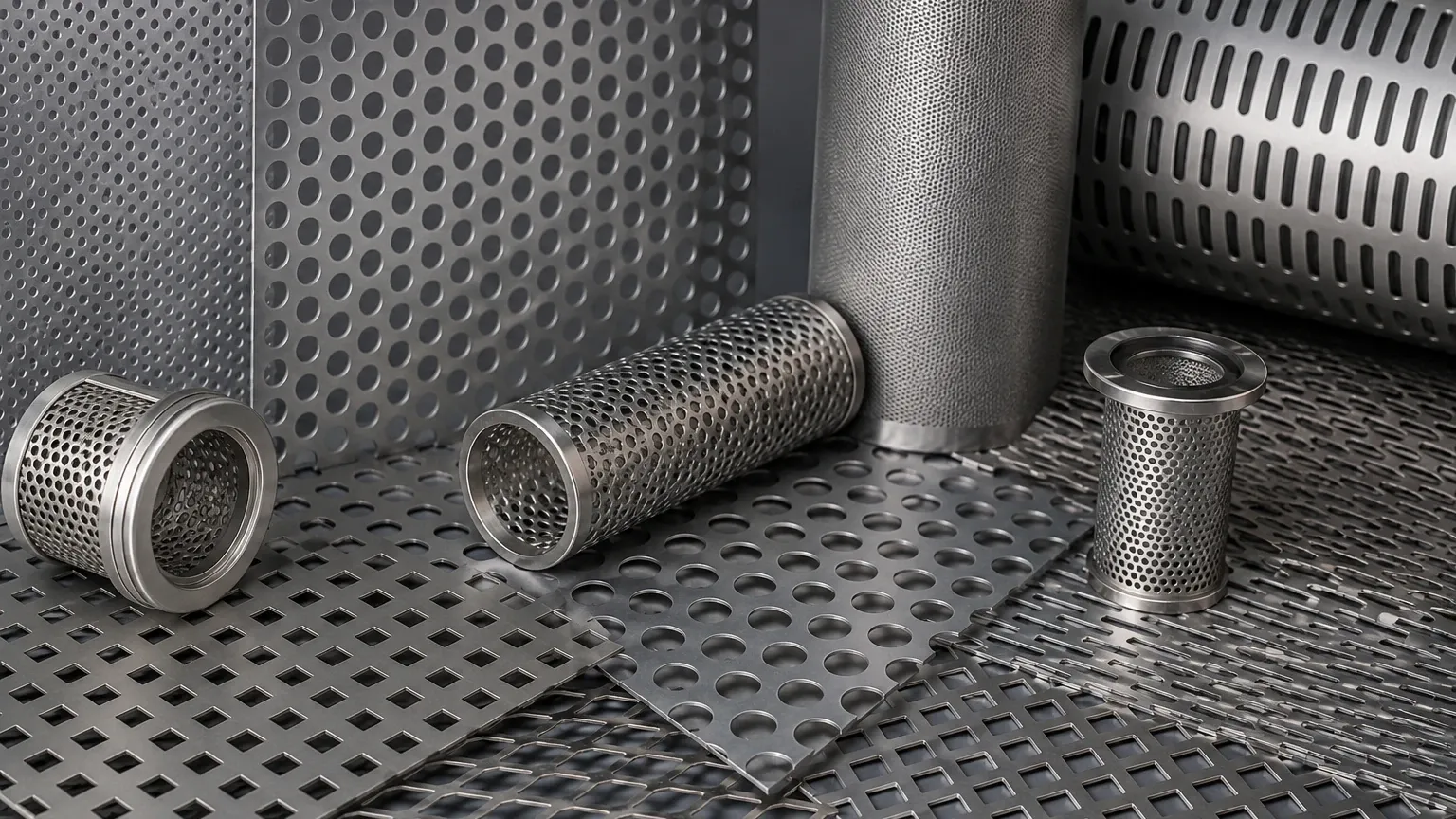
- Round Holes: The most common and efficient pattern for filtration. Staggered round holes provide the highest open area and are generally the most cost-effective to produce.
- Square Holes: Often used when a higher open area is required for airflow or visibility, though they may offer less structural stability than round holes.
- Slotted Holes: Ideal for sorting or filtering elongated particles, such as those found in grain processing or specific chemical separations.
2. The Open Area Percentage
The open area is the ratio of the total area of the holes to the total area of the sheet, expressed as a percentage. This is a critical metric for engineers calculating pressure drop and flow velocity. To buy perforated metal sheet that functions correctly in a hydraulic or air filtration system, the open area must be optimized. Too little open area leads to excessive pressure drop; too much can compromise the mechanical strength of the filter element.
3. Pitch and Arrangement
The pitch refers to the distance between the centers of adjacent holes. A 60-degree staggered pattern is the industry standard for round holes because it maximizes the number of holes per square inch while maintaining the strength of the metal "bridges" between the perforations.
Material Selection: Why Stainless Steel Dominates Demanding Environments
Material choice is perhaps the most significant factor in the longevity of a filtration component. While perforated sheets can be made from aluminum, carbon steel, or copper, stainless steel remains the gold standard for industrial applications.
When you buy perforated metal sheet for chemical, pharmaceutical, or food and beverage processing, the following grades are typically specified:
- Grade 304 Stainless Steel: Offers excellent corrosion resistance and is suitable for most general-purpose industrial applications. It is widely used in food processing due to its ease of cleaning and resistance to organic chemicals.
- Grade 316L Stainless Steel: Contains molybdenum, which provides superior resistance to chlorides and pitting. This is the mandatory choice for marine environments, high-salinity applications, and aggressive chemical filtration.
- Specialty Alloys: For extreme temperatures or highly acidic environments, alloys such as Hastelloy or Monel may be required. Kaifil specializes in processing these high-performance materials to meet specific OEM requirements.
Engineering Considerations: Thickness, Tolerance, and Flatness
The physical dimensions of the sheet go beyond just the length and width. Engineers must consider the gauge (thickness) of the metal in relation to the hole diameter. A general rule in perforation is that the hole diameter should not be smaller than the material thickness. Attempting to punch holes smaller than the thickness increases the risk of tool breakage and results in inconsistent hole quality.
Tolerances are another critical factor. Standard commercial tolerances may be acceptable for architectural panels, but industrial filtration components often require precision tolerances for diameter and pitch to ensure they fit perfectly into filter housings or assembly frames.
Furthermore, the perforation process naturally introduces internal stresses into the metal, which can cause the sheet to curl or bow. For high-precision applications, it is essential to specify that the sheets undergo a leveling or flattening process post-perforation to ensure they meet flatness requirements for subsequent welding or assembly.
Customization and OEM Capabilities
Standard off-the-shelf perforated sheets rarely meet the specialized needs of advanced industrial systems. This is where OEM (Original Equipment Manufacturer) capabilities become vital. When looking to buy perforated metal sheet for a custom project, consider the following customization options:
- Margin Requirements: You may require "safe edges" or unperforated margins around the perimeter of the sheet to facilitate welding or mounting. Specifying exact margin dimensions is crucial for seamless integration.
- Secondary Processing: Many filtration applications require the perforated sheet to be rolled into cylinders, welded, or formed into specific shapes. Partnering with a manufacturer like Kaifil, who understands the entire lifecycle of a filter cartridge, ensures that the base material is compatible with these secondary operations.
- Surface Finishes: Depending on the application, the metal may need degreasing, pickling, passivation, or electropolishing. These treatments enhance corrosion resistance and ensure the component is free from manufacturing oils and burrs, which is particularly important in pharmaceutical and food-grade applications.
Quality Control and Performance Evaluation
A reliable supplier does more than just punch holes; they provide verification of quality. When you buy perforated metal sheet for critical systems, you should expect documentation that confirms the material's properties and the accuracy of the manufacturing process.
Key quality checkpoints include:
- Material Traceability: Mill test reports (MTRs) that verify the chemical composition and mechanical properties of the stainless steel.
- Dimensional Inspection: Using calibrated tools to verify hole diameters, pitch, and sheet thickness.
- Burr Removal: Ensuring that the "exit side" of the punch is smooth. Excessive burrs can trap contaminants or cause turbulence in fluid flow, undermining the filtration process.
Cost-Efficiency and Procurement Strategy
To optimize the total cost of ownership when you buy perforated metal sheet, it is important to balance material costs with manufacturing complexity. High-volume production runs typically reduce the per-unit cost, as the setup time for CNC machinery is distributed across more pieces.
However, for specialized filtration projects, the focus should be on "fit-for-purpose" quality rather than the lowest initial price. A cheaper sheet made from inferior alloy or with inconsistent hole patterns can lead to premature filter failure, increased maintenance downtime, and potential contamination of the process stream. Working directly with a manufacturer that provides engineering support allows you to refine your specifications to achieve the best balance of performance and cost.
Conclusion: Selecting the Right Partner
Procuring perforated and expanded metal is a technical task that requires a partner with both manufacturing expertise and an understanding of industrial applications. Whether you are designing a new hydraulic system, upgrading a chemical processing plant, or developing a custom filtration solution, the quality of the perforated sheet is the foundation of your success.
Kaifil provides comprehensive support for engineers and purchasing teams, offering high-precision Perforated & Expanded Metal tailored to the most demanding specifications. By focusing on material integrity, dimensional accuracy, and customized design, we help our global clients achieve reliable and efficient filtration performance. When you are ready to buy perforated metal sheet, ensure your specifications are clear, your material is verified, and your manufacturer has the technical capability to deliver a component that meets the rigors of your industry.
