


Cloverleaf Perforated Metal Sheet
In the realm of industrial filtration and architectural engineering, the selection of a perforation pattern is rarely a matter of aesthetics alone. While standard round or square holes dominate the high-volume commodity market, specialized geometries like the cloverleaf perforated metal sheet offer a unique combination of high open area, structural rigidity, and specific flow characteristics. As a component of the broader Perforated & Expanded Metal category, cloverleaf patterns serve critical roles in applications ranging from coarse fluid filtration to decorative yet functional ventilation grilles in pharmaceutical and food processing environments.
For engineers and procurement specialists, understanding the technical nuances of the cloverleaf pattern—including its mechanical properties, material compatibility, and manufacturing tolerances—is essential for optimizing system performance and ensuring long-term durability. This guide examines the engineering considerations behind cloverleaf perforated metal and how to evaluate its suitability for demanding industrial applications.
Understanding the Geometry and Design of Cloverleaf Patterns
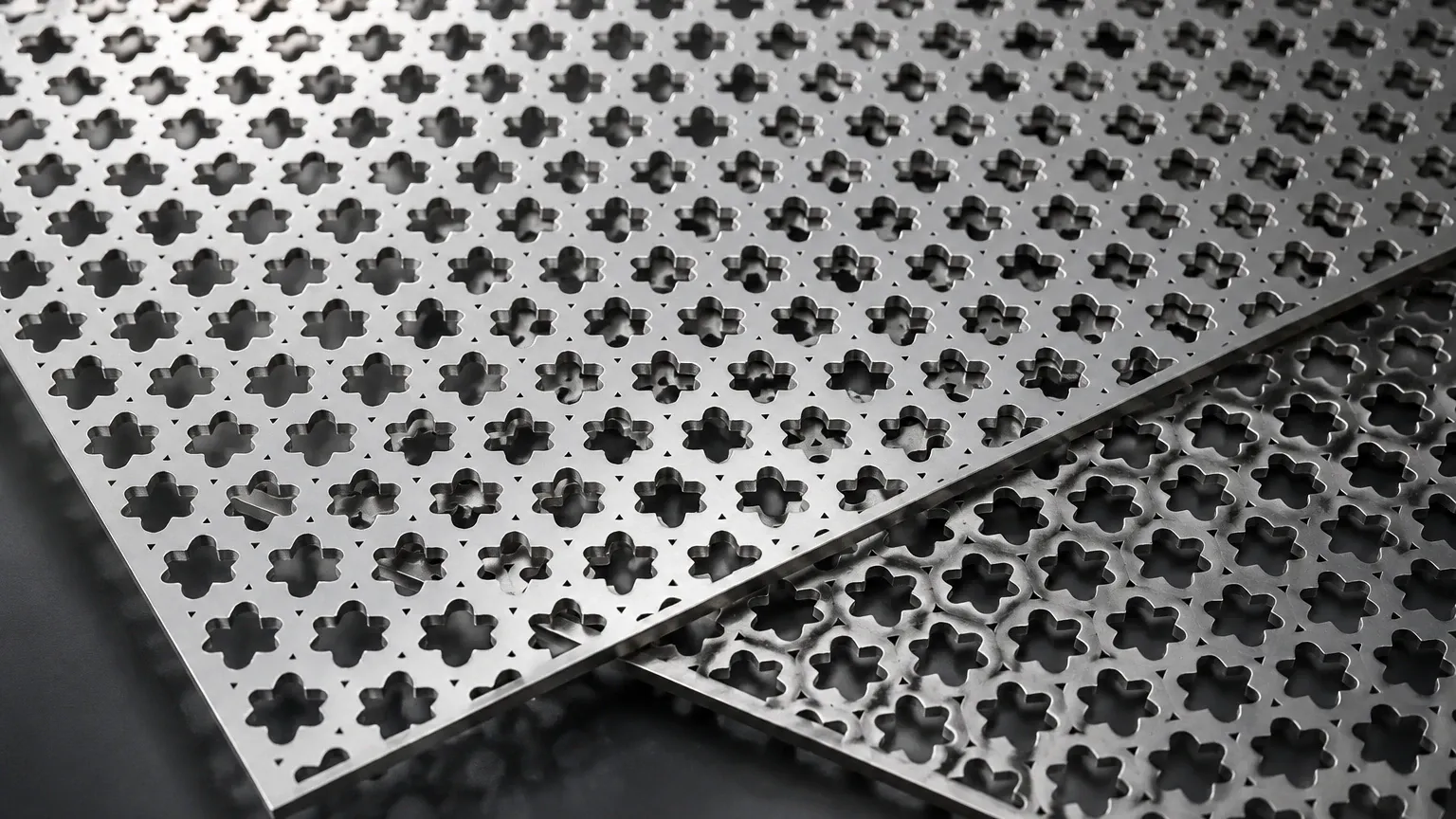
The cloverleaf pattern, often referred to as a "four-leaf" or "club" design, consists of four rounded lobes radiating from a central point. Unlike simple geometric shapes, the cloverleaf provides a high percentage of open area while maintaining a complex "bridge" network between the perforations. This bridge network is what provides the sheet with its mechanical strength.
Open Area Calculations
In filtration, the open area percentage directly correlates to flow capacity and pressure drop. Cloverleaf patterns typically offer an open area ranging from 30% to 50%, depending on the size of the cloverleaf and the pitch (the distance between the centers of adjacent holes). Because the lobes of the cloverleaf can be nested closely together, manufacturers can achieve a higher flow rate than many traditional decorative patterns without sacrificing the integrity of the metal substrate.
Pitch and Orientation
Cloverleaf sheets are generally produced in either a staggered or straight-row orientation. A staggered pattern is often preferred in industrial filtration because it distributes mechanical stress more evenly across the sheet and provides a more uniform flow of media (liquid or gas). When specifying a cloverleaf perforated metal sheet, engineers must define the "center-to-center" distance to ensure the resulting "bridge" (the metal remaining between holes) is wide enough to withstand the operating pressures of the specific application.
Engineering Material Selection for Industrial Environments
Material selection is the most significant factor in determining the service life of a perforated component. At Kaifil, the focus is primarily on stainless steel alloys due to their superior resistance to corrosion, oxidation, and mechanical wear.
Stainless Steel 304 vs. 316
* Grade 304: The most common choice for general industrial use. It provides excellent forming and welding characteristics and is resistant to many atmospheric and chemical corrosives. It is frequently used in HVAC systems and architectural filtration where extreme chemical exposure is not a factor.
* Grade 316: For chemical processing, marine environments, or pharmaceutical applications, Grade 316 is the industry standard. The addition of molybdenum enhances resistance to pitting and crevice corrosion, particularly in chloride-rich environments. For filtration systems handling aggressive solvents or saline solutions, 316 stainless steel is the technically superior choice.
Specialized Alloys and Surface Treatments
In certain high-temperature or highly acidic environments, specialized alloys like 310S or Duplex stainless steel may be required. Furthermore, surface treatments such as electropolishing can be applied to the cloverleaf perforated metal sheet to reduce surface roughness. This is particularly important in the food and beverage industry, where a smooth, burr-free surface prevents bacterial growth and facilitates "Clean-in-Place" (CIP) protocols.
Performance Characteristics: Flow Rates and Pressure Drop
One of the primary reasons engineers specify cloverleaf patterns in filtration is the balance between particle retention and fluid dynamics. The non-linear edges of the cloverleaf shape create a specific type of turbulence as fluid passes through the aperture.
Pressure Drop Considerations
Every perforated sheet acts as a flow restrictor. The pressure drop (∆P) across a cloverleaf sheet is influenced by the fluid velocity, viscosity, and the percentage of open area. Because cloverleaf patterns can achieve high open areas, they are often used as support structures for finer wire mesh filters. In this configuration, the cloverleaf sheet provides the necessary mechanical backing to prevent the mesh from collapsing under high pressure while allowing for maximum throughput.
Particle Retention
While cloverleaf patterns are generally used for coarse filtration or as a support layer, their geometry can be advantageous in capturing elongated or non-spherical particles that might otherwise pass through a standard round hole. However, it is vital to note that for precision filtration requirements (below 100 microns), the perforated sheet usually serves as a housing or support for a secondary filter medium, such as sintered wire mesh or a filter cartridge.
Manufacturing and Customization Capabilities
Producing a high-quality cloverleaf perforated metal sheet requires precision tooling and advanced manufacturing capabilities. At Kaifil, the manufacturing process is designed to ensure consistency across large production runs, which is critical for OEM integration.
Precision Punching
The most common method for creating cloverleaf patterns is CNC punching. This process allows for high repeatability and the ability to leave "blank" margins around the edges of the sheet, which facilitates easier welding and installation into filter housings. For thicker materials or extremely intricate designs, laser cutting may be employed, though punching remains the most cost-effective method for standard industrial gauges.
Secondary Processing
After the perforation process, the metal sheet often undergoes several secondary operations to meet industrial standards:
1. Leveling: The punching process can introduce internal stresses that cause the sheet to curl. Precision leveling ensures the final product is flat within tight tolerances.
2. Degreasing: Especially important for oxygen-service or food-grade applications, removing residual lubricants from the manufacturing process is a mandatory step.
3. Deburring: To ensure safety and prevent flow interference, all sharp edges must be removed, particularly on the exit side of the punch.
Key Applications in Modern Industry
The versatility of the cloverleaf perforated metal sheet makes it a staple in several specialized sectors. Its dual-purpose nature—providing both high functionality and an improved aesthetic—is a key driver for its selection.
Food and Beverage Processing
In large-scale drying or sorting equipment, cloverleaf sheets provide the necessary airflow to dry products uniformly. The pattern's ability to be easily cleaned makes it compliant with stringent hygienic standards. It is often found in grain separators and brewery filtration systems.
Pharmaceutical and Chemical Filtration
Cloverleaf sheets are frequently used as protective guards or internal support structures in chemical reactors. Their resistance to deformation under thermal cycling ensures that the filtration system maintains its integrity even during exothermic reactions.
Architectural and Acoustic Filtration
In industrial environments where noise reduction is necessary, cloverleaf perforated sheets are used as the facing for acoustic panels. The pattern allows sound waves to pass through into absorbent material while providing a durable, impact-resistant surface that can withstand the rigors of a factory floor.
Procurement and Quality Evaluation Criteria
When sourcing cloverleaf perforated metal, purchasing teams and engineers should confirm several critical parameters to ensure the component meets the application's demands. Failure to specify these details can lead to premature component failure or system inefficiencies.
Technical Confirmation Checklist
* Material Certification: Always request Mill Test Reports (MTRs) to verify the chemical composition of the stainless steel.
* Dimensional Tolerances: Confirm the tolerance for hole size, pitch, and sheet flatness. For OEM applications, even a 1mm deviation can cause assembly issues.
* Burr Limits: Specify the maximum allowable burr height, especially if the sheet will be in contact with delicate filter media or used in a manual handling environment.
* Edge Margins: Clearly define the width of the unperforated margins. This is essential for secure mounting and welding into frames.
Total Cost of Ownership
While the initial cost of a cloverleaf pattern may be slightly higher than a standard round-hole sheet due to tooling complexity, the total cost of ownership is often lower. The high open area can lead to reduced energy consumption in pumping systems, and the use of high-grade stainless steel extends the replacement cycle, reducing downtime in critical industrial processes.
Conclusion
The cloverleaf perforated metal sheet is more than a decorative variant; it is a high-performance engineering solution for complex filtration and ventilation challenges. By offering a strategic balance of open area and structural strength, it enables engineers to design systems that are both efficient and durable. Whether used as a standalone coarse filter or as a robust support structure within a multi-stage filtration system, the cloverleaf pattern remains a vital component in the modern industrial toolkit.
For those seeking customized solutions, working with a manufacturer like Kaifil ensures that material selection, perforation accuracy, and secondary processing are aligned with the specific technical requirements of the application. By focusing on precision and quality, industrial operations can achieve the reliable filtration performance necessary for demanding environments.
