


Corrugated Perforated Metal Panel Qiusuo
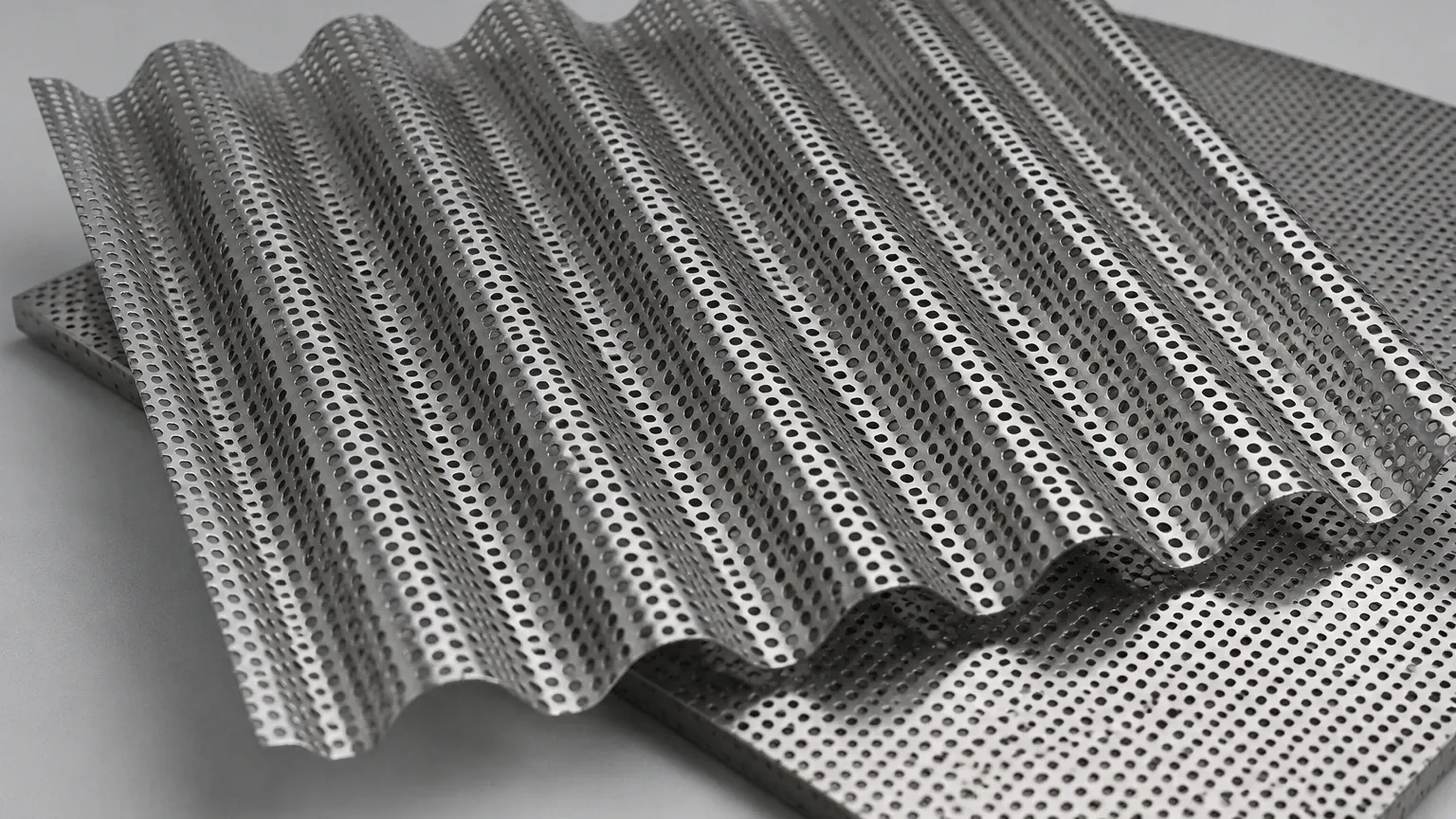
In industrial engineering and filtration design, the requirement for structural integrity often conflicts with the need for high permeability. Standard flat perforated sheets, while effective for basic screening, frequently lack the mechanical strength to withstand significant pressure differentials or heavy structural loads without excessive thickness. The corrugated perforated metal panel qiusuo addresses this engineering challenge by combining the precision of CNC perforation with the structural rigidity of corrugated profiling.
For engineers and procurement professionals, understanding the technical nuances of these panels is essential for optimizing system performance in chemical processing, water treatment, and heavy industrial ventilation. This guide examines the engineering principles, material considerations, and application-specific benefits of integrating Perforated & Expanded Metal solutions into complex industrial systems.
Engineering Fundamentals: Perforation Meets Corrugation
The performance of a corrugated perforated metal panel is defined by two distinct manufacturing processes: the punching of the hole pattern and the subsequent cold-forming of the corrugation profile. Each step significantly alters the mechanical properties of the base material.
Perforation Dynamics and Open Area
Perforation involves removing material to create a specific "open area" percentage. This percentage is critical because it dictates the flow rate and pressure drop across the panel. For industrial applications, the most common patterns include staggered round holes, square holes, and slotted apertures. The calculation for open area must be precise; for instance, a 60-degree staggered round hole pattern is calculated using the formula:
* Open Area % = (D² × 90.69) / P²
*(Where D is hole diameter and P is pitch)*
The Mechanics of Corrugation
Corrugation transforms a two-dimensional sheet into a three-dimensional structural component. By folding the metal into waves or ridges (V-shaped, U-shaped, or trapezoidal), the "moment of inertia" is vastly increased. This allows the panel to resist bending and shearing forces far better than a flat sheet of the same gauge. In filtration systems, this rigidity is vital for supporting secondary filter media, such as fine wire mesh, against the force of high-viscosity fluids or high-velocity gas streams.
Material Selection for Demanding Environments
Selecting the correct alloy is the most significant factor in determining the service life and total cost of ownership (TCO) of a corrugated perforated metal panel qiusuo. Industrial environments typically demand materials that offer a balance of formability and corrosion resistance.
1. Stainless Steel 304/304L: The standard choice for general industrial use, providing excellent corrosion resistance and good weldability. It is suitable for food processing and basic chemical filtration.
2. Stainless Steel 316/316L: Containing molybdenum, this alloy is essential for marine environments or processes involving chlorides and acids. It prevents pitting corrosion, which is a common failure point in perforated components.
3. Aluminum Alloys: Used where weight reduction is a priority, such as in aerospace ventilation or architectural windbreaks. While lighter, aluminum requires careful consideration of its lower fatigue limit compared to steel.
4. Carbon Steel (Galvanized or Powder Coated): A cost-effective solution for structural applications where the panel is not exposed to highly corrosive chemicals. The corrugation provides the necessary strength for large-scale windbreak walls or safety guards.
Performance Benefits in Industrial Applications
The integration of corrugated perforated metal into industrial designs offers several technical advantages over traditional flat screening or solid structural panels.
Enhanced Structural Rigidity
The primary benefit of the corrugated profile is its self-supporting nature. In large-scale filtration vessels, flat perforated plates often require heavy internal support grids to prevent sagging. Corrugated panels can span longer distances with fewer supports, reducing the overall weight of the assembly and simplifying internal vessel design.
Improved Fluid and Gas Dynamics
In ventilation and gas scrubbing applications, the corrugations can act as baffles, directing flow and increasing the surface area contact between the gas and the metal. This is particularly useful in moisture separators and mist eliminators, where the corrugated surface helps coalesce droplets more effectively than a flat surface.
Acoustic Attenuation
Corrugated perforated metal panels are frequently used in industrial noise control. The combination of the perforated surface (which allows sound waves to enter) and the corrugated shape (which scatters the waves) makes these panels excellent for lining engine rooms, compressor housings, and high-pressure piping systems to reduce resonant noise.
Applications in Filtration and Processing
While often used in architectural cladding, the technical utility of the corrugated perforated metal panel qiusuo is most evident in rigorous industrial processing sectors.
Filter Media Support
In high-pressure hydraulic and chemical filtration, fine wire mesh is often used as the primary filtration layer. However, the mesh itself lacks structural integrity. A corrugated perforated panel serves as a "support cage" or pleat protector. The corrugations provide a high-strength backbone that maintains the shape of the filter element even under extreme back-pressure during cleaning cycles.
Centrifuge Baskets and Drying Trays
In pharmaceutical and food processing, corrugated perforated panels are used in centrifuge baskets to facilitate rapid liquid drainage while retaining solids. The corrugations increase the effective drainage area and prevent the "blinding" of the perforations by creating channels for fluid to escape.
Windbreaks and Dust Control
For outdoor industrial sites, such as coal yards or chemical storage facilities, large-scale corrugated perforated panels are used as windbreak walls. The specific perforation pattern is engineered to reduce wind velocity by a calculated percentage, preventing the entrainment of dust particles into the atmosphere while the corrugations provide the wind-load resistance necessary for tall structures.
Technical Specifications and Customization Criteria
When specifying a corrugated perforated metal panel qiusuo for a project, engineers must define several critical parameters to ensure the component meets performance expectations.
* Pitch and Depth: The distance between the peaks of the corrugations (pitch) and the vertical height (depth) determine the panel's stiffness. A deeper corrugation generally offers higher load-bearing capacity.
* Hole Size and Arrangement: For filtration, the hole size must be smaller than the particles being retained, or it must be sized to provide optimal support for a secondary mesh layer. Staggered patterns are usually preferred for their uniform strength.
* Margin Requirements: "Margins" refer to the unperforated areas along the edges of the panel. Specifying exact margins is crucial for welding the panel into frames or bolting it to structural supports without compromising the integrity of the holes.
* Surface Finish: For chemical and food applications, a 2B mill finish or electropolishing may be required to ensure the surface is smooth and free of microscopic burrs that could harbor bacteria or cause flow turbulence.
Common Risks and Evaluation Criteria
Procuring industrial-grade Perforated & Expanded Metal requires a rigorous evaluation of the manufacturer’s capabilities. Substandard panels can lead to catastrophic system failures.
Burr Formation and Edge Quality
During the punching process, burrs can form on the exit side of the hole. In filtration applications, these burrs can break off and contaminate the downstream fluid or damage delicate filter mesh. Engineers should confirm that the manufacturer utilizes precision leveling and deburring processes after perforation.
Stress Cracking in Corrugations
Cold-forming metal into tight corrugation profiles introduces internal stresses. If the material is too thin or the alloy is not sufficiently ductile, micro-cracks can form at the peaks and valleys of the corrugations. These cracks are often invisible to the naked eye but will expand under thermal cycling or vibration, leading to premature failure. Requesting material mill certificates and performing dye penetrant testing on critical components is recommended.
Dimensional Stability
Corrugation can cause "spring-back," where the metal attempts to return to its original flat shape. This can lead to dimensional inaccuracies that make installation difficult. Precision manufacturers use calculated over-bending and hydraulic pressing to ensure that the final corrugated perforated metal panel qiusuo meets tight tolerances for length, width, and profile height.
Maintenance and Durability Considerations
The longevity of a corrugated perforated panel is largely dependent on its environment and the maintenance protocols in place. In filtration applications, the primary concern is "fouling" or "scaling," where solids accumulate within the perforations or the corrugation valleys.
* Cleaning Protocols: Stainless steel panels are generally compatible with CIP (Clean-In-Place) systems using caustic or acidic washes. However, the corrugation valleys must be inspected to ensure no "dead zones" exist where cleaning agents or contaminants can stagnate.
* Replacement Cycles: While these panels are designed for long-term use, they should be inspected periodically for signs of erosion-corrosion, especially in high-velocity slurry applications. A thinning of the metal around the hole edges is a primary indicator that the panel is reaching the end of its functional life.
Conclusion: Selecting the Right Filtration Partner
Integrating corrugated perforated metal panels into an industrial system is an engineering decision that impacts the efficiency, safety, and durability of the entire process. Whether used as a structural support in a chemical reactor or as a primary screen in a water intake system, the quality of the perforation and the precision of the corrugation are paramount.
At Kaifil, we specialize in providing custom stainless steel filtration solutions tailored to the specific demands of our global clients. Our expertise in manufacturing high-performance Perforated & Expanded Metal ensures that every component—from material selection to final finish—meets the rigorous standards of the chemical, pharmaceutical, and industrial sectors. When performance cannot be compromised, choosing a partner with deep technical knowledge in metal fabrication and filtration dynamics is the most critical step in your project’s success.
