


Decorative Expanded Metal Mesh
In the realm of industrial design and engineering, the distinction between functional components and aesthetic elements is increasingly blurred. Decorative expanded metal mesh stands as a primary example of this convergence, offering a unique combination of structural integrity, ventilation, and visual appeal. Unlike traditional woven wire or perforated sheets, expanded metal is manufactured through a specific process of slitting and stretching, resulting in a continuous piece of material with no joins or welds. This guide explores the technical nuances, material considerations, and engineering applications of decorative expanded metal mesh within industrial and commercial contexts.
Understanding the Engineering Behind Expanded Metal
The production of expanded metal is a precision engineering process. It begins with a solid metal sheet—typically stainless steel, aluminum, or carbon steel—which is fed into an expanding machine. This machine uses a reciprocating knife to simultaneously slit and stretch the metal. The pattern is determined by the shape of the knife and the distance the metal is stretched.
One of the most significant technical advantages of this process is that it produces zero waste. Unlike perforated metal, where the "slugs" or holes are punched out and discarded (or recycled), expanded metal uses the entirety of the base material. This makes it an inherently resource-efficient choice for large-scale industrial projects. The resulting mesh consists of strands and bonds (the points where strands intersect) that form a uniform diamond or hexagonal pattern. Because the mesh is made from a single piece of metal, it maintains a high strength-to-weight ratio and cannot unravel if a single strand is cut.
Material Selection for Decorative and Functional Performance
For engineers and purchasing teams, selecting the correct alloy is the first step in ensuring the longevity of the mesh. While decorative expanded metal mesh is often chosen for its visual impact, its performance in demanding environments depends heavily on its metallurgical composition.
Stainless Steel (Grades 304 and 316)
Stainless steel is the gold standard for industrial applications involving chemical processing, food and beverage production, or pharmaceutical manufacturing. Grade 304 offers excellent corrosion resistance for most indoor and mild outdoor environments. However, for applications exposed to chlorides or coastal air, Grade 316 (or 316L) is preferred due to its molybdenum content, which provides superior pitting resistance. In filtration support roles, stainless steel ensures that the mesh does not introduce contaminants into the system.
Aluminum Alloys
Aluminum is frequently utilized for decorative facades and sunshades due to its lightweight nature and natural oxide layer, which provides basic corrosion protection. It is easily anodized or powder-coated to achieve specific colors or textures, making it a favorite for architectural accents that still require structural rigidity.
Carbon Steel
While more susceptible to oxidation, carbon steel is a cost-effective option for indoor industrial partitions or equipment guards where the material can be galvanized or painted to prevent rust. In heavy-duty industrial settings, hot-dipped galvanized expanded metal provides a rugged, industrial aesthetic with significant durability.
Technical Specifications: SWD, LWD, and Open Area Calculations
To accurately specify Perforated & Expanded Metal for a project, engineers must use standardized terminology. The geometry of the mesh is defined by several key measurements:
* SWD (Short Way of Diamond): The distance from the center of one bond to the center of the next bond measured across the short diamond diagonal.
* LWD (Long Way of Diamond): The distance from the center of one bond to the center of the next bond measured across the long diamond diagonal.
* Strand Width: The amount of metal fed into the machine between the slits.
* Strand Thickness: The thickness of the original base metal sheet.
* Open Area: This is a critical calculation for applications requiring airflow or light transmission. It is generally calculated as the ratio of the open space to the total area of the sheet.
For decorative applications, the LWD and SWD determine the "scale" of the pattern. A larger LWD creates a more transparent, airy feel, while a smaller SWD results in a denser, more opaque appearance. Engineers must balance these aesthetic choices with the required mechanical properties, such as the ability to support a specific load or resist impact.
Applications of Decorative Expanded Metal Mesh in Industrial Environments
While the term "decorative" suggests a focus on appearance, in industrial B2B sectors, this mesh often serves dual purposes. Its unique geometry allows it to perform tasks that standard perforated sheets cannot.
Protective Enclosures and Machine Guarding
In manufacturing facilities, expanded metal is used to create safety guards for moving machinery. The decorative aspect comes into play when these guards are part of a high-end equipment design or a customer-facing laboratory environment. The mesh allows operators to visually inspect the machinery while remaining protected from moving parts. The angled strands of the mesh can also be oriented to deflect debris or fluids away from the operator.
Filtration Support and Housing
In the filtration industry, decorative expanded metal mesh is often used as an outer protective cage for pleated filter elements or as a support structure for wire mesh filters. Its rigidity prevents the collapse of finer filter media under high pressure. When used in the food and beverage industry, the mesh must be electropolished to ensure a smooth, burr-free surface that prevents bacterial growth and facilitates easy cleaning.
Architectural Facades and Ventilation
For industrial buildings, expanded metal panels serve as functional facades. They provide a modern, high-tech aesthetic while simultaneously acting as sunshades that reduce solar heat gain within the building. Because the mesh is three-dimensional, it can be installed with the strands angled to block direct sunlight while still allowing natural ventilation and indirect light to pass through.
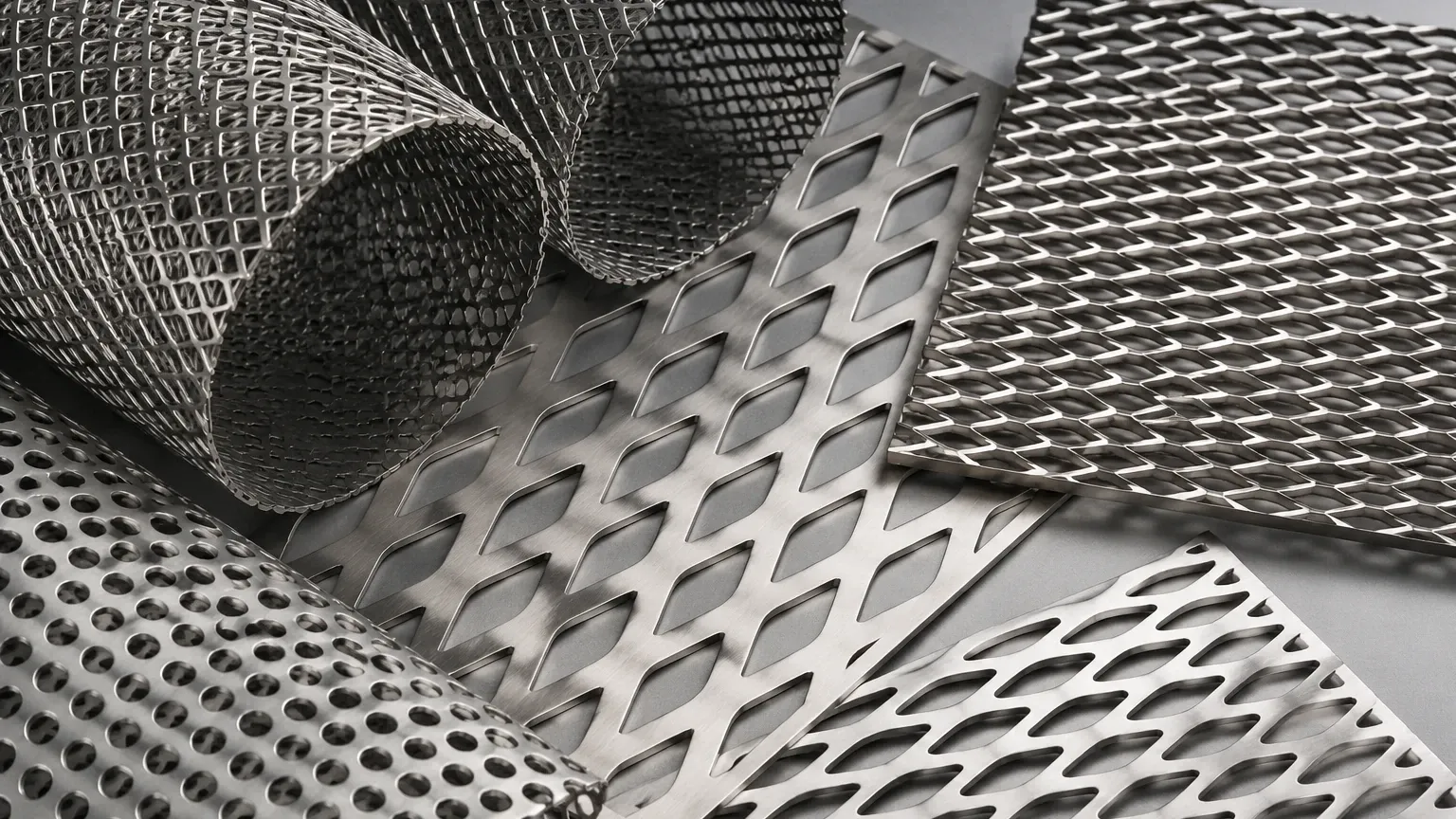
Comparing Raised vs. Flattened Expanded Metal
When ordering decorative expanded metal mesh, one of the most important decisions is whether to use the "raised" or "flattened" variety.
* Raised Expanded Metal: This is the standard form as it comes off the machine. The strands are set at an angle to the plane of the sheet, creating a three-dimensional surface. This provides maximum rigidity and a high-grip surface, which is useful for industrial walkways or stair treads. From a decorative standpoint, the raised strands create a dynamic interplay of light and shadow.
* Flattened Expanded Metal: After the expansion process, the sheet is passed through a cold-rolling mill. This flattens the strands and bonds back into a single plane. The result is a smooth, flat surface that is easier to handle and safer for applications where skin contact is likely. Flattening slightly increases the LWD and decreases the SWD, which must be accounted for in the initial design phase.
Selection Criteria for Procurement and Engineering Teams
Choosing the right supplier for decorative expanded metal mesh requires a focus on technical precision and quality control. For B2B buyers, the following criteria are paramount:
1. Dimensional Tolerances: In industrial assemblies, even a few millimeters of deviation in sheet size or diamond alignment can lead to installation failures. Ensure the manufacturer can meet tight tolerances for LWD, SWD, and overall sheet dimensions.
2. Surface Finish: For decorative applications, the quality of the finish is non-negotiable. This includes the removal of burrs (deburring), degreasing of the metal, and the application of coatings. For stainless steel, electropolishing is often required to achieve a mirror-like or high-satin finish.
3. Flatness Requirements: Expanded metal has a natural tendency to curl due to the stresses of the stretching process. High-quality suppliers use leveling machines to ensure the final panels are perfectly flat for easy installation in frames or housings.
4. Customization Capabilities: Every industrial project has unique requirements. Whether it is a non-standard diamond size, a specific open area for airflow, or custom-cut shapes, the ability to provide OEM solutions is a key differentiator for manufacturers like Kaifil.
Common Risks and Mitigation in Mesh Specification
One of the primary risks in specifying expanded metal is underestimating the effect of the "transparency" angle. Because the strands are angled, the mesh may appear opaque from one direction and transparent from another. Engineers should request physical samples or 3D renders to confirm that the mesh provides the desired level of shielding or visibility from the intended vantage points.
Another risk involves material fatigue. In environments with high vibration or fluctuating pressures, the bonds of the expanded metal can become stress points. Selecting a thicker gauge or a smaller diamond pattern can help distribute these stresses more effectively. Furthermore, when using expanded metal in corrosive chemical environments, ensuring that the material is properly passivated (in the case of stainless steel) is essential to prevent premature failure.
The Role of Customization and OEM Support
For complex industrial projects, off-the-shelf solutions rarely suffice. Customization allows engineers to optimize the mesh for specific performance metrics. This includes adjusting the strand width to increase the load-bearing capacity or modifying the diamond shape to match the flow characteristics of a specific fluid in a filtration application.
Working with a manufacturer that understands the intersection of filtration technology and metal fabrication is invaluable. By providing detailed application data—such as operating temperatures, chemical exposure, and required flow rates—procurement teams can ensure that the decorative expanded metal mesh they receive is not only visually appropriate but also technically sound for the long term.
In conclusion, decorative expanded metal mesh is a sophisticated material that offers significant advantages in terms of weight, strength, and resource efficiency. By understanding the technical specifications and material properties, engineering and purchasing professionals can leverage this versatile material to enhance both the form and function of their industrial projects.
