


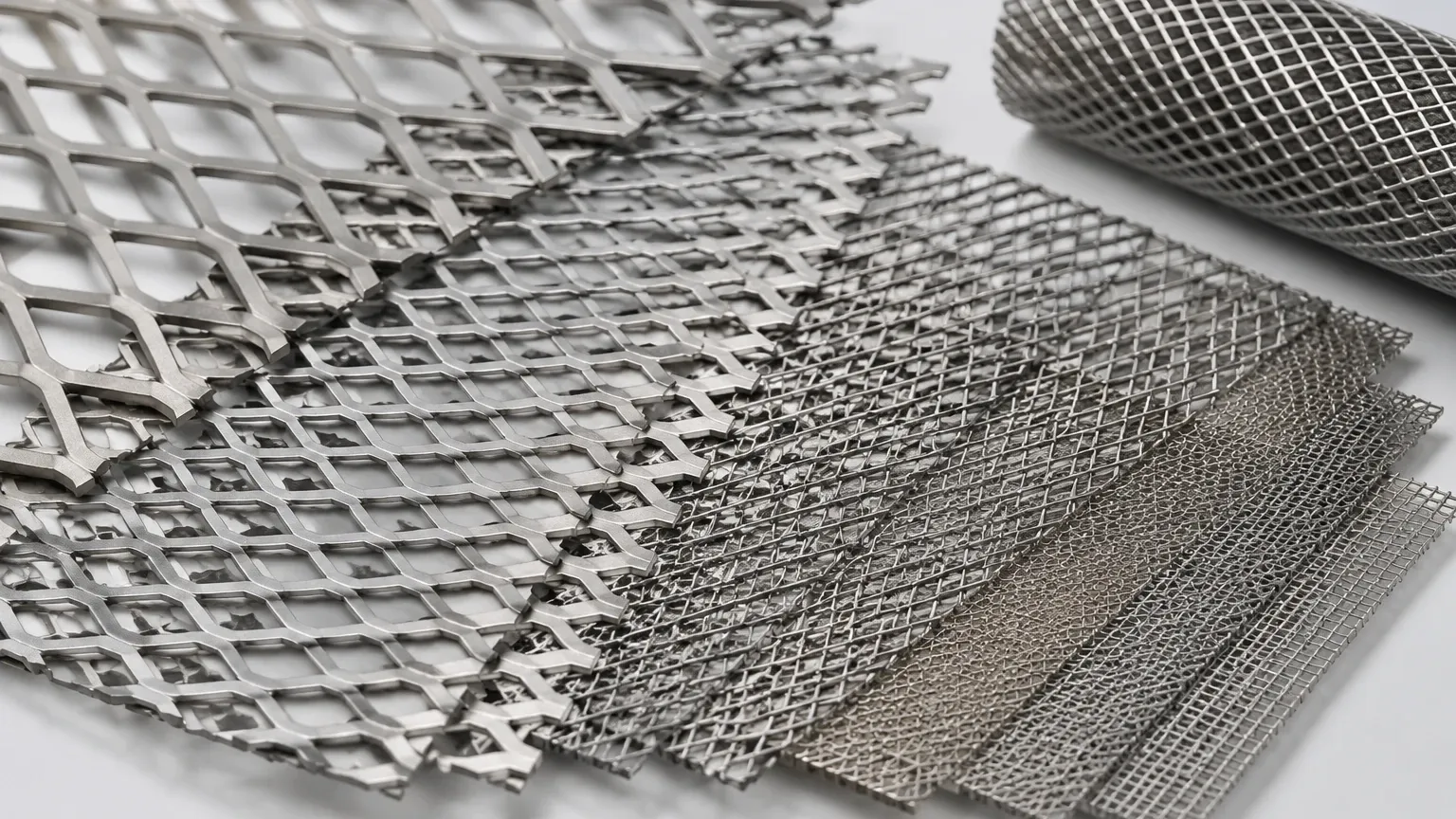
Different Sizes of Expanded Metal
In industrial filtration and structural engineering, expanded metal serves as a critical component for support, protection, and media retention. Unlike perforated metal, which is created by punching holes and generating scrap, expanded metal is manufactured by simultaneously slitting and stretching a solid sheet of metal. This process creates a diamond-shaped pattern that is both structurally rigid and cost-effective. However, selecting the appropriate specifications involves understanding how different sizes of expanded metal affect flow rates, pressure drops, and mechanical strength.
For engineers and procurement teams, the terminology used to describe these sizes is standardized but technical. Choosing the right Perforated & Expanded Metal requires a deep dive into the geometric properties of the mesh and how those dimensions interact with the specific requirements of industrial environments, such as chemical processing, food production, and hydraulic systems.
Understanding the Geometry: Key Dimensions of Expanded Metal
When specifying expanded metal, dimensions are not just about the overall sheet size; they refer to the intricate geometry of the diamond openings. There are four primary measurements that define the size and performance of the mesh:
SWD and LWD (Short Way and Long Way of Diamond)
* SWD (Short Way of Diamond): This is the distance from a point on one bond to a corresponding point on the next bond, measured across the short axis of the diamond. It is a critical dimension for determining the density of the mesh.
* LWD (Long Way of Diamond): This is the distance measured across the long axis of the diamond, from bond center to bond center. The ratio between LWD and SWD determines the shape of the opening and the structural orientation of the sheet.
SWO and LWO (Short Way and Long Way of Opening)
While SWD and LWD measure from the centers of the bonds, SWO and LWO measure the actual clear space within the diamond. For filtration applications, the SWO and LWO are often more important than the diamond centers because they define the maximum particle size that can pass through the mesh or the level of support provided to a secondary filter medium like wire mesh or fiberglass.
Strand Thickness and Strand Width
* Strand Thickness: This refers to the thickness of the base metal sheet used to create the expanded metal. In stainless steel filtration, this usually ranges from light gauges for fine pleated supports to heavier gauges for industrial strainers.
* Strand Width: This is the amount of metal fed into the expanding machine for each stroke. It dictates the width of the "ribs" that form the diamond pattern. Together, thickness and width determine the cross-sectional area of the strand, which directly impacts the mesh's tensile strength and weight.
How Different Sizes of Expanded Metal Impact Industrial Performance
The performance of a filter or a structural component is inextricably linked to the size of its openings. In industrial settings, the selection of different sizes of expanded metal is rarely arbitrary; it is a calculated decision based on fluid dynamics and mechanical stress.
Filtration Efficiency and Particle Retention
In primary filtration, the opening size (LWO/SWO) determines the cut-off point for debris. If the openings are too large, the filter fails to protect downstream equipment like pumps and valves. If they are too small, the filter may clog prematurely, leading to excessive maintenance cycles. In many Kaifil solutions, expanded metal acts as a "pre-filter" or a coarse strainer, protecting finer mesh layers from large-scale contaminants.
Structural Support for Pleated Media
In high-pressure hydraulic or air filtration systems, filter media (such as wire mesh or synthetic fiber) often lack the rigidity to withstand high differential pressures. Expanded metal is used as a support cage or inner core. Here, the SWD and LWD must be sized to provide maximum surface area support while minimizing the "blind area"—the portion of the filter media blocked by the metal strands. A smaller SWD often provides more uniform support for delicate media, preventing pleat collapse under flow surges.
Flow Rate and Pressure Drop
The "open area" percentage of expanded metal is a function of its size dimensions. A larger opening with thinner strands results in a higher open area, which facilitates higher flow rates and lower initial pressure drops. Conversely, smaller openings or wider strands increase resistance to flow. Engineers must balance the need for structural integrity (which usually requires more metal) with the need for efficient flow (which requires more open space).
Comparing Standard and Flattened Expanded Metal Sizes
When reviewing options for different sizes of expanded metal, it is essential to distinguish between "standard" (raised) and "flattened" varieties, as the manufacturing process significantly alters the final dimensions.
Standard (Raised) Expanded Metal
Standard expanded metal comes off the machine with the strands set at an angle to the plane of the sheet. This creates a three-dimensional surface that provides excellent grip and high rigidity-to-weight ratios. However, the thickness of a standard sheet is significantly greater than the original gauge of the metal because of the angled strands. This 3D profile can be beneficial in certain filtration applications where it creates turbulence, potentially improving the capture of certain types of particulates.
Flattened Expanded Metal
Flattened expanded metal is standard expanded metal that has been passed through a cold-rolling reducing mill. This process flattens the strands and bonds into a single plane, resulting in a smooth, flat surface.
Flattening has several effects on size:
1. Thickness: The final thickness is usually slightly less than the original metal gauge.
2. Dimensions: The SWD and LWD dimensions typically increase slightly as the metal is stretched further during the flattening process.
3. Open Area: The percentage of open area may decrease slightly because the strands are widened as they are compressed.
For many stainless steel filter cartridges, flattened expanded metal is preferred because it provides a smooth interface for secondary mesh layers, reducing the risk of abrasion or tearing of the fine wire cloth.
Material Selection and Its Influence on Dimensional Stability
The material used to manufacture expanded metal significantly influences how well it maintains its size and shape under industrial stress. Kaifil specializes in stainless steel solutions, typically utilizing Grades 304, 304L, 316, and 316L.
Stainless Steel 304 vs. 316
While 304 stainless steel is suitable for many general-purpose industrial applications, 316 stainless steel contains molybdenum, which provides superior resistance to chlorides and pitting. In chemical processing or marine environments, the dimensional integrity of the mesh can be compromised by corrosion if the wrong material is selected. As the metal corrodes, the strand thickness decreases, leading to a change in the effective opening size and a reduction in structural strength.
Thermal Expansion
In high-temperature applications, such as steam filtration or exhaust gas treatment, the thermal expansion of the metal must be considered. Different alloys expand at different rates. If the expanded metal is used as a support core inside a rigid housing, the sizing must account for thermal growth to prevent buckling or mechanical failure of the filter assembly.
Engineering Calculations: Open Area and Flow Considerations
To accurately select from different sizes of expanded metal, engineers often calculate the percentage of open area. This value is critical for predicting the performance of the system. The formula for calculating the open area of standard expanded metal is more complex than for perforated metal because of the strand angle, but for flattened expanded metal, it can be approximated using the following relationship:
**Open Area % = (1 – (Strand Width * 2 / SWD)) * 100**
*(Note: This is a simplified model; actual open area may vary based on the specific diamond geometry and bond size.)*
Why Open Area Matters
* Velocity: High open area results in lower fluid velocity through the mesh, which reduces the likelihood of "media migration" or particle breakthrough.
* Energy Consumption: Systems with lower pressure drops (higher open area) require less pump or fan power, leading to lower total cost of ownership (TCO) over the life of the equipment.
* Cleanability: In food and beverage or pharmaceutical applications, the size and shape of the diamond must allow for effective Clean-in-Place (CIP) procedures. If the diamonds are too small or the bonds too thick, bacteria or product residue can become trapped in the "nooks" of the mesh.
Selecting the Right Size for Specific Industrial Applications
Different industries have standardized on certain sizes of expanded metal based on decades of performance data. Understanding these common applications can help guide the selection process.
1. Water Treatment and Desalination
In these environments, expanded metal is often used as a support for membrane filtration. The sizes selected are typically small (fine mesh) with a high degree of flattening to ensure the membrane is not punctured by sharp edges. 316L stainless steel is the standard here due to high salt concentrations.
2. Chemical and Petrochemical Processing
Heavier gauges and larger diamond sizes are common in chemical reactors where expanded metal acts as a catalyst support grid. These grids must support the weight of the catalyst bed while allowing for high-volume gas or liquid flow. The LWD and SWD are chosen based on the size of the catalyst pellets to prevent them from falling through the grid.
3. Food and Beverage Production
Hygiene is the priority. Expanded metal used in this sector often features larger openings to facilitate easy cleaning and inspection. Stainless steel is mandatory to meet FDA and other regulatory requirements. The sizes are often chosen to balance the need for structural support in vibrating screens or conveyor systems with the need for sanitary design.
4. Hydraulic and Lubrication Systems
Filter cores in hydraulic systems require precise sizing. The expanded metal must be strong enough to resist high collapse pressures (often exceeding 3,000 PSI in some industrial circuits). Small SWD sizes are used to provide frequent support points for the pleated hydraulic media, ensuring the pleats stay open and functional even as they load with contaminants.
Quality Assurance in Custom Expanded Metal Manufacturing
When sourcing different sizes of expanded metal, consistency is as important as the initial specification. Variations in strand width or thickness can lead to "weak spots" in a filter cartridge or inconsistencies in flow across a large surface area.
Precision Manufacturing
At Kaifil, the manufacturing process for Perforated & Expanded Metal involves rigorous quality control. This includes monitoring the feed rate of the metal into the expander to ensure strand width remains constant and checking the tension of the sheet to prevent warping or "cambering."
Customization Options
Standard stock sizes do not always meet the needs of specialized engineering projects. Customization allows for:
* Non-standard Diamond Shapes: Adjusting the LWD/SWD ratio to create elongated or more squared diamonds.
* Variable Strand Widths: Increasing the strand width for extra strength without changing the opening size.
* Specific Material Gauges: Using non-standard sheet thicknesses to meet specific weight or pressure requirements.
Verification and Documentation
For critical B2B applications, especially in the pharmaceutical or aerospace sectors, providing material test reports (MTRs) and dimensional inspection reports is standard practice. This ensures that the "different sizes" ordered are exactly what is delivered, maintaining the integrity of the engineer's original design and the safety of the industrial process.
Conclusion: Making an Informed Selection
Selecting the correct size of expanded metal is a foundational step in designing efficient and durable industrial filtration systems. By understanding the relationship between SWD, LWD, strand dimensions, and open area, engineers can optimize their systems for flow, strength, and longevity. Whether the application requires the 3D rigidity of standard expanded metal or the smooth precision of flattened mesh, the material choice and dimensional accuracy remain the most critical factors.
When evaluating Perforated & Expanded Metal for your next project, consider the total cost of ownership. A slightly more expensive, precision-sized stainless steel mesh can prevent costly equipment downtime, reduce energy consumption, and extend the life of your filtration components. For technical teams, confirming the exact SWO/LWO requirements and the necessary strand thickness before production is the best way to ensure the final product meets the demanding needs of modern industrial environments.
