


Decorative Perforated Metal
In industrial design and architectural engineering, decorative perforated metal serves as a bridge between aesthetic requirements and functional performance. While the term "decorative" suggests a focus on visual appeal, these components are engineered products that must meet rigorous standards for structural integrity, airflow, and material longevity. For engineers and procurement teams, selecting the right perforated metal involves a deep understanding of metallurgy, hole geometry, and manufacturing tolerances to ensure the final product performs as intended in demanding environments.
As a specialized manufacturer, Kaifil provides precision-engineered Perforated & Expanded Metal solutions that cater to both the architectural and industrial sectors. This guide examines the technical considerations, material properties, and selection criteria essential for integrating decorative perforated metal into professional projects.
Engineering Fundamentals of Perforated Metal
At its core, perforated metal is a sheet of material—typically stainless steel, aluminum, or carbon steel—that has been mechanically punched or laser-cut to create a pattern of holes. In decorative applications, these patterns range from standard geometric shapes to complex, custom-designed motifs. However, every pattern choice has a direct impact on the physical properties of the sheet.
Open Area Calculations
The "open area" is the total area of the holes expressed as a percentage of the total area of the sheet. This is a critical metric for engineers managing ventilation, light transmission, or fluid dynamics. For example, a decorative pattern used in an HVAC grille must provide enough open area to prevent excessive backpressure, while a pattern used for sunshades must balance light filtration with heat reduction.
The formula for calculating open area varies based on the hole arrangement. A 60-degree staggered round hole pattern—the most common and efficient for strength—is calculated differently than a straight-line square pattern. When selecting decorative perforated metal, the engineering team must confirm that the desired aesthetic does not compromise the required airflow or structural rigidity.
Hole Geometry and Pitch
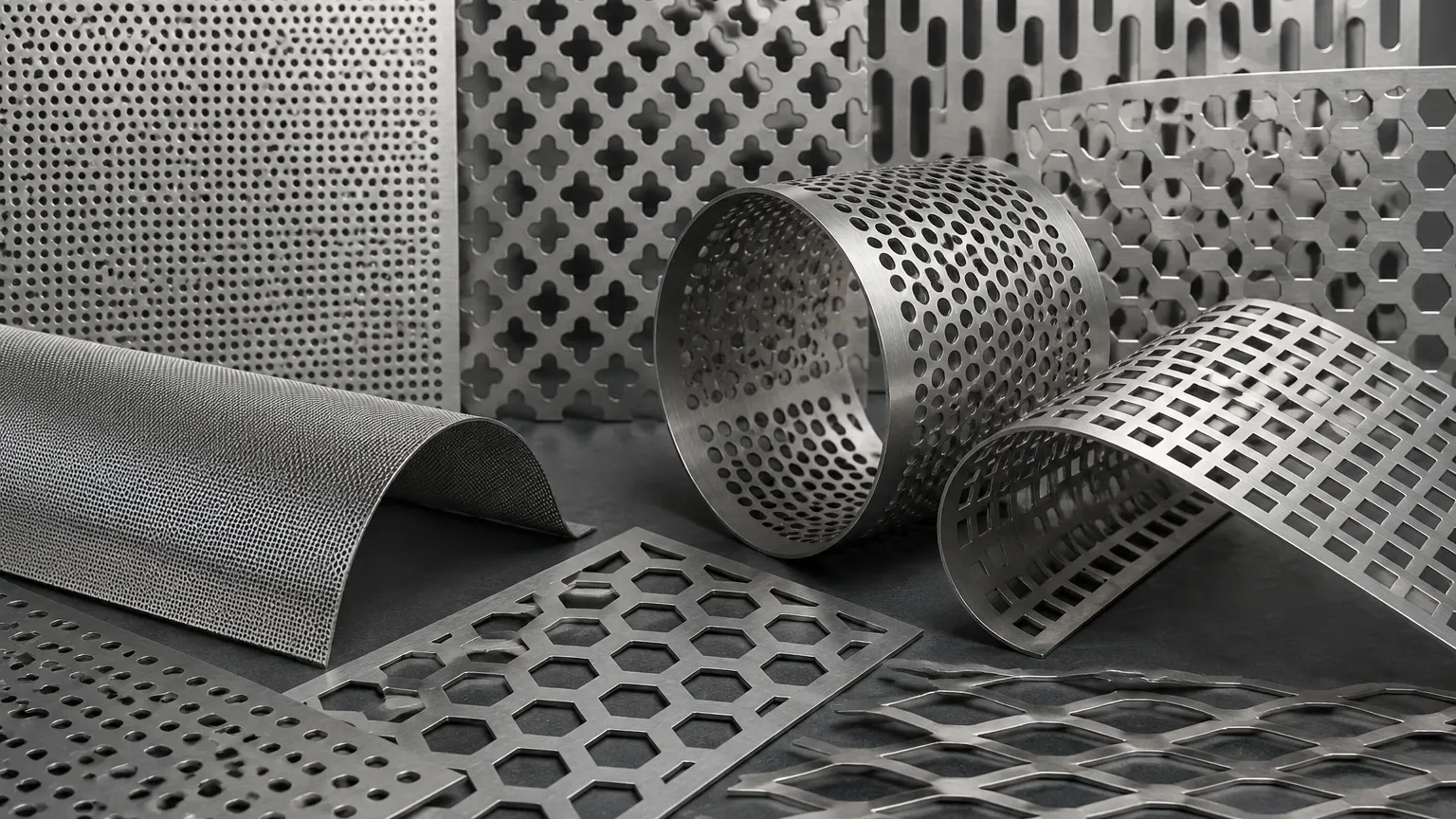
Decorative patterns often utilize non-standard shapes such as hexagons, slots, or ornate filigree. The "pitch" refers to the center-to-center distance between adjacent holes. A smaller pitch results in a higher hole density and greater open area but can reduce the structural strength of the "bars" (the metal remaining between the holes). Maintaining a proper bar-to-thickness ratio is essential to prevent the sheet from warping or tearing during the manufacturing process or under operational load.
Material Selection for Industrial Durability
The environment in which the decorative perforated metal will be installed dictates the material choice. Because many decorative elements are exposed to the elements or corrosive industrial atmospheres, material science is a primary consideration.
Stainless Steel (304 and 316 Grades)
Stainless steel is the preferred choice for most industrial and high-end architectural applications due to its corrosion resistance and strength.
- Grade 304: Suitable for indoor applications and mild outdoor environments. It offers excellent formability and is cost-effective for general decorative use.
- Grade 316: Contains molybdenum, making it significantly more resistant to chloride-induced pitting. This is the standard for marine environments, chemical processing facilities, and coastal architectural installations.
Aluminum and Specialized Alloys
Aluminum is frequently used where weight reduction is a priority. It is naturally corrosion-resistant and can be anodized in various colors, making it a favorite for decorative facades. For high-temperature industrial applications, specialized alloys may be required to maintain structural integrity when the metal is thinned out by the perforation process.
Manufacturing Precision and Customization
Producing high-quality decorative perforated metal requires advanced machinery and technical expertise. The two primary methods used are CNC punching and laser cutting, each offering distinct advantages depending on the project scope.
CNC Punching
For high-volume production with repetitive patterns, CNC punching is the most efficient method. It allows for rapid throughput and high consistency. However, punching creates mechanical stress on the metal. At Kaifil, we employ precision leveling processes to ensure that sheets remain flat and free of the "oil canning" effect (slight buckling) that can occur during the punching of thin-gauge materials.
Laser and Plasma Cutting
When the decorative design is highly intricate or requires varying hole sizes across a single panel, laser cutting provides the necessary precision. Laser cutting is also ideal for thicker plates where traditional punching might cause excessive deformation. This method allows for the creation of "image perforation," where holes of different diameters are used to recreate a photograph or complex graphic in the metal sheet.
Margins and Borders
One often overlooked technical detail is the margin—the unperforated area along the edges of the sheet. Custom margins are essential for mounting and welding. Engineers must specify whether they require a "full pattern" (perforations reaching the very edge) or specific solid borders to facilitate installation into frames or support structures.
Functional Roles in Industrial Applications
While the visual aspect of decorative perforated metal is prominent, these components often serve dual purposes in industrial settings. Understanding these functional roles helps in selecting the correct specifications for Perforated & Expanded Metal products.
Acoustic Dampening
In power plants, manufacturing facilities, and commercial buildings, perforated metal is used as a facing for acoustic insulation. The holes allow sound waves to pass through into sound-absorbing material behind the metal, while the metal itself provides a durable, impact-resistant surface. The hole size and open area must be precisely tuned to the frequency of the noise being targeted.
Filtration and Media Support
In many filtration systems, a decorative or standard perforated metal cylinder serves as the outer cage or inner core for finer wire mesh filters. The perforated layer provides the mechanical strength to withstand high-pressure differentials, protecting the delicate filter media from collapsing. Even in these functional roles, a clean, burr-free finish is required to prevent damage to the mesh and ensure easy cleaning.
Heat Dissipation and Ventilation
Electronic enclosures and heavy machinery guards often utilize decorative patterns to allow for heat dissipation. The challenge for the designer is to provide maximum airflow while ensuring the openings are small enough to meet safety standards (preventing finger ingress) and maintaining the aesthetic language of the equipment.
Evaluation Criteria for Procurement Teams
When sourcing decorative perforated metal, purchasing departments and engineers should evaluate suppliers based on technical capability rather than price alone. Low-quality perforation can lead to significant issues during assembly and installation.
1. Flatness Tolerances: The punching process naturally introduces internal stresses. A supplier must have the capability to re-level the sheets to meet industry standards (such as those set by the Industrial Perforators Association).
2. Burr Removal: Sharp edges or burrs can be a safety hazard and can interfere with coatings. Deburring is a critical secondary process for any decorative component.
3. Surface Finish: Depending on the application, the metal may require electropolishing (for stainless steel), powder coating, or anodizing. The quality of the perforation directly affects how well these finishes adhere to the edges of the holes.
4. Consistency of Pattern: In large-scale architectural facades, the alignment of patterns across multiple panels is vital. Precision in the starting and stopping points of the perforation ensures a seamless visual transition between panels.
Common Risks and Mitigation Strategies
Integrating decorative perforated metal into a project involves navigating several technical risks. One common issue is the "bowing" of the metal when a high percentage of open area is concentrated in the center of a sheet with wide solid margins. This creates an imbalance in material tension. To mitigate this, manufacturers may suggest adjusting the margin width or using a slightly thicker gauge of metal.
Another risk is atmospheric corrosion at the edges of the perforations. Even in stainless steel, the shearing action of the punch can expose the micro-structure to contaminants. For high-corrosion environments, Kaifil recommends post-production passivation or electropolishing to restore the protective oxide layer across the entire surface, including the interior of the holes.
Technical Confirmation Checklist
Before finalizing an order for decorative perforated metal, the following technical details should be confirmed with the engineering team:
* Material Grade: Is the alloy suited for the specific chemical or atmospheric exposure?
* Thickness (Gauge): Does the thickness provide enough structural support for the intended span?
* Hole Pattern and Size: Is the open area sufficient for the required airflow or light transmission?
* Pitch and Orientation: Is the pattern staggered or straight, and does the orientation match the visual or structural requirements?
* Margins: Are the unperforated borders clearly defined for mounting?
* Secondary Operations: Does the part require forming (bending), welding, or specific surface treatments?
By addressing these factors during the design phase, engineers can ensure that decorative perforated metal provides the perfect balance of form and function. Kaifil’s expertise in custom metal fabrication allows us to support projects from initial concept through to the delivery of high-precision filtration and structural components. For more information on available patterns and technical specifications, professionals are encouraged to Review product options and application support to find the optimal solution for their specific industrial or architectural needs.
