


Expanded Metal 4×8
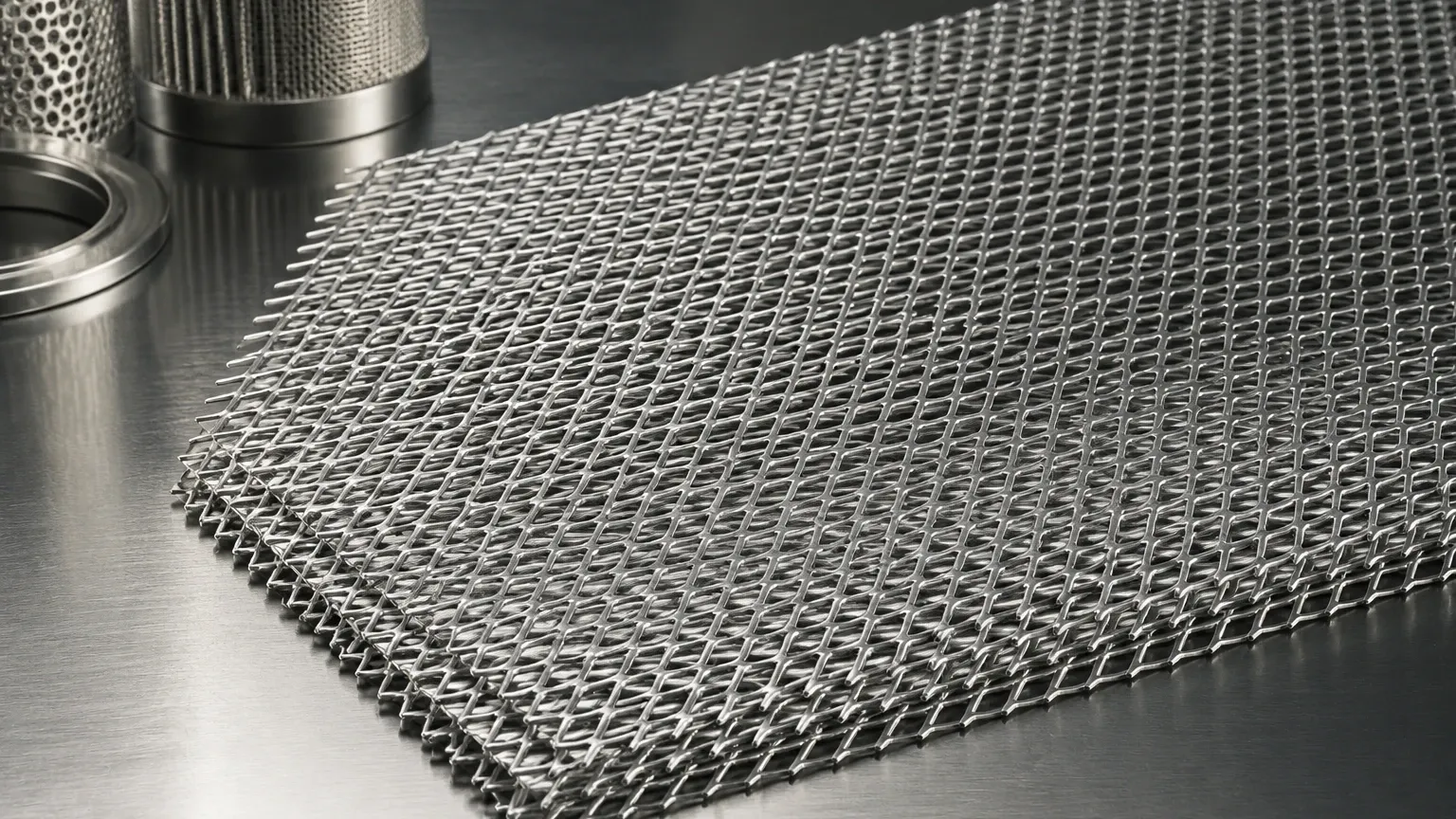
In industrial manufacturing and filtration engineering, the 4×8 sheet—measuring four feet by eight feet—is the standard dimensional unit for raw material procurement. Expanded metal 4×8 sheets represent a versatile and cost-effective solution for structural support, protective screening, and primary filtration stages. Unlike perforated metal, which is created by punching holes and removing material, expanded metal is produced by simultaneously slitting and stretching the substrate. This process results in a diamond-patterned mesh that retains the structural integrity of the original metal while significantly increasing its surface area.
For engineers and procurement specialists, selecting the correct expanded metal 4×8 specification requires a deep understanding of diamond geometry, material properties, and the specific demands of the operating environment. Whether utilized as a support cage for high-pressure filter cartridges or as a safety partition in a chemical processing plant, the performance of the material is dictated by its technical configuration.
The Structural Mechanics of Expanded Metal 4×8
The unique manufacturing process of expanded metal creates a series of interconnected strands and bonds. Because the metal is stretched rather than punched, there is zero material waste, making it an environmentally and economically efficient choice. The geometry of the diamond opening is defined by four primary measurements:
1. Short Way of Diamond (SWD): The distance from the center of one bond to the center of the next bond across the short axis of the diamond.
2. Long Way of Diamond (LWD): The distance from the center of one bond to the center of the next bond across the long axis.
3. Strand Width: The amount of metal fed into the expanding machine for each stroke.
4. Strand Thickness: The gauge or thickness of the original metal sheet.
When specifying expanded metal 4×8, engineers must also choose between "Standard" (Raised) and "Flattened" variations. Standard expanded metal features strands that are set at a sharp angle to the plane of the sheet, providing maximum rigidity and a high-friction surface. Flattened expanded metal is cold-rolled after the expansion process, resulting in a smooth, level surface. In filtration applications, flattened expanded metal is often preferred as it provides a uniform support surface for secondary filter media, such as fine wire mesh, without the risk of the raised strands puncturing the delicate layers.
Material Selection and Chemical Compatibility
The choice of material for an expanded metal 4×8 sheet is the most critical factor in determining its service life, especially in corrosive or high-temperature industrial environments. Kaifil specializes in stainless steel solutions, which offer the highest levels of durability for demanding applications.
Stainless Steel (304 and 316L)
Stainless steel is the gold standard for filtration and industrial processing. Grade 304 provides excellent corrosion resistance for general industrial use, while Grade 316L (low carbon) is essential for environments involving chlorides, acids, or high-salinity fluids. In food and beverage or pharmaceutical applications, stainless steel expanded metal is preferred due to its ease of sterilization and resistance to oxidation.
Carbon Steel
For structural applications where corrosion is not a primary concern, or where the material will be coated (galvanized or powder-coated), carbon steel offers a high strength-to-weight ratio at a lower price point. It is commonly used for machinery guards and walkway gratings.
Aluminum
Aluminum expanded metal is utilized when weight reduction is a priority. While it lacks the extreme chemical resistance of stainless steel, its natural oxide layer provides decent protection in atmospheric conditions. It is frequently seen in HVAC filtration and architectural screening.
Comparing Perforated & Expanded Metal for Industrial Filtration
When designing a filtration system, engineers often weigh the benefits of Perforated & Expanded Metal to determine which serves better as a support structure or a coarse filter. Both materials offer distinct advantages depending on the flow requirements and pressure drops of the system.
Perforated Metal allows for highly precise hole shapes and sizes, which is beneficial for exact particle retention. However, the punching process creates scrap material, which can increase the cost per square foot. Perforated sheets also tend to be heavier than expanded metal of equivalent thickness.
Expanded Metal is generally more cost-effective because the expansion process increases the yield from the base material. In terms of filtration, the angular strands of standard expanded metal can create turbulence, which may be desirable in certain mixing or specialized filtration processes. Furthermore, the interconnected diamond structure provides superior structural rigidity, allowing an expanded metal 4×8 sheet to withstand higher mechanical stresses than a perforated sheet of the same weight.
Engineering Considerations: Open Area and Flow Dynamics
The "Open Area" percentage is a vital metric for any filtration component. It determines the flow rate of the fluid or gas and the resulting pressure drop across the media. For expanded metal 4×8 sheets, the open area is calculated based on the relationship between the strand width and the diamond dimensions.
A higher open area percentage reduces resistance to flow but decreases the structural strength of the sheet. Conversely, a lower open area provides a more robust support structure but may lead to higher energy costs due to increased pump or fan pressure required to move the medium through the filter. Engineers must balance these factors based on the viscosity of the fluid, the velocity of the flow, and the expected contaminant load.
In hydraulic and water treatment applications, expanded metal is often used as a "trash screen" or a pre-filter. Here, the diamond pattern is effective at catching elongated debris that might pass through circular perforations. The 4×8 format allows for large-scale screens to be fabricated with fewer seams, reducing potential failure points in the system.
Manufacturing Standards and Quality Control
To ensure consistency in industrial projects, expanded metal 4×8 sheets should adhere to recognized standards, such as ASTM F1267. This standard covers material types, classes (Grades), and styles (Standard vs. Flattened). Quality control at the manufacturing level involves several critical checks:
* Dimensional Accuracy: Ensuring the 4×8 sheet meets the specified width and length tolerances (typically +/- 1/8 inch for stock sheets).
* Squareness: Verifying that the sheet is not skewed, which is essential for proper fitment in frames or filter housings.
* Levelness: Particularly for flattened expanded metal, the sheet must be free from waves or buckles that could interfere with subsequent fabrication steps.
* Surface Integrity: Checking for burrs, sharp edges (unless specified), or fractures in the bonds that could compromise the material's strength or cause injury during handling.
Kaifil’s manufacturing process emphasizes precision in these areas, ensuring that every expanded metal component integrates seamlessly into the final industrial assembly. For custom filtration projects, the 4×8 sheet serves as the starting point for precision laser cutting, rolling, and welding into cylindrical or pleated filter cartridges.
Maintenance and Total Cost of Ownership
While the initial purchase price of an expanded metal 4×8 sheet is a factor, the total cost of ownership (TCO) is driven by durability and maintenance requirements. In high-fouling environments, the ability to clean the filter media is paramount.
Stainless steel expanded metal is highly amenable to backwashing, ultrasonic cleaning, and chemical sanitation. Because the diamond intersections are solid bonds rather than welds, there are no crevices where bacteria or contaminants can easily hide, provided the material is properly finished. In many industrial settings, replacing a low-quality carbon steel screen every six months is far more expensive than investing in a 316L stainless steel expanded metal solution that lasts for years.
Replacement cycles should be determined by monitoring the pressure differential (delta P) across the filter. When the pressure drop exceeds a pre-defined threshold even after cleaning, it indicates that the media has reached the end of its functional life or has suffered mechanical deformation.
Customization and OEM Solutions
While the expanded metal 4×8 sheet is the standard size for distribution, many industrial applications require specific dimensions, specialized patterns, or unique material alloys. As a professional manufacturer, Kaifil provides extensive OEM capabilities that go beyond standard stock items.
Customization options include:
* Bespoke Diamond Sizes: Tailoring the SWD and LWD to meet specific filtration or airflow requirements.
* Edge Treatments: Providing sheets with solid borders (random sheared vs. bond sheared) to facilitate easier welding and safer handling.
* Secondary Fabrication: Cutting, bending, and forming expanded metal into complex shapes, such as conical strainers or multi-layered filter elements.
* Material Certification: Providing full traceability and Mill Test Reports (MTRs) to ensure compliance with industry regulations in the pharmaceutical and food sectors.
By working closely with an experienced manufacturer, engineering teams can optimize their filtration systems for maximum efficiency and longevity. Whether the project requires a single expanded metal 4×8 sheet for a prototype or a large-scale production run of custom-fabricated components, understanding the technical nuances of the material is the first step toward a successful industrial application.
