


Expanded Metal Drawing
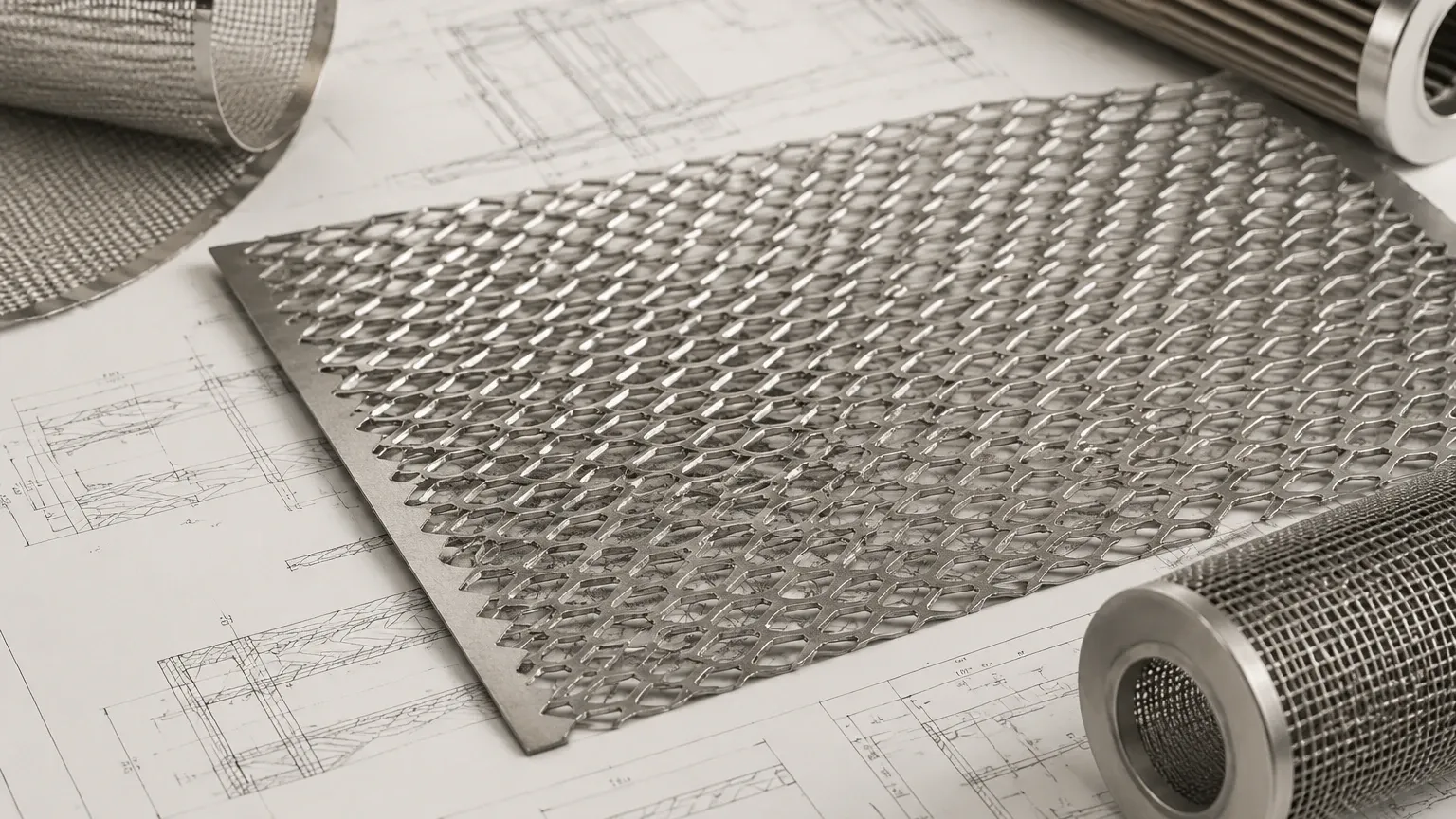
In the realm of industrial filtration and structural engineering, the accuracy of an expanded metal drawing serves as the foundational blueprint for performance, safety, and cost-efficiency. Expanded metal is a unique material produced by simultaneously slitting and stretching a solid sheet of metal—typically stainless steel—to create a continuous mesh with diamond-shaped openings. Unlike perforated metal, the expansion process involves no scrap loss, making it a highly sustainable and cost-effective choice for filtration support, architectural grilles, and industrial safety components.
For engineers and procurement teams, interpreting and creating a precise expanded metal drawing is essential to ensure the final product meets the rigorous demands of chemical processing, pharmaceutical manufacturing, and high-pressure hydraulic systems. This guide examines the technical specifications, material considerations, and engineering nuances required to translate a design concept into a functional Perforated & Expanded Metal component.
The Fundamentals of an Expanded Metal Drawing
An expanded metal drawing must define several geometric variables that differ significantly from standard wire mesh or perforated sheets. Because the material is stretched, the dimensions are categorized by the direction of the diamond pattern and the thickness of the remaining metal strands.
Key Dimensional Variables
1. SWD (Short Way of Design): This is the distance measured from the center of a bond on one side to the center of a bond on the opposite side, across the short axis of the diamond. It is often the primary metric for determining the density of the mesh.
2. LWD (Long Way of Design): This is the distance measured across the long axis of the diamond, from bond center to bond center. The ratio between SWD and LWD determines the shape and angle of the openings.
3. SWO (Short Way of Opening): This refers to the clear distance of the opening measured across the short axis. For filtration applications, the SWO is a critical factor in determining the size of particles that can pass through the mesh.
4. LWO (Long Way of Opening): The clear distance of the opening across the long axis.
5. Strand Width: The amount of metal fed into the precision dies between each stroke of the expansion press.
6. Strand Thickness: The thickness of the original base metal sheet.
When reviewing an expanded metal drawing, it is crucial to distinguish between "raised" (standard) and "flattened" expanded metal, as these states drastically alter the final thickness and surface profile of the part.
Structural Variations: Raised vs. Flattened Profiles
One of the most common points of confusion in technical procurement is the difference between standard (raised) and flattened expanded metal. A comprehensive drawing must specify which state is required for the application.
Raised Expanded Metal (Standard)
Raised expanded metal is the product as it comes directly off the expansion machine. The strands and bonds are set at a uniform angle to the plane of the sheet. This creates a three-dimensional surface that provides excellent structural rigidity and a high strength-to-weight ratio. In industrial settings, raised expanded metal is often used for walkways or as a primary support layer where maximum airflow or drainage is required.
Flattened Expanded Metal
Flattened expanded metal is produced by passing the standard raised sheet through a cold-roll reducing mill. This process flattens the strands and bonds into a single plane, resulting in a smooth, level surface. While flattening reduces the overall thickness of the sheet (often to roughly the original gauge of the base metal), it increases the length of the sheet by approximately 5%. For filtration applications, particularly when the mesh serves as a support layer for fine wire cloth or synthetic membranes, a flattened profile is usually preferred to prevent the sharp edges of raised strands from puncturing the delicate primary filter media.
Material Engineering and Chemical Compatibility
In the context of Kaifil’s specialization in stainless steel filtration, the material specified in the expanded metal drawing is as important as the dimensions. While expanded metal can be made from carbon steel or aluminum, stainless steel is the industry standard for demanding environments.
* Grade 304/304L: The most common stainless steel grade, offering good corrosion resistance and excellent formability. It is suitable for most food and beverage or general industrial applications.
* Grade 316/316L: Contains molybdenum, which provides superior resistance to chlorides and pitting. This is the mandatory choice for marine environments, pharmaceutical processing, and aggressive chemical filtration.
* High-Nickel Alloys: For extreme temperatures or highly acidic environments, drawings may specify Hastelloy or Monel, though these require specialized manufacturing expertise due to their work-hardening characteristics.
Engineers must also consider the mechanical properties of the material after expansion. The process of cold-working the metal during stretching increases its hardness and tensile strength, which can impact subsequent operations like rolling into filter cartridges or welding into frames.
Calculating Performance Metrics from Technical Drawings
For filtration and fluid dynamics, the most critical data point derived from an expanded metal drawing is the "Percentage of Open Area." This figure dictates the flow rate, pressure drop, and overall efficiency of the system.
Open Area Calculation
The open area of expanded metal is calculated by comparing the area of the openings to the total area of the sheet. Unlike perforated metal, where the calculation is straightforward based on hole diameter and pitch, expanded metal calculations must account for the strand width and the angle of the diamonds.
A higher percentage of open area results in lower pressure drop but may sacrifice structural integrity. Conversely, a smaller open area provides a more robust support structure but may lead to higher energy costs due to restricted flow. An experienced manufacturer like Kaifil can help optimize these dimensions to find the "sweet spot" for specific hydraulic or pneumatic applications.
Critical Tolerances and Edge Configurations
A professional expanded metal drawing should always specify the desired edge configuration. This is a detail often overlooked during the initial design phase but becomes critical during the assembly of filter housings or industrial enclosures.
Bond Edges vs. Random Edges
* Bond Edges (Closed Diamonds): The sheet is cut exactly at the center of the bond, resulting in a "closed" diamond pattern along the edges. This provides a safer edge to handle and a more stable surface for welding. However, achieving perfect bond edges on all four sides may require specific sheet dimensions that don't always align with standard stock sizes.
* Random Edges (Open Diamonds): The sheet is cut without regard to the diamond pattern, leaving "points" or open prongs along the perimeter. This is more common for bulk sheets that will be trimmed further during final installation. In filtration cartridges, random edges are generally avoided as the sharp points can interfere with the sealing gaskets or damage outer protective layers.
Dimensional Tolerances
Standard industry tolerances for expanded metal are typically +/- 1/4" for sheet size, but precision filtration components often require much tighter control. When providing an expanded metal drawing for a custom filter component, engineers should specify whether the dimensions are "nominal" or "minimum/maximum" to ensure the part fits perfectly within its housing.
Customization and OEM Collaboration with Kaifil
When transitioning from a conceptual drawing to a production-ready component, collaborating with a specialized manufacturer is vital. At Kaifil, we understand that expanded metal is rarely a standalone product in the B2B sector; it is often a component of a larger, more complex filtration system.
The Importance of the Drawing in the RFQ Process
When submitting an inquiry for Perforated & Expanded Metal, providing a detailed CAD file or a high-resolution technical drawing allows our engineering team to conduct a manufacturability review. This review identifies potential issues, such as:
* Strand-to-Opening Ratios: Ensuring the strands are thick enough to support the intended pressure without deforming.
* Tooling Compatibility: Matching the requested SWD and LWD to existing precision dies to reduce lead times and tooling costs.
* Post-Processing Requirements: Identifying if the part needs degreasing, pickling, or electropolishing to meet pharmaceutical or food-grade standards.
Integration with Other Filtration Media
Many of our clients use expanded metal as a drainage layer or outer protector for multi-layered stainless steel filter cartridges. In these cases, the expanded metal drawing must align with the pleat height and circumference of the inner media. Precision in the LWD and SWD is paramount here; even a slight deviation can cause the mesh to buckle or leave gaps in the filter assembly.
Conclusion: Ensuring Project Success
The expanded metal drawing is more than just a visual representation; it is a technical document that defines the mechanical limits and functional capabilities of a metal component. By clearly specifying the SWD/LWD, material grade, raised or flattened profile, and edge configurations, engineers can significantly reduce the risk of part failure and streamline the procurement process.
For organizations requiring high-performance filtration solutions, the choice of partner is critical. Kaifil provides the technical expertise and manufacturing precision necessary to turn complex drawings into reliable, industrial-grade products. Whether you are designing a high-pressure hydraulic filter or a large-scale chemical strainer, ensuring your technical specifications are accurate from the start is the most effective way to optimize total cost of ownership and operational longevity.
