


Expanded Metal How Its Made
In the landscape of industrial filtration and structural engineering, expanded metal stands out as a unique material that combines structural rigidity with high permeability. For engineers and procurement specialists, understanding expanded metal how its made is not merely a matter of technical curiosity; it is a fundamental requirement for selecting the right filtration media. Unlike woven wire mesh or perforated sheets, expanded metal is produced through a specific mechanical process that alters the physical properties of the base metal without removing any material.
At Kaifil, we specialize in high-precision Perforated & Expanded Metal solutions, often utilizing stainless steel to meet the rigorous demands of chemical processing, pharmaceutical manufacturing, and water treatment. This article provides a comprehensive technical breakdown of the manufacturing process, the engineering considerations involved, and how these factors influence the performance of the final filtration component.
The Core Mechanics: The Slit and Stretch Process
The most critical aspect of expanded metal how its made is the simultaneous slitting and stretching process. This is a cold-working operation where a solid sheet or coil of metal is fed through a machine equipped with specialized knives.
The Expansion Cycle
1. Feeding: The base material—typically a stainless steel plate or coil—is positioned under the upper tool (the knife).
2. Slitting: The knife descends, creating a series of precise slits in the metal. The pattern of these slits is determined by the shape of the knife teeth, which are usually diamond-shaped, though hexagonal and square patterns are also possible.
3. Stretching: As the knife slits the metal, it also exerts downward pressure, stretching the material. Because the metal is slit in a staggered pattern, this stretching opens the slits into uniform diamond-shaped apertures.
4. Indexing: The sheet is then moved forward, and the knife shifts laterally before the next stroke. This staggering of the slits creates the "bonds"—the points where the strands of metal remain connected.
One of the primary advantages of this process is that it is a zero-waste manufacturing method. Unlike perforated metal, where the "slugs" or holes are punched out and discarded (or recycled), expanded metal uses the entirety of the raw material. This makes it an exceptionally cost-effective choice for high-grade alloys like 316L stainless steel.
Material Selection and Metallurgical Considerations
While the process of expanded metal how its made remains consistent across different metals, the choice of material significantly impacts the manufacturing parameters and the final application's success. In industrial filtration, stainless steel is the industry standard due to its corrosion resistance and mechanical strength.
Common Alloys in Expanded Metal Production
* Grade 304/304L: The most common stainless steel used for general-purpose filtration. It offers excellent formability during the expansion process and good resistance to atmospheric corrosion.
* Grade 316/316L: Preferred for marine environments, chemical processing, and pharmaceutical applications. The addition of molybdenum enhances resistance to pitting and crevice corrosion in chloride-rich environments.
* Specialty Alloys: For high-temperature or highly corrosive environments, materials such as Monel, Inconel, or Duplex stainless steels can be expanded, though these require specialized tooling and slower production speeds due to their high work-hardening rates.
During the expansion process, the metal undergoes significant strain. This cold-working increases the hardness and tensile strength of the strands, a phenomenon known as work hardening. For filtration applications requiring high pressure-drop resistance, this added structural integrity is a major benefit.
Standard vs. Flattened Expanded Metal
When researching expanded metal how its made, it is essential to distinguish between the two primary finishes: standard (raised) and flattened.
Standard Expanded Metal
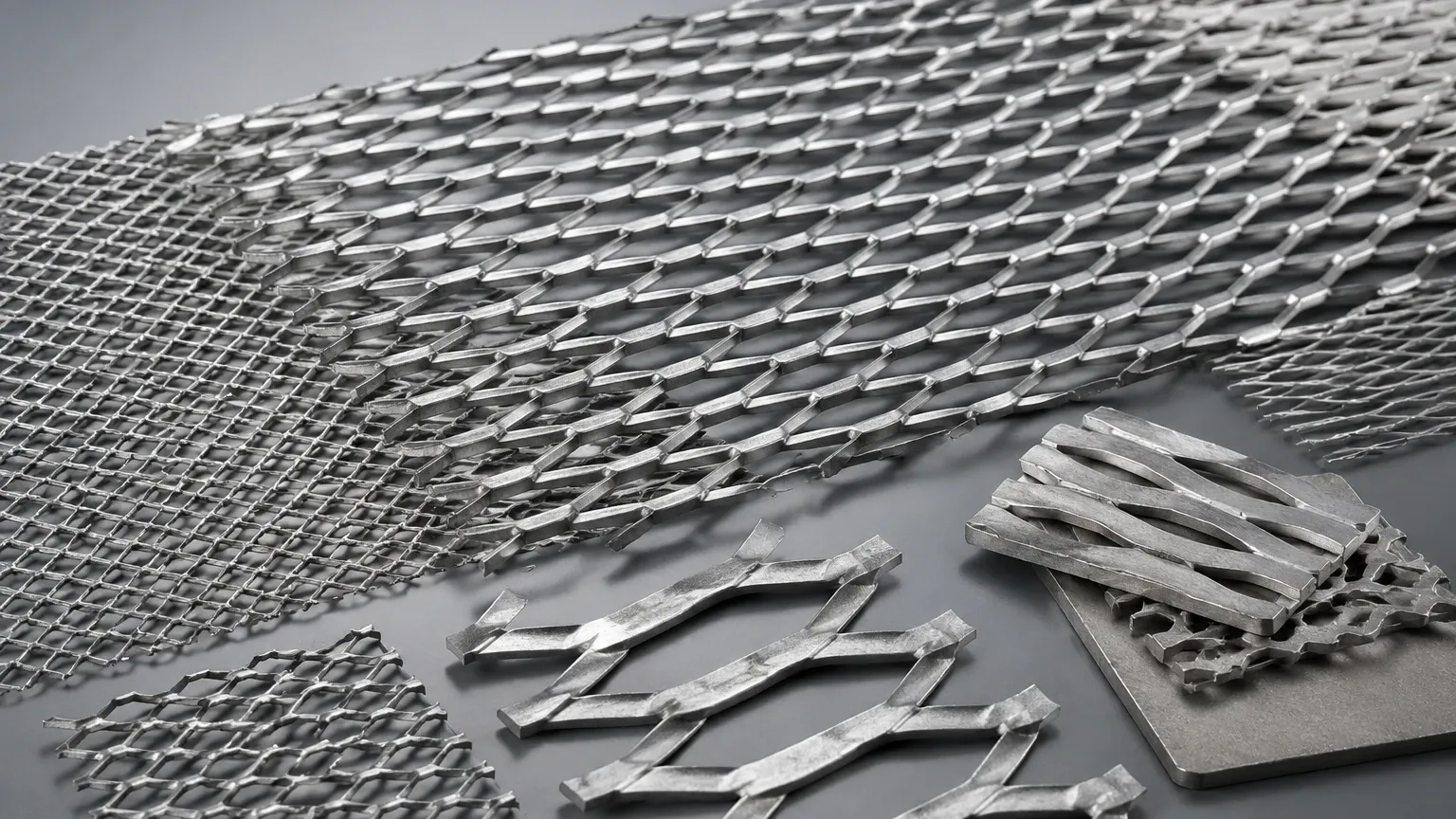
Standard expanded metal is the product as it comes directly off the expansion press. The strands and bonds are set at a uniform angle to the plane of the sheet. This creates a 3D texture that provides a high strength-to-weight ratio and excellent grip. In filtration, the angularity of the strands can be used to create turbulence, which may be desirable in certain mixing or gas-liquid separation processes.
Flattened Expanded Metal
To produce flattened expanded metal, the standard expanded sheet is passed through a cold-rolling reducing mill. This process flattens the strands and bonds back into a single plane.
* Thickness Reduction: Flattening typically reduces the thickness of the original sheet by about 5% to 10%.
* Surface Smoothness: The resulting surface is smooth and level, making it ideal for applications where the filter media must be in close contact with another layer, such as in multi-stage filter cartridges.
* Dimensional Stability: Flattening can slightly increase the overall length of the sheet, which must be accounted for during the engineering and design phase.
Engineering Dimensions: SWD, LWD, and Open Area
To specify expanded metal for a technical project, engineers must use a specific set of measurements that arise from the manufacturing process. These dimensions dictate the filtration efficiency and flow rates.
1. SWD (Short Way of Design): The distance from the center of one bond to the center of the next bond measured across the short diamond diagonal.
2. LWD (Long Way of Design): The distance from the center of one bond to the center of the next bond measured across the long diamond diagonal.
3. SWO (Short Way of Opening): The actual width of the opening, excluding the strand width.
4. LWO (Long Way of Opening): The actual length of the opening.
5. Strand Width: The amount of metal fed under the knives between strokes.
6. Strand Thickness: The thickness of the original base metal.
Calculating Open Area: The percentage of open area is a vital metric for filtration. It is calculated based on the relationship between the strand width and the SWD. A larger open area allows for higher flow rates and lower pressure drops, while a smaller open area provides finer particle retention. Because the expansion process can be adjusted by changing the feed rate (strand width), manufacturers like Kaifil can customize the open area to meet specific filtration requirements.
Advantages of Expanded Metal in Industrial Filtration
Understanding expanded metal how its made reveals why it is often superior to other materials in demanding environments.
Structural Integrity
Because the metal is slit and stretched rather than joined or woven, there are no welds to break or wires to unravel. The bonds are part of the original metal, providing a continuous path for heat and electrical conductivity, as well as uniform mechanical strength. This makes expanded metal filter elements highly resistant to vibration and pressure surges.
Cost Efficiency
As previously mentioned, the zero-waste nature of the process makes it more economical than perforated metal, especially when using expensive materials like titanium or high-nickel alloys. Engineers can achieve a high percentage of open area with less raw material weight compared to a solid plate with drilled or punched holes.
Versatility in Design
The expansion process allows for a wide range of mesh sizes, from micro-mesh (used in battery electrodes and fine chemical filters) to heavy-duty grating. By adjusting the knife geometry and the feed rate, Kaifil can produce custom Perforated & Expanded Metal components that fit precisely into existing housing units or OEM equipment.
Comparison: Expanded Metal vs. Perforated Metal
While both are used in filtration, the manufacturing differences between expanded and perforated metal lead to different performance characteristics.
* Manufacturing Waste: Perforated metal involves punching holes, resulting in significant scrap. Expanded metal has no scrap.
* Strength: Expanded metal generally has a higher strength-to-weight ratio because the strands are oriented at an angle (in standard form), acting like structural trusses.
* Flow Characteristics: Perforated metal offers a two-dimensional flow path, whereas standard expanded metal creates a three-dimensional flow path that can assist in capturing particles throughout the depth of the media, rather than just on the surface.
* Customization: Perforated metal allows for more complex hole shapes (slots, circles, squares) and specific margins (un-perforated borders). Expanded metal is primarily limited to diamond or hexagonal shapes but offers more flexibility in varying the "depth" or thickness of the mesh through the expansion ratio.
Quality Control and Confirmation for Procurement
When sourcing expanded metal for filtration, technical professionals should confirm several factors with their manufacturer to ensure the product meets the application's demands:
1. Tolerances: The expansion process involves mechanical stretching, which can lead to slight variances in LWD and SWD. Ensure the manufacturer can meet the required dimensional tolerances for your filter housing.
2. Edge Conditions: Expanded metal can be supplied with "random sheared" edges (where diamonds are cut through) or "bonded" edges (where the cut happens at the bond, leaving a smoother edge). For filtration cartridges, bonded edges are often preferred to prevent bypass and simplify welding.
3. Surface Cleanliness: In pharmaceutical and food-grade applications, the lubricants used during the slitting and stretching process must be thoroughly removed. Kaifil employs advanced cleaning and degreasing processes to ensure our stainless steel filters meet stringent purity standards.
4. Material Certification: Always request Mill Test Reports (MTRs) to verify the chemical composition and mechanical properties of the stainless steel, ensuring it matches the specified grade (e.g., 316L).
Conclusion
The process of expanded metal how its made is a testament to efficient engineering, transforming a solid sheet of metal into a high-performance, porous medium without the waste associated with traditional machining. For the industrial filtration sector, expanded metal offers a robust, cost-effective, and versatile solution capable of withstanding harsh chemical and mechanical environments.
Whether you are designing a new hydraulic filtration system or seeking a more durable support structure for fine wire mesh, understanding these manufacturing nuances allows for better material selection and optimized system performance. For more information on custom specifications and engineering support, explore our range of Perforated & Expanded Metal products and consult with our technical team to find the ideal solution for your specific application requirements.
