


Expanded Metal in Spanish
In the global industrial landscape, clear communication regarding technical specifications is essential for successful procurement and engineering outcomes. For professionals operating in international markets, particularly within the Americas and Europe, understanding the terminology and technical nuances of "expanded metal in spanish"—referred to as *metal expandido* or *malla desplegada*—is a critical step in sourcing high-quality filtration and structural components.
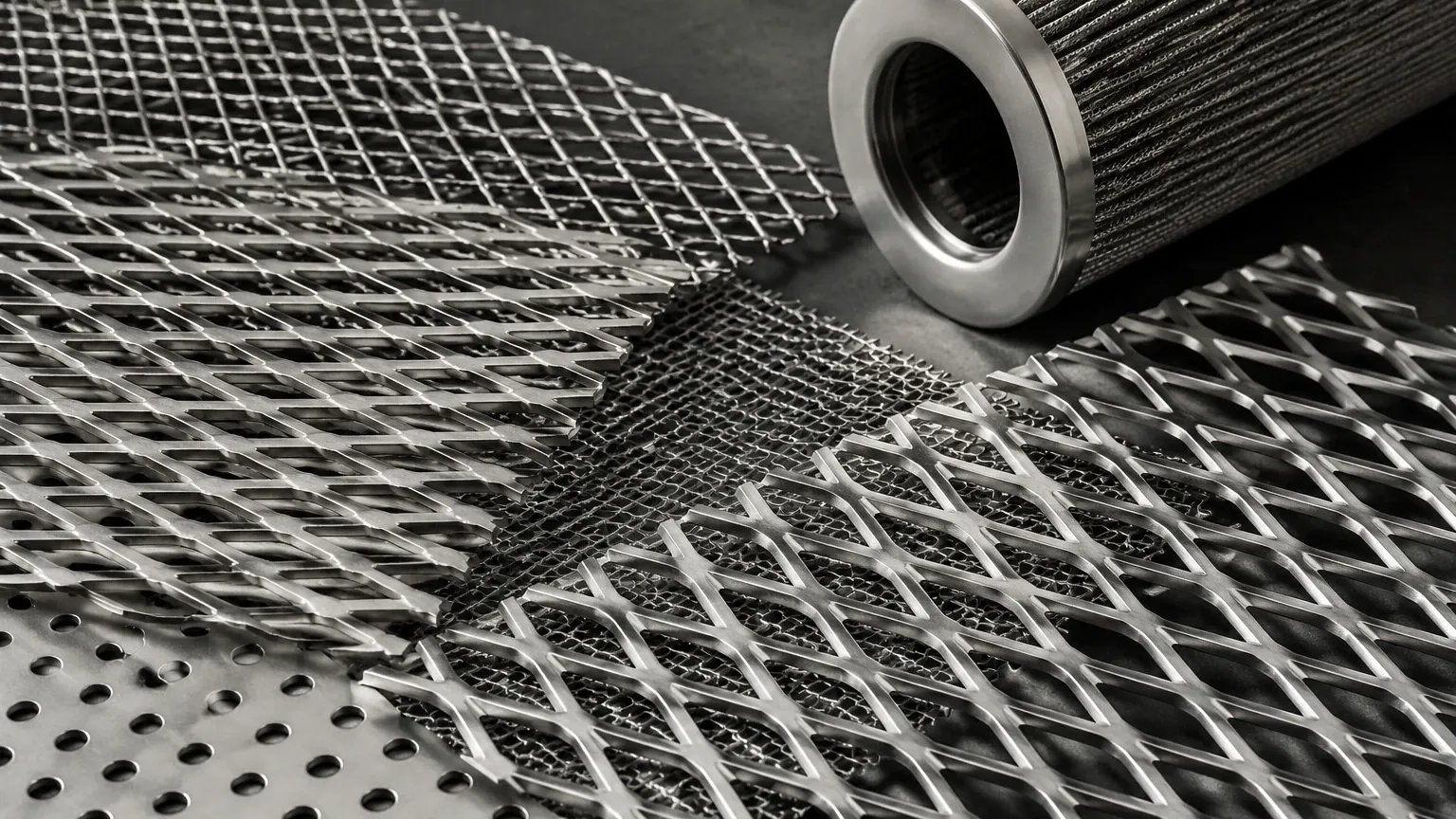
Expanded metal is a versatile material produced by simultaneously slitting and stretching a solid sheet of metal. This process creates a diamond-shaped pattern of openings, maintaining the structural integrity of the original material while reducing weight and increasing surface area. In the context of industrial filtration, these components serve as essential support structures, protective cages, and primary coarse filter media. This guide explores the technical characteristics, manufacturing processes, and selection criteria for Perforated & Expanded Metal to assist engineers in making informed technical decisions.
Understanding the Terminology: Expanded Metal in Spanish
When collaborating with international engineering teams or sourcing materials for projects in Spanish-speaking regions, technical accuracy in nomenclature prevents costly errors. The term expanded metal in spanish most commonly translates to *metal expandido*. However, depending on the specific region and application, you may also encounter the term *malla desplegada* (unfolded mesh).
In a B2B procurement context, it is not enough to simply know the translation. Engineers must ensure that technical parameters remain consistent across languages. For instance, the dimensions of the diamond pattern, the thickness of the strands, and the material grade must be specified using standardized units (metric or imperial) to ensure the final product meets the application's mechanical requirements. Whether the documentation refers to *metal expandido* or expanded metal, the focus remains on the geometric precision and material properties that define performance in demanding environments like chemical processing or hydraulic filtration.
The Manufacturing Process: Slitting and Stretching
Unlike perforated metal, which is created by punching holes and removing material, expanded metal is manufactured through a zero-waste process. A heavy-duty machine equipped with a reciprocating knife slits and stretches a solid metal plate or coil in a single motion. This results in a continuous mesh with no joins or welds, as the "bonds" where the strands intersect are part of the original solid metal.
Standard (Raised) vs. Flattened Expanded Metal
There are two primary forms of expanded metal used in industrial applications:
1. Standard (Raised) Expanded Metal: This is the product as it comes off the machine. The strands and bonds are set at a uniform angle to the plane of the sheet. This provides maximum strength and rigidity, making it ideal for support cores in high-pressure filter cartridges. The raised profile also creates a three-dimensional surface that can assist in breaking up fluid flow or providing mechanical grip.
2. Flattened Expanded Metal: Standard expanded metal is passed through a cold-rolling reducing mill to flatten the strands and bonds into the same plane. This results in a smooth, flat surface. Flattened expanded metal is often preferred when the component needs to be layered closely with fine wire mesh or when a low-profile thickness is required for compact filtration housings.
Key Technical Parameters for Engineering Selection
To specify expanded metal accurately, engineers must define several geometric variables. These dimensions dictate the open area, flow resistance, and mechanical load-bearing capacity of the component.
* SWD (Short Way of Design): The distance from the center of one bond to the center of the next bond measured across the short diamond diagonal.
* LWD (Long Way of Design): The distance from the center of one bond to the center of the next bond measured across the long diamond diagonal.
* SWO (Short Way of Opening): The actual width of the diamond opening, excluding the strand width.
* LWO (Long Way of Opening): The actual length of the diamond opening, excluding the strand width.
* Strand Thickness: The thickness of the original base metal sheet.
* Strand Width: The amount of metal fed into the machine for each stroke of the knife.
By manipulating the SWD and LWD in relation to the strand width and thickness, manufacturers can create a wide range of open area percentages. For filtration applications, the percentage of open area is a critical calculation, as it directly impacts the pressure drop ($ΔP$) across the filter element.
Material Selection: Stainless Steel and Alloys
In industrial filtration, material compatibility is paramount. Kaifil specializes in stainless steel expanded metal, which offers superior corrosion resistance and durability compared to carbon steel or aluminum.
* AISI 304/304L: The most common grade for general industrial use, providing good corrosion resistance and excellent formability. It is suitable for food and beverage applications and general water treatment.
* AISI 316/316L: Contains molybdenum, which enhances resistance to pitting and crevice corrosion in chloride-rich environments. This is the standard choice for chemical processing, marine applications, and pharmaceutical filtration.
* Specialty Alloys: For extreme environments involving high temperatures or highly aggressive chemicals, expanded metal can be produced from Monel, Inconel, or Hastelloy.
When specifying *metal expandido* (expanded metal in spanish) for a project, engineers must confirm that the alloy grade meets the specific chemical resistance requirements of the process fluid to prevent premature failure due to stress corrosion cracking or general oxidation.
Applications in Industrial Filtration Systems
Expanded metal plays a multifaceted role in filtration systems. Its primary function is often structural, providing the necessary rigidity to support delicate filter media under high-pressure differentials.
Support Cores and Cages
In many stainless steel filter cartridges, a layer of fine woven wire mesh is pleated to increase surface area. However, the mesh itself lacks the structural integrity to withstand the force of the fluid flow. An expanded metal core provides the internal support needed to prevent the pleats from collapsing. Similarly, an outer cage made of expanded metal protects the filter media from mechanical damage during installation and operation.
Coarse Filtration and Pre-filtering
In systems where large particulate matter must be removed before the fluid reaches fine polishing filters, expanded metal acts as an effective coarse strainer. Its rigid, one-piece construction allows it to be cleaned and reused multiple times, reducing the total cost of ownership compared to disposable filter elements.
Flame and Spark Arrestors
The unique geometry of expanded metal, particularly in its raised form, is effective at dissipating heat and interrupting the path of sparks. This makes it a common component in industrial ventilation and exhaust systems where fire safety is a concern.
Selection Criteria: Open Area and Pressure Drop
One of the most common questions engineers face is how to balance mechanical strength with filtration efficiency. A higher percentage of open area reduces the resistance to flow, leading to a lower initial pressure drop. However, increasing the open area typically requires thinner strands or larger diamond openings, which can compromise the structural strength of the part.
When selecting Perforated & Expanded Metal, engineers should consider the following:
1. Flow Velocity: Higher velocities require more robust support structures to prevent vibration and mechanical fatigue.
2. Particulate Load: If the expanded metal is acting as a primary filter, the diamond size must be significantly smaller than the smallest particle intended to be captured.
3. Cleaning Protocols: Will the filter be cleaned via backwashing, ultrasonic cleaning, or chemical soaking? Stainless steel expanded metal is highly resilient to these processes, but the design must allow for easy access to the mesh surface.
Customization and OEM Capabilities
Industrial filtration requirements are rarely "one size fits all." Customization is often necessary to meet specific housing dimensions or unique flow characteristics. Working with a professional manufacturer like Kaifil allows engineers to specify custom LWD/SWD ratios, non-standard strand widths, and precise edge treatments.
In many B2B scenarios, the expanded metal component must be integrated into a larger assembly. This may involve welding the expanded metal to end caps, flanges, or support rings. Because expanded metal is a single piece of material without welds, it provides a stable and predictable substrate for TIG or resistance welding, ensuring the integrity of the final filter assembly.
Conclusion: Ensuring Quality in Global Procurement
Whether you are searching for "expanded metal in spanish" for a project in Latin America or specifying high-precision components for a domestic chemical plant, the technical fundamentals remain the same. The choice of material, the precision of the diamond pattern, and the understanding of the manufacturing process are the pillars of a reliable filtration solution.
By focusing on high-grade stainless steel and precise engineering tolerances, Kaifil provides the industrial sector with expanded metal components that excel in demanding environments. When evaluating suppliers, engineers should confirm the manufacturer's ability to provide detailed material certifications, dimensional inspections, and technical support to ensure that the final product aligns with the performance expectations of the application. For more information on technical specifications and customization options, engineers are encouraged to Review product options and application support to optimize their filtration systems.
